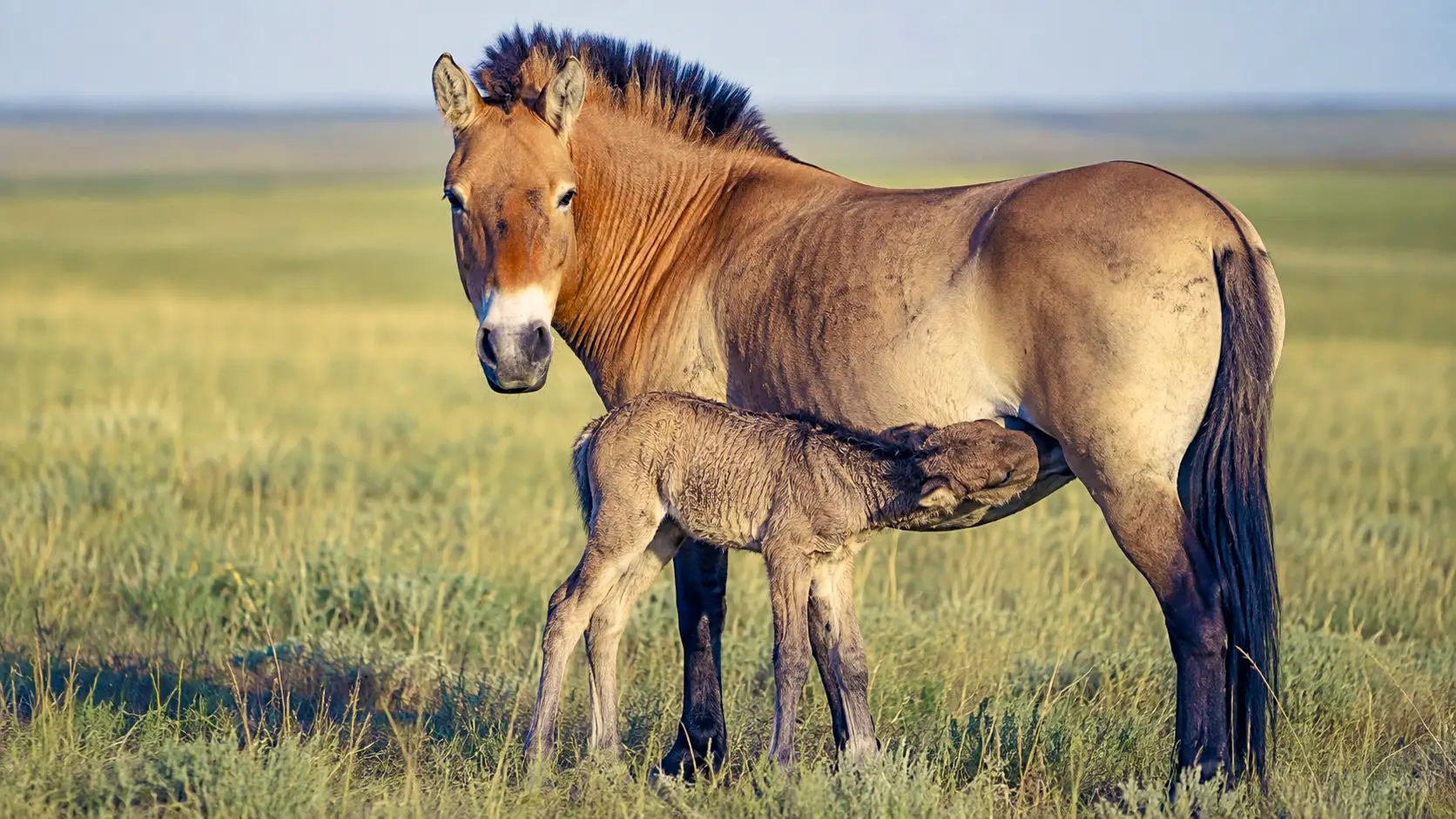
The steppes of Kazakhstan mark a major ecological turning point with the birth of a young wild equid. Indeed, no foal from this historic lineage had trodden these vast lands for two hundred years. This event reinforces the hope for a sustainable restoration of threatened wildlife in Central Asia.
A first wild foal revives the vast plains of Altyn Dala after two centuries of disappearance
The young male cried his first cries in the Altyn Dala State Nature Reserve. More precisely, the event took place at the Alibi Reintroduction Center located in the Kostanay region. Moreover, local biologists are closely monitoring his first vigorous steps.
This birth materializes decades of tireless conservation work for the Przewalski’s horse. The animal represents the last surviving wild group of equids on our planet. Thus, these beings possess a genetic heritage distinct from today’s domestic mounts.
During the last century, hunting and breeding decimated these Eurasian herds. The remaining free specimens had even disappeared from the Gobi Desert around 1969. Fortunately, a few European parks preserved twelve ancestors to save the species.
The couple formed by Tessa and Zorro ensures the genetic lineage thanks to the work of European zoological parks
The newborn is directly descended from two equids brought from Europe in June 2024. His mother, Tessa, is a seven-year-old female from the Berlin Tierpark. His father, named Zorro, originates from the Prague Zoo’s breeding program.
The youngster stood up very quickly after whelping in the steppe. He regularly nursing from his mother and explores his acclimation enclosure without fear. From then on, veterinarians confirm an exemplary adaptation before the final release.
International cooperation launches a broad program to sustainably restore the herds in Central Asia
This success rewards a solid alliance between scientific and political institutions. Indeed, the Association for Biodiversity Conservation of Kazakhstan leads this project. Local authorities actively collaborate with their Czech and German counterparts.
Mongolia had already achieved a major reinsertion in the 1990s. Now, specialists are reproducing this model to establish an autonomous population. Consequently, the country offers an ideal sanctuary far from any human activity.
The current plan envisions transferring a group of about forty animals within a few years. These vast protected prairies contain water points and exclude competing livestock. Thus, the founding herds will find a perfect habitat to thrive without constraint.
The large herbivores regulate the steppe vegetation and naturally protect the region against fires
The return of this grazer profoundly changes the dynamics of plant formations. By consuming the tough grasses, the animal naturally reduces the flammable ground matter. This action thus limits the spread of steppe fires during the summer.
Moreover, the trampling of the soil stimulates the regeneration of a diverse flora. These horses now coexist with saiga antelopes and wild donkeys. Together, they reform the guild of large herbivores of the Eurasian plains.

Contact details
Address:
Farmers Forum,
36, Dominick Street,
Mullingar,
Co. Westmeath,
Ireland
Phone:
+353 (0)44 9310206
Or email us:
For technical issues please check out our FAQ's page or email - [email protected]
For general Queries email - [email protected]
Request to add event to our Calendar - [email protected]
Send us your mart reports - [email protected]
Suggestions and feedbacks - [email protected]
News Items / Press Release - [email protected]
To Advertise on Farmers Forum - [email protected]