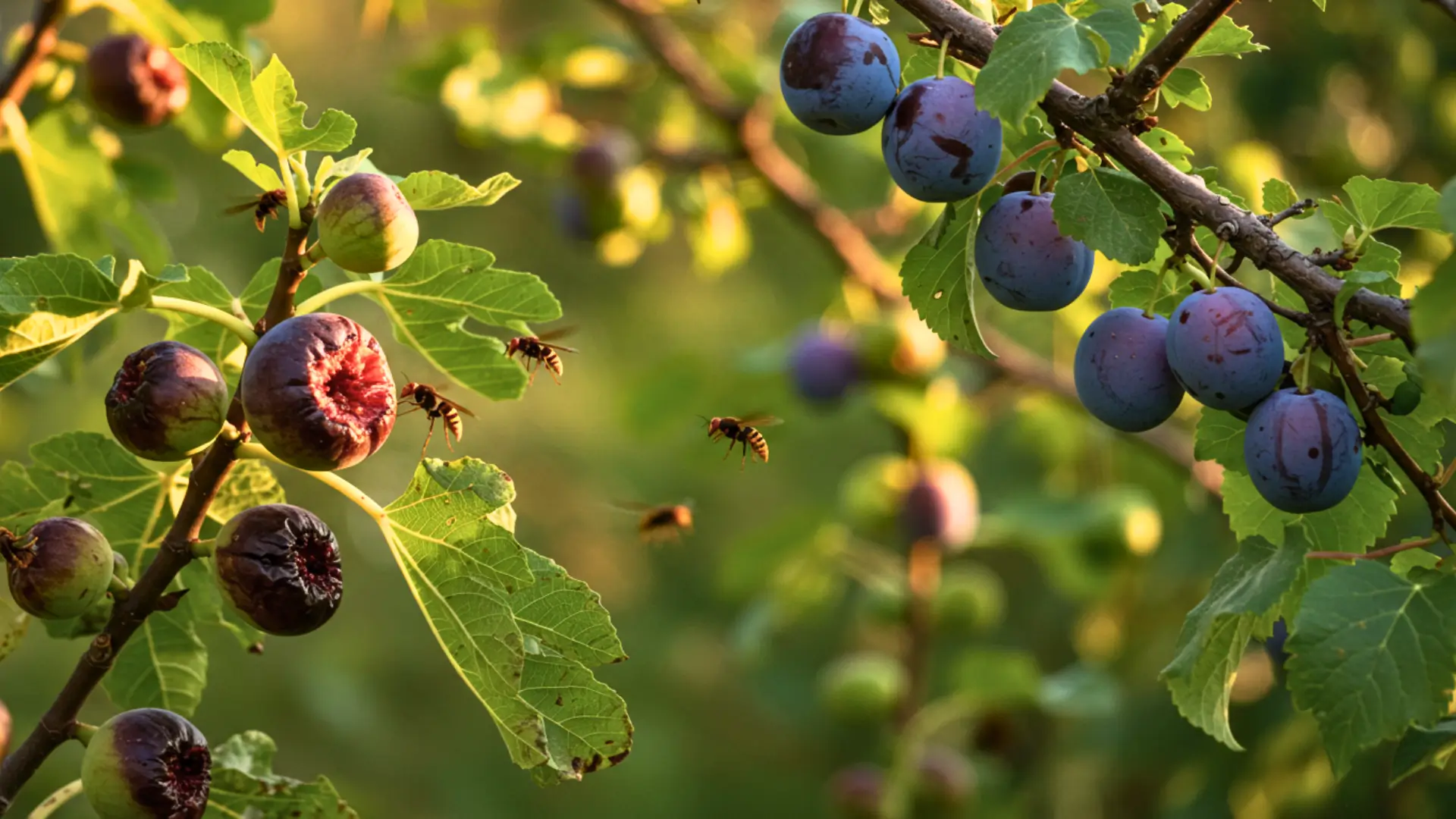
From July to October, many orchards see an unwelcome visitor appear. Attracted by sugar-rich fruits, the Asian hornet increases its visits around fig trees, plum trees, or grapevines. Understanding this phenomenon helps adopt the right actions to protect harvests, fruit trees, and garden safety.
Why fig trees, vineyards and plum trees become prime targets for the Asian hornet
At the end of summer, certain fruit trees gradually become true attraction hubs for the Asian hornet. In particular, the fig tree ranks among the favorite targets, because its very sweet fruits release powerful aromas as they reach full maturity. Thus, these scents act as a chemical signal detectable from several tens of meters away.
Moreover, the vine, the plum trees or even the apple trees also produce highly concentrated sugars during maturation. When some fruits crack open or get damaged, access to the juice becomes immediate. Consequently, for the Asian hornet, these fruits represent a quick and abundant energy source, particularly valuable at the end of the season.
The role of sugar and fermented fruits in guiding Asian hornets toward orchards
When fruits fall to the ground and begin to ferment, they rapidly emit highly volatile aromatic compounds. From then on, these scents attract hornets patrolling the surroundings. Thus, the phenomenon becomes especially noticeable in orchards rich in fig trees, plum trees, or highly productive grapevines.
In fact, this sugar-seeking behavior serves a very precise biological need. Indeed, at the end of summer, colonies reach their maximum size and must feed a large number of individuals. Consequently, the energy resources become essential to maintain hunting activity and the breeding of future queens.
Moreover, the Asian hornet does not limit itself to ripe fruits. It also captures pollinating insects and other garden helpers. Thus, this dual pressure gradually undermines the orchard’s balance, as it reduces both fruit production and the presence of species useful to biodiversity.
Three concrete actions to reduce the attraction of Asian hornets in a family orchard
First of all, a first measure consists of quickly picking up the fruits that have fallen to the ground. Indeed, their fermentation releases particularly attractive odors. Thus, by limiting these easily accessible sugar sources, the environment becomes much less interesting for hornets seeking energy.
Next, installing Asian hornet traps can help reduce the pressure around the orchard. However, these devices must be placed away from walking paths and positioned strategically. In this way, a thoughtful installation allows intercepting a portion of the exploratory individuals.
Finally, certain mechanical protection methods also yield interesting results. For example, bagging ripening fruits or installing nets limits direct access to the juiciest fruits. Thus, these devices reduce damage while allowing the fruits to continue developing.
What to do when an Asian hornet nest is discovered near an orchard or a dwelling
When an Asian hornet nest is spotted near a dwelling or an orchard, caution remains essential. Indeed, colonies can number in the thousands of individuals and become particularly defensive at the end of summer. Consequently, any improvised intervention carries a real risk of stings.
That is why authorities recommend calling on certified , specially trained to neutralize colonies safely. With their equipment and suitable methods, these operators can effectively eliminate a nest while limiting hornet dispersion.
Finally, in some municipalities, local assistance programs exist to help residents with nest destruction. Thus, municipal services or certain agricultural organizations can direct people toward approved service providers and, in some cases, contribute to funding the intervention.

Contact details
Address:
Farmers Forum,
36, Dominick Street,
Mullingar,
Co. Westmeath,
Ireland
Phone:
+353 (0)44 9310206
Or email us:
For technical issues please check out our FAQ's page or email - [email protected]
For general Queries email - [email protected]
Request to add event to our Calendar - [email protected]
Send us your mart reports - [email protected]
Suggestions and feedbacks - [email protected]
News Items / Press Release - [email protected]
To Advertise on Farmers Forum - [email protected]