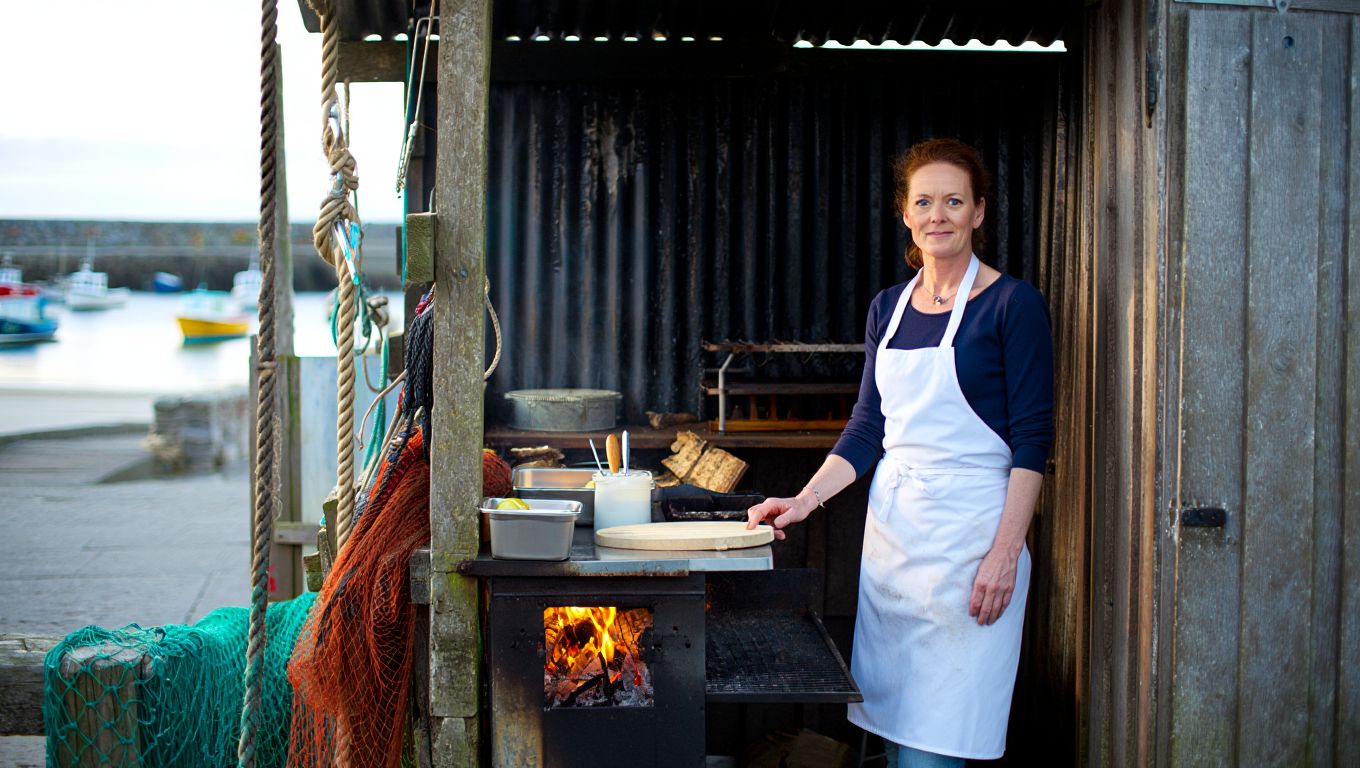
She traded a year-round dining room for a salt-sprayed hatch on an island pier, and the change felt like a door swinging open. The grind of tasting menus, the staff rotas, the late-night emails—she swapped them for ferry horns, the swell of Roaringwater Bay, and a calendar that runs to just eleven high-summer weeks. “I needed to remember why I cook,” she says, “and now I do. The winters are mine again.”
From 80 Hours to the Tide Clock
In Bantry, she once ran a serious kitchen. Sixty covers, five nights a week, and a weekend that never really ended. “I wasn’t a chef anymore; I was an admin in heat,” she jokes, the kind of laugh that admits it wasn’t very funny. The lockdown pauses gave her room to listen. What she heard was the sea.
So she shuttered the restaurant, stacked the heavy pans, and packed a few knives into a crate. She moved her work to Sherkin, where the timetable wears wellies. Here the clock is the tide, and the rush hour is the ten-minute window when a ferry empties onto the quay.
The Kiosk on the Quay
Her new kitchen is a former harbour kiosk the size of a walk-in wardrobe. It has a sliding hatch, a tiny plancha, a battered pot for chowder, and a shelf that smells faintly of netting. Gulls heckle. Someone always leans on the counter to ask if the mackerel were landed this morning.
She writes the menu on a black board. The chalk dust feels like school—like learning something you’ll actually use. “Small menu, small footprint, big taste,” she says, eyes flicking to the boat wakes like a metronome for the day.
- Sherkin seafood chowder with fennel and dill, brown soda bread, island butter
- Crab roll with lemony mayo, celery leaf, and a whisper of wild garlic
- Smoked mackerel pâté, pickled cucumbers, rye crisp
- Tomato salad from island polytunnels, sea-salt ricotta, basil oil
- Rhubarb tart with crème fraîche and a spoon of honey from a neighbour’s hives
Radical Seasonality, Tiny Footprint
“People call it ‘nose-to-tail’ in the city,” she says, “but here it’s more ‘tide-to-table’—which is messier, and more honest.” If a squall keeps the boats in, she leans on the gardens and her jars of pickled things. When the mackerel run, you’ll taste them within the hour: seared fast, glossy with vinegar and heat.
She buys from the quay, from fields that tilt toward the sea, from foragers who trade sea lettuce for hot scones. Waste is a watchword. Portions are tight but generous with flavour. “When it’s gone, it’s gone,” she shrugs, sliding a chalk line through the day’s last crab roll. There is no freezer, no panic, no back-up plan—just the weather.
Money, Maths, and Eleven Weeks
It sounds like a fairy tale until you do the numbers. The kiosk is cheap to run, but boats, butter, and labour still add up in West Cork. She pays fair, keeps hours sane, and prices for what it costs, not for what a tourist might swallow. “I wanted a life, not a brand,” she says. “I make enough in summer to breathe all winter.”
The magic, she insists, is choosing limits: eleven weeks, four days a week, five hours a day. Prep happens early with coffee in a rented cottage, windows open to the diesel-and-salt thrum of the harbour. Service is a sprint with a grin, the kind that burns the lungs and leaves you grinning back.
Island Choreography
By late morning the queue braids down the pier. Painters lug canvases, kids count jellyfish, and old hands trade weather wisdom. She knows faces now: the beekeeper with great gossip, the fiddler who pays with exact change and the tune of a half-remembered reel. The ferry master gets coffee before anyone else, because tides don’t wait.
“Hospitality is community in motion,” she says, passing a bowl of chowder through the hatch like a lit lantern. The food is simple because the setting does the heavy lifting. Wind makes its own seasoning; the island edits the menu.
What the Work Feels Like Now
The shift ends when the pots are empty and the light begins to slant. She stacks plates, spritzes the counter, and closes the hatch with a click that feels like a full stop. Some evenings she swims, skin tingling, mind rinsed clean by the cold Atlantic bite. “It’s a reset I never found behind a pass,” she says.
In the quiet, she writes notes: more dill tomorrow, less celery, ask Mick about the small lobsters if the weather turns kind. These are the margins of a career re-drawn with bolder strokes.
Owning the Dark Months
When the last ferry shrinks to a comma and the island settles into its soft hums, she plans her off-season like a chef plans a service. There are growers to visit, knives to sharpen, recipes to chase down into their stubborn corners. She teaches a few workshops, takes long walks, and lets the stove heat the room and the day in equal measure.
“The winter teaches you to taste again,” she says. “You slow down and the flavours step forward.” Then, almost offhand: “The winters are mine again.” It’s not a boast, just a statement of recovered truth—the kind you taste in a bowl of hot chowder on a windy pier.
Every summer morning, she lifts the hatch and considers the tide. The rest of the year, she lifts her life and holds it to the light. Eleven weeks to cook for the world; the other forty-one to remember why the world tastes this good.

Contact details
Address:
Farmers Forum,
36, Dominick Street,
Mullingar,
Co. Westmeath,
Ireland
Phone:
+353 (0)44 9310206
Or email us:
For technical issues please check out our FAQ's page or email - [email protected]
For general Queries email - [email protected]
Request to add event to our Calendar - [email protected]
Send us your mart reports - [email protected]
Suggestions and feedbacks - [email protected]
News Items / Press Release - [email protected]
To Advertise on Farmers Forum - [email protected]