A water-starved flower does not simply wither. Long before its petals betray its stress, its chemistry may already be changing. Its fragrance then transforms, with an unexpected consequence: the insects responsible for pollinating it can alter their visits.
Even before wilting, a thirsty flower starts sending another chemical message
At first glance, nothing seems alarming. The flower remains open, its colors look intact, and its scent remains perceptible. Yet water shortage can already have disrupted its cocktail of odor molecules. These volatile organic compounds, or VOCs, form a true chemical signature, far more sensitive to external conditions than its appearance would suggest.
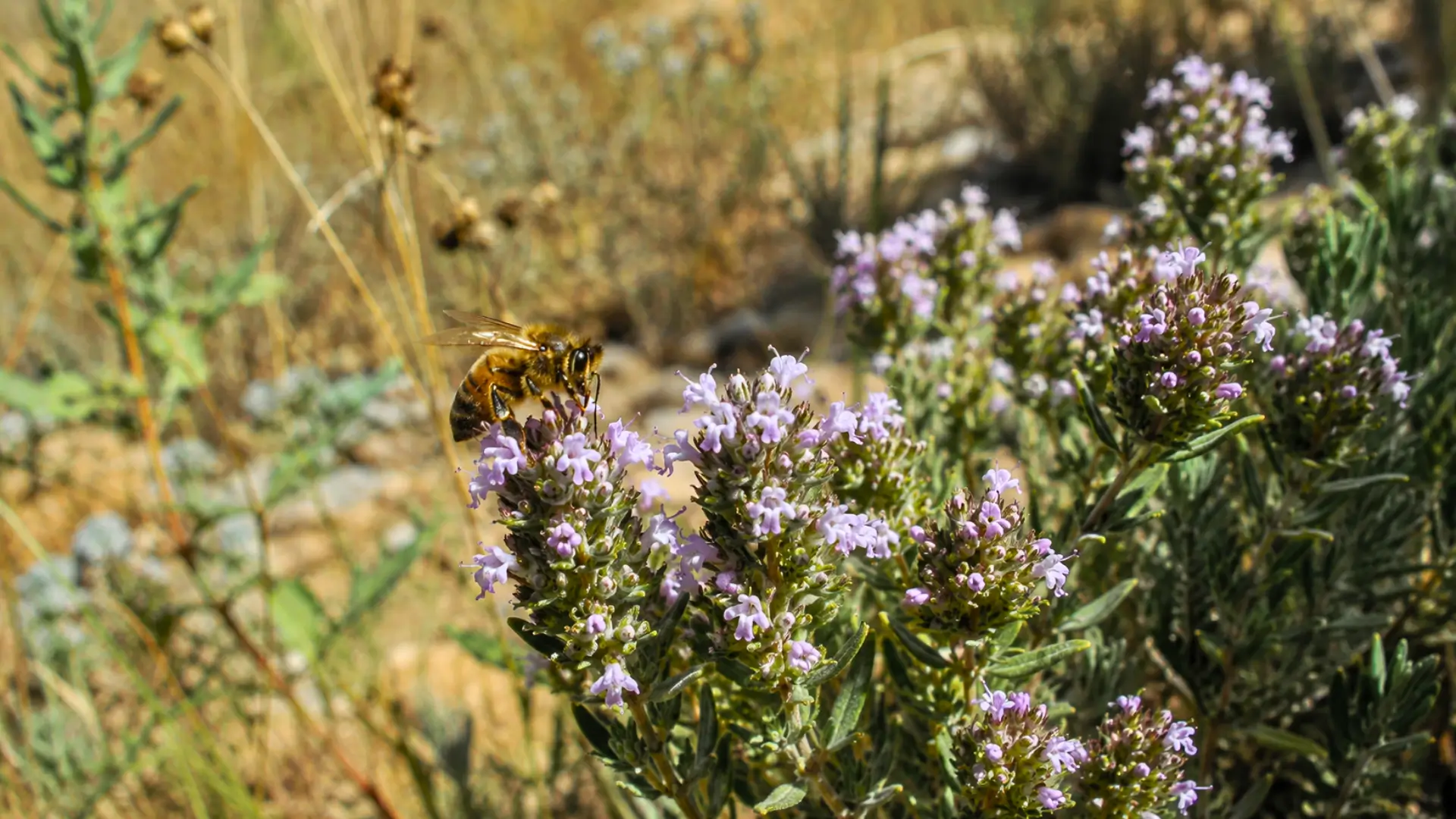
A study conducted in a Mediterranean scrubland focusing on thyme, rosemary and rockrose revealed that drought altered the floral scent of all three species studied. The changes involved molecules associated with stress. The work, published in the Journal of Ecology, thus shows that a plant can chemically signal its thirst before it actually seems to be in trouble.
Behind this scent shift lies a small revolution in plant chemistry
Producing a smell requires energy and a particularly elaborate biochemical machinery. Among its components is the MEP pathway, located in the plastids of plant cells. It participates notably in the production of monoterpenes, a broad family of aromatic molecules that include familiar compounds such as linalool or certain pinenes.
But drought does not have a simple “more scent” or “less scent” switch. The response depends on the species, the intensity of the stress and its duration. Some plants temporarily increase several volatile emissions, while a severe or prolonged water deficit can, conversely, reduce production due to limited resources.
The most recent work confirms this. In 2026, a study on cultivated blueberries identified 28 floral volatile compounds. Drought significantly altered certain chemical families, while the combination of heat and water shortage drastically reduced overall emissions. A stressed flower thus does not simply “smell stronger”: its entire message can be rewritten.
For a bee, a few different molecules can be enough to mislead the trail
This transformation would be almost anecdotal if the floral scent served only a decorative function. Yet, for many pollinators, the odor acts as an information panel. Bees and other insects can learn to associate certain odor blends with a valuable resource. Altering this bouquet can therefore potentially change the cues along their route.
In the Mediterranean field, researchers observed that domestic bees and some bumblebees frequented the control plots more than the drought-exposed plots. Surprisingly, small wild bees reacted differently and visited dry plots more often. The disruption does not wipe out all visitors: it can reshape the community of pollinators.
With stronger droughts, this subtle change in scent could become a real issue
The story does not end with the fragrance. In the Mediterranean experiment, thymus nectar production was greatly reduced under drought. Other research also shows that water deficit can alter flower size, resources or numbers. Insects must interpret several signals that have become less reliable at once.
A 2025 study on white mustard pushed the investigation a step further. Under water shortage, some attractive compounds diminished while stress-related molecules increased. Pollinators tended to prefer less-stressed plants, highlighting how a physiological disturbance can end up directly influencing plant reproduction.
The phenomenon invites us to view summer-dry landscapes differently. A meadow can stay in bloom while becoming, chemically, very different for the insects that traverse it. In a hotter climate, the invisible networks between flowers and pollinators could therefore transform before their effects become visible to the human eye.

Contact details
Address:
Farmers Forum,
36, Dominick Street,
Mullingar,
Co. Westmeath,
Ireland
Phone:
+353 (0)44 9310206
Or email us:
For technical issues please check out our FAQ's page or email - [email protected]
For general Queries email - [email protected]
Request to add event to our Calendar - [email protected]
Send us your mart reports - [email protected]
Suggestions and feedbacks - [email protected]
News Items / Press Release - [email protected]
To Advertise on Farmers Forum - [email protected]