
For millennia, the myth of immortality has fascinated humanity. Marine biologists have discovered that a tiny jellyfish is capable of “rewinding time” once it reaches sexual maturity: Turritopsis dohrnii.
Jellyfish are fascinating creatures in many ways. Devoid of a brain and a heart, they have a single opening that serves both feeding and excretion. In more poetic terms: they eat through the anus (a crucial detail if you’re reading these lines before you sit down to eat).
Exceptional swimmers, they expend far less energy to move than any other marine creature, by expelling water in the opposite direction to the one they follow through a twofold mechanism that blends suction and propulsion, whereas fish chase them laterally with their fins.
Concretely, the jellyfish contracts its bell, creating a circular vortex of low pressure, while a region of high pressure forms beneath its body.
The tiny Mediterranean species Turritopsis dohrnii has the peculiarity of traveling “in first class.” Caught in the ballast of ships when they fill with water, it is then released at another port when they are emptied, thereby increasing its chances of finding its “soul mate.”
In these gelatinous creatures, fertilization is external. Males and females release sperm and eggs that drift in the ocean. Once fertilized, the eggs develop into tiny larvae called planulae, which then anchor themselves to rocks scattered across the seabed to continue their development.
The planulae then transform into highly branched polyps. A few days later, tiny jellyfish about one millimeter in diameter detach from their ends and teem the oceans.
After two weeks, our jellyfish become male and female and are ready to reproduce. Measuring about five millimeters in diameter, they feed on plankton, tiny mollusks, as well as larvae and fish eggs.
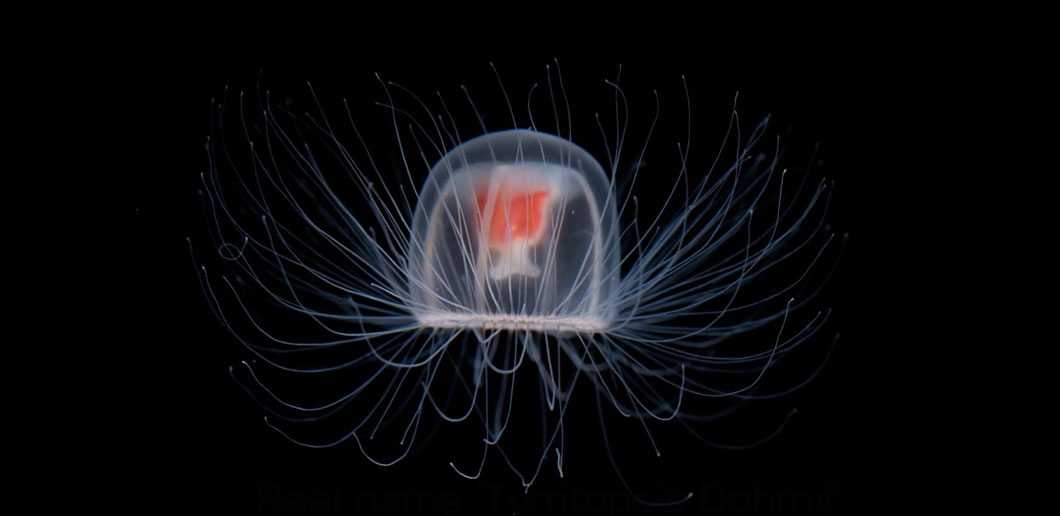
The superpower of Turritopsis dohrnii becomes apparent when it is faced with intense environmental stress (a predator’s attack, lack of food…). The jellyfish then triggers an astonishing survival mechanism that allows it to revert to an earlier stage of its development.
Thanks to a cascade of genetic and cellular reactions, it transforms into a tiny gelatinous mass and, within three days, regains its polyp stage, genetically identical to the original jellyfish, and then continues its life cycle. It’s a bit like a chicken turning back into an egg before hatching again.
The Immortal jellyfish does not, however, mean invulnerability: this tiny cnidarian remains exposed to disease, can end up in the gut of a fish, be swept away by currents before reaching maturity, or be drawn into the cooling systems of power plants.
Not quite immortal, the Greenland shark can live for nearly 400 years.

Contact details
Address:
Farmers Forum,
36, Dominick Street,
Mullingar,
Co. Westmeath,
Ireland
Phone:
+353 (0)44 9310206
Or email us:
For technical issues please check out our FAQ's page or email - [email protected]
For general Queries email - [email protected]
Request to add event to our Calendar - [email protected]
Send us your mart reports - [email protected]
Suggestions and feedbacks - [email protected]
News Items / Press Release - [email protected]
To Advertise on Farmers Forum - [email protected]