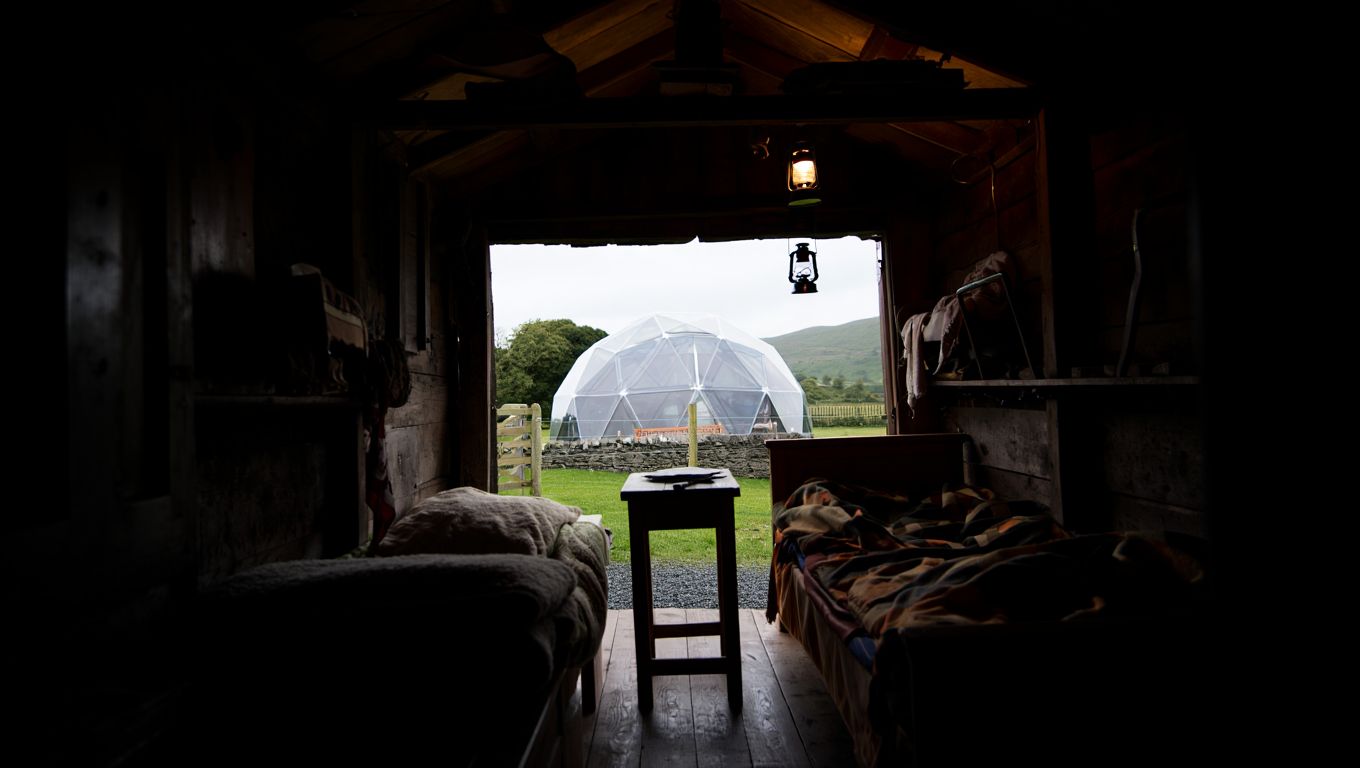
Wind-rippled fields now hide unexpected shapes: gleaming domes, timber-clad cabins, and quiet decks tucked between hedges and stone walls. Weekends vanish fast on booking calendars as city-weary travellers chase starlight and the soft thud of hooves beyond their windows.
A new kind of farmyard welcome
What began as rural diversification has become a movement, with farmers turning spare paddocks into stays that feel both rooted and fresh. “We wanted people to hear the curlews again,” says Siobhán, a smallholder who installed two domes at the edge of a rushy meadow. “And we needed a second income that didn’t need more cattle.”
Hosts talk about a simpler exchange: guests bring curiosity and calm, and leave with muddy boots and a story. The farm keeps its rhythm, and visitors step into it without the fuss of a hotel.
Why the humble hut works
Shepherd’s huts arrive on wheels, slip through narrow gates, and sit lightly on the land. Inside, you find wool throws, a tiny stove, and clever shelves that make small spaces generous. Domes deliver drama: skylights for meteor showers, curved walls that amplify birdsong, and a feeling of sleeping inside a compass.
“People book for the novelty, then rebook for the quiet,” says Darren, who splits his time between lambing and laundering linens. A dome can frame a bog like a gallery; a hut turns rain into a soothing drumroll.
- Expect real darkness, actual silence, hot showers fed by a farm boiler, breakfasts with farm eggs, and a host who knows the weather better than any app.
The business calculus
Behind the romance sits a ledger. A well-sited unit can earn in three nights what a pen of weanlings nets in a month, yet it demands daily care. Hosts talk dynamic pricing, shoulder seasons, and the art of saying no to single-night Saturdays. Insurance, fire safety, and planning add a layer of paperwork to the earthy work.
Some lean on local grants, others bootstrap with sweat equity and secondhand stoves. “We built our first hut on a trailer, then upgraded once bookings felt solid,” says Aidan, who treats the project like a field rotation: light footprint, steady return.
Design that treads lightly
Simplicity carries its own ethic. Many sites use solar panels, filtered rainwater, and low-impact foundations that won’t scar a meadow. Compost loos have quietly gone upmarket, losing the whiff and keeping the sense. Trails are mown, not paved; lighting is warm and low to protect bats and skies.
The best setups feel honest: recycled timber, local stone, wool for insulation, and a view chosen for birds, not just for Instagram.
Weekends are the gold dust
From May to September, Fridays disappear first, then Saturdays follow, and soon the Sundays slip, too. Guests chase short escapes that don’t require airports, adore the two-night arc, and come ready to switch off phones they swear they won’t check.
“By Thursday we’re full, and by Monday we’re back to fencing,” laughs Niamh, who keeps a spreadsheet as diligently as a calving diary. Midweek still tempts the remote workers who want a strong signal and a stronger skyline.
The guest’s view
For visitors, the draw is a mix of texture and truth. You smell wet hay, feel damp grass wick through your boots, and taste jam that hasn’t met a motorway. “I thought I needed a spa,” says Orla, sipping tea on a deck, “but I just needed a place where time is the only noise.”
Even rainy spells find their fans. Domes turn showers into theatre, with clouds peeling over glens like curtains. Huts glow in late light, kettles humming like contented bees.
Challenges behind the charm
Nothing here is entirely pastoral. Winter storms like to test guy ropes and farmer patience. Sheets don’t launder themselves, and stovepipes sulk at the first gust. Hosts juggle check-ins with sick calves, wrangle parking on single-lane boreens, and field the odd 11pm text about a stubborn latch.
Planning remains a local puzzle, with rules that shift like sand and neighbours who need early conversations. Good signage is modest; good boundaries are kind.
What’s next for the farm stay
The next wave looks both crafty and quiet: seaweed soaks after cliff walks, hedgerow foraging with a thermos, sheepdog demos that end with fresh scones. More sites are winterising domes with layered membranes, adding infra-red panels, and offering star tours on crisp nights.
Expect smaller clusters rather than sprawling parks, with each unit telling a story about soil, season, or a particular field. The strongest thread remains place—and the gentle certainty that you’re sleeping inside a working landscape, not just near one.
Across these lanes and headlands, it feels as if rural Ireland has found a new kind of hospitality—close to the ground, big on the sky, and perfectly sized for a two-night escape that lingers far longer than your footprints.

Contact details
Address:
Farmers Forum,
36, Dominick Street,
Mullingar,
Co. Westmeath,
Ireland
Phone:
+353 (0)44 9310206
Or email us:
For technical issues please check out our FAQ's page or email - [email protected]
For general Queries email - [email protected]
Request to add event to our Calendar - [email protected]
Send us your mart reports - [email protected]
Suggestions and feedbacks - [email protected]
News Items / Press Release - [email protected]
To Advertise on Farmers Forum - [email protected]