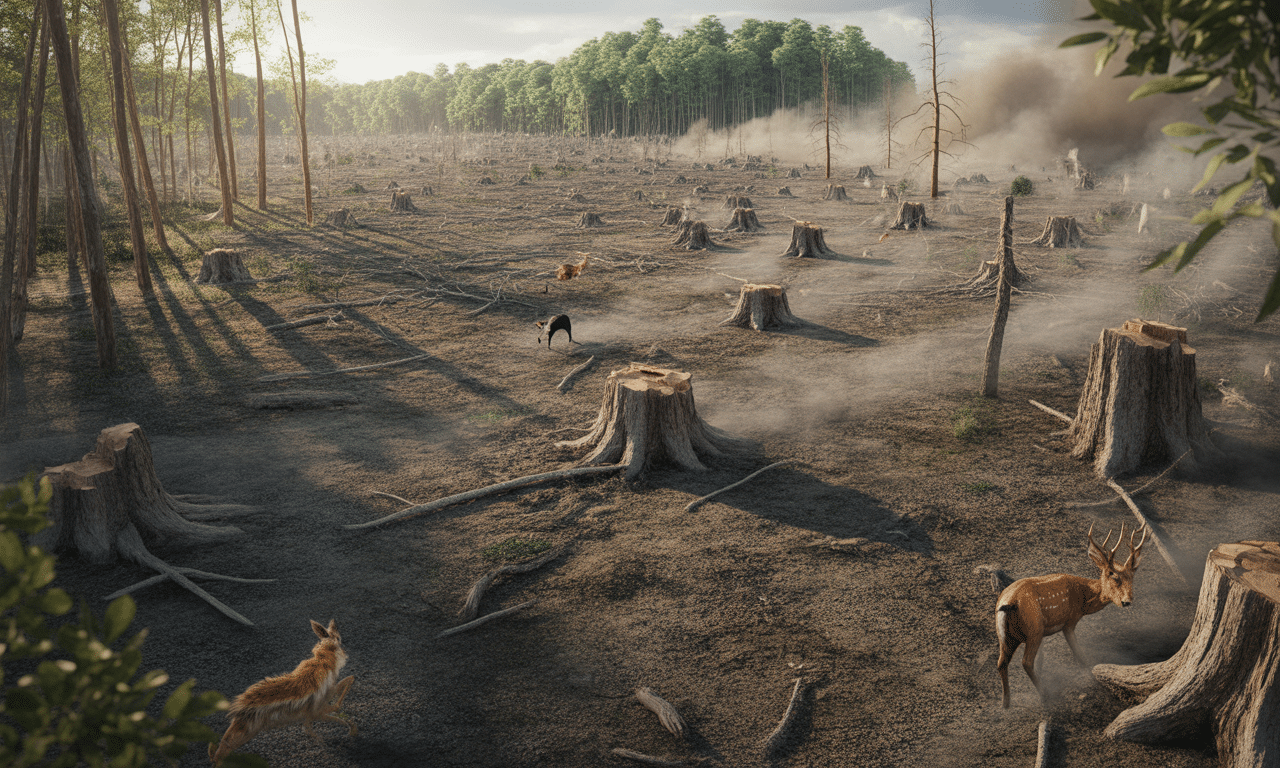
Massive deforestation today forces an ecological turn that the planet pays dearly for. By uprooting millions of hectares of forests, humanity destroys reservoirs of biodiversity and releases substantial amounts of CO2 into the atmosphere, accelerating climate warming. Recent data show that areas comparable to the size of large regions continue to disappear each year, mainly to make way for commercial agriculture, livestock farming, and industrial plantations such as palm oil. The tropical regions—from the Amazon to the Congo Basin, including Indonesia—suffer the most dramatic losses: habitat collapse, ecosystem fragmentation, and rising greenhouse gas emissions. Beyond wildlife and flora, deforestation disrupts the water cycle, weakens soils, and jeopardizes the food security and climate resilience of local populations. In light of these dangers, the challenge is no longer merely to plant trees, but to redefine economic practices and supply chains.
Impact climatique et émissions de CO2
Deforestation transforms carbon-rich forests into net sources of emissions. Trees store CO2 throughout their lives; when they are cut down or burned, this carbon is released rapidly, directly contributing to climate warming. Estimates indicate that forest destruction yields between 4.3 and 5.5 gigatons of CO2 equivalent per year, an amount comparable to that of the largest national emitters.
Tropical forests concentrate a disproportionate share of the carbon stored in terrestrial vegetation: their degradation greatly reduces the planet’s capacity to absorb anthropogenic emissions. The loss of these carbon sinks amplifies climate disruption and tightens the margin for achieving climate targets. This reality makes the idea that reforestation alone will suffice without simultaneously stopping logging and wildfires seem nonsensical.
At the level of public policies, accounting for the carbon impact of imported products becomes crucial. Educational resources and footprint evaluation tools exist to help citizens and businesses understand these links — for example, accessible synthesis pieces explain how deforestation fuels emissions and propose avenues to offset or reduce one’s footprint (climate.selectra).
It is therefore essential to act on two levers simultaneously: reduce active deforestation and restore enduring forest corridors that truly function as carbon sinks, not merely monoculture plantations. Without the preservation of primary forests and sustainable management of replanted areas, the anticipated climate gains will remain largely insufficient. Investment decisions, trade policies, and European regulation now weigh on the ability to reverse these trends.
Perte de biodiversité et extinction d’espèces
Biodiversity on land depends heavily on forests: around 80 % of terrestrial species are found there. The accelerated conversion of forests into agricultural land or plantations leads to habitat fragmentation, local extinctions and, ultimately, global ones. Scientific figures are chilling: it is estimated that almost 137 species disappear every day due to the loss of forest habitats.
The cases of the Amazon and Indonesia illustrate the scale of the problem. The Amazon, disrupted by intensive cattle ranching and soybean cultivation, sees vast areas disappear each year, endangering thousands of endemic species; analyses and investigations report fires and mass deforestation kept out of sight, with a dramatic impact on wildlife (vivredemain).
In Indonesia, the shift to palm oil plantations has destroyed primary forests and endangered iconic species such as the orangutans. The industrial logic, based on short-term gains, sacrifices entire ecosystems that will not recover in a few decades. The biological consequences are also measured in the loss of essential ecosystem services: pollination, pest control, soil renewal, and resistance to biological invasions.
Educational resources and syntheses illuminate the mechanisms at play and remind us of the urgency to act through strict protection policies and appropriate restoration approaches (Canopee, Planet-Vie). Biodiversity is not a luxury: it conditions the resilience of socio-ecological systems and our future food security. Deforestation accelerates a vicious cycle that weakens the planet and human populations over the long term.
Perturbation des cycles hydrologiques et dégradation des sols
Forest presence moderates the water cycle through evapotranspiration, rain retention, and infiltration. When forests are destroyed, the amount of locally recycled water falls significantly, leading to a drop in precipitation of about 20 to 30 % in affected areas. This alteration of rainfall patterns reshapes landscapes, increases the frequency of droughts, and disrupts rain-dependent agricultural activities.
The soils suffer accelerated erosion without vegetative cover: organic matter is lost, structure weakens and fertility declines. Assessments show losses of organic matter up to 50 % in a few years on cleared plots, often leading to progressive desertification. Floods become more violent as water runs off rather than infiltrating, causing loss of life and material damage.
Locally, average temperatures can rise by roughly 2 °C after substantial deforestation, altering ecological niches and promoting pest outbreaks. Consolidated analyses explain how fires, logging, and unsustainable farming practices intertwine to amplify these effects (Actualités en direct, Sylvidra).
In response to these dynamics, only integrated strategies can be effective: protecting primary forests, agroforestry to preserve soil cover, and restoring degraded areas with locally adapted species. Treating deforestation as a standalone problem is a strategic mistake; its hydrological and pedological impacts require coordinated responses across land management, agricultural policies, and watershed protection. Without these approaches, agricultural productivity losses and local climate risks will intensify, weakening entire communities.
Pressions socio-économiques et chaînes d’approvisionnement
Deforestation is above all a phenomenon shaped by economic logics and globalized supply chains. Commercial farming and livestock account for the majority of converted lands: it is estimated that nearly 90 % of direct deforestation is linked to these activities, with cattle ranching accounting for about 40 % of deforested lands in certain hotspots such as South America.
Global demand for palm oil, soy, cocoa, or meat creates strong incentives to convert forests into cropland, often at the expense of local land rights and ecosystems. The companies integrated into global markets bear a central responsibility: without traceability and strict controls, their supply chains can continue to support imported deforestation, including through indirect suppliers.
Recent data show a concentrated geography of the phenomenon: Brazil, Indonesia, and the Democratic Republic of the Congo are among the most affected areas, with significant shares of global forest losses. Investigations and journalistic analyses report illegal practices and intensive exploitation in protected areas (Vivredemain).
Regulation of the domestic market alone is not enough — it is necessary to combine laws, credible certifications, and full transparency of supply chains. Demanding traceability down to the plot is now an imperative to break the entanglement between consumption and deforestation.
Réglementations, surveillance et pistes d’action
Face à l’urgence, les réponses politiques se renforcent. Le Règlement européen 2023/1115 impose désormais que certains produits (café, cacao, caoutchouc, huile de palme, soja, viande bovine, bois) ne puissent être mis sur le marché s’ils proviennent de territoires déforestés illégalement. Cette logique contraignante de diligence raisonnable marque une rupture avec les seuls engagements volontaires.
Au niveau national, des stratégies comme la SNDI française cherchent à réduire la déforestation importée via des engagements privés et des instruments publics. Les initiatives internationales (COP26) ont aussi mobilisé des financements et des engagements pour 2030, mais l’efficacité dépendra de la mise en œuvre et du contrôle sur le terrain.
La surveillance par satellite et intelligence artificielle permet aujourd’hui de repérer la déforestation presque en temps réel, de renseigner des enquêtes et d’orienter des sanctions. Des innovations technologiques prometteuses sont régulièrement présentées et testées pour améliorer la prévention (Vivredemain – technologie).
Agroforesterie, projets carbone forestiers et certifications sont des leviers complémentaires : ils réconcilient production et conservation lorsqu’ils sont conçus avec des communautés locales et des espèces adaptées. Sans moyens de contrôle et sans responsabilité effective des acteurs économiques, les instruments resteront des promesses. Il faut donc articuler dispositifs réglementaires, innovations de surveillance et financement orienté vers des projets qui protègent réellement les forêts primaires et restaurent les paysages dégradés.
Conséquences majeures de la déforestation massive sur la planète
Deforestation massive directly weakens the foundations of life on Earth. By destroying hundreds of millions of hectares of forest cover, indispensable habitats are removed and species disappear at an accelerated rate: the biological richness contained in forests represents a major portion of global biodiversity. Habitat fragmentation and loss lead to local extinctions and then global ones, altering food chains and the resilience of ecosystems in the face of disturbances.
On the climatic front, tree felling turns carbon sinks into emission sources. The release of large amounts of CO2, coupled with the loss of absorptive capacity, weakens the fight against climate warming. The tropical regions, which store a disproportionate share of terrestrial carbon, are particularly critical: their degradation accelerates climate disruption on a planetary scale.
The hydrological and pedological effects are equally severe. Forests regulate the water cycle through evapotranspiration; their disappearance reduces local precipitation and increases the risks of erosion, floods, and desertification. Soils quickly become poorer without the forest cover, losing organic matter and fertility, which permanently compromises agricultural activities and local livelihoods.
Finally, deforestation has heavy socio-economic repercussions: it fuels land conflicts, weakens forest-dependent communities, and promotes unsustainable agricultural and extractive supply chains. Global supply chains render the phenomenon systemic, involving consumers, businesses, and policymakers. Faced with these cumulative effects, it is imperative to strengthen forest protection, encourage responsible farming practices, and reinforce traceability and accountability mechanisms to halt this destructive spiral.
FAQ — Les conséquences de la déforestation massive sur la planète
Q. Qu’entend-on exactement par déforestation et pourquoi est-ce problématique ?
R. La déforestation désigne la disparition volontaire et souvent irréversible des surfaces boisées pour laisser place à des cultures, des pâturages, des mines ou des infrastructures. Ce processus n’est pas neutre : il détruit des habitats, réduit la capacité de la planète à stocker le CO2 et compromet la résilience des écosystèmes — autant de raisons pour lesquelles la lutte contre la déforestation est impérative.
Q. Quelle est l’ampleur actuelle des pertes forestières à l’échelle mondiale ?
R. Les bilans internationaux montrent des pertes massives : près de 420 millions d’hectares entre 1990 et 2020, et plus récemment environ 6,3 millions d’hectares détruits en 2023-2024, dont une part importante en forêts primaires. Ces chiffres montrent que, malgré des progrès locaux, le phénomène reste d’une ampleur critique.
Q. Quelles régions payent le plus lourd tribut à la déforestation ?
R. Les zones tropicales subissent la plus forte pression : l’Amazonie, le Sud-Est asiatique et le bassin du Congo concentrent l’essentiel des pertes. À titre d’exemple, le Brésil représente une large part des superficies détruites (près de 43% du total mondial récent), suivi par l’Indonésie (19%), la RDC (12%) et la Bolivie (9%).
Q. Quelles sont les causes principales de cette déforestation massive ?
R. Ce sont essentiellement des activités humaines : l’agriculture commerciale et l’élevage expliquent la quasi-totalité des conversions de forêt (près de 90% des causes), avec des cultures telles que le soja, l’huile de palme et l’extension de pâturages. L’exploitation minière et l’urbanisation complètent le tableau, bien que dans une moindre mesure.
Q. Quel est l’impact de la déforestation sur le climat mondial ?
R. La déforestation libère d’importantes quantités de gaz à effet de serre : on estime entre 4,3 et 5,5 gigatonnes d’équivalent CO2 par an. En détruisant les puits de carbone, elle réduit aussi la capacité future d’absorption des émissions anthropiques, exacerbant le réchauffement global.
Q. En quoi la déforestation menace-t-elle la biodiversité ?
R. Les forêts abritent environ 80% de la biodiversité terrestre ; leur disparition entraîne la fragmentation et la perte d’habitats. Les conséquences sont dramatiques : de nombreuses espèces voient leur survie compromise et les experts estiment des centaines d’espèces affectées chaque jour, ce qui fragilise durablement les services écosystémiques.
Q. Quels effets la déforestation a-t-elle sur les sols et le cycle de l’eau ?
R. En supprimant la couverture arborée, on accélère l’érosion, on appauvrit le sol en matière organique (jusqu’à 50% de perte en quelques années) et on réduit l’infiltration d’eau. Parallèlement, l’évapotranspiration diminue, ce qui peut réduire les précipitations locales de l’ordre de 20 à 30% et augmenter les risques d’inondation et de désertification.
Q. La déforestation a-t-elle des effets climatiques locaux mesurables ?
R. Oui. Les zones déboisées voient souvent une hausse des températures locales d’environ 2°C en moyenne et une modification des régimes pluviométriques, ce qui transforme les microclimats et réduit la capacité des territoires à soutenir l’agriculture et la biodiversité.
Q. La reforestation est-elle une solution suffisante ?
R. La reforestation aide, mais elle n’est pas une panacée. Planter des arbres est utile uniquement si on prend en compte la qualité écologique, la diversité des espèces et l’adaptation au milieu. Des plantations mono-spécifiques ou mal situées peuvent remplacer une forêt riche par un simple couvert végétal inefficace. Il faut coupler reboisement, protection des forêts existantes et pratiques telles que l’agroforesterie ou les projets carbone bien conçus.
Q. Quel rôle jouent les entreprises et les chaînes d’approvisionnement ?
R. Les grandes entreprises, par leurs achats massifs de huile de palme, soja, cacao ou de viande bovine, participent à la conversion des forêts quand leurs filières ne sont pas traçables. La responsabilité est donc économique : imposer une traçabilité stricte et des critères sans déforestation est indispensable pour inverser la tendance.
Q. Quelles réponses réglementaires existent pour freiner la déforestation ?
R. Les institutions renforcent les règles : l’Union européenne a adopté le Règlement 2023/1115 exigeant une traçabilité jusqu’aux parcelles pour certains produits, et des stratégies nationales (comme la SNDI en France) encouragent la prévention des importations liées à la déforestation. Par ailleurs, des engagements internationaux (COP26) visent l’arrêt de la déforestation d’ici 2030, soutenus par des financements publics et privés.
Q. Comment la déforestation est-elle surveillée et sanctionnée ?
R. Des outils satellitaires couplés à l’intelligence artificielle permettent aujourd’hui une surveillance en quasi-temps réel. Les entreprises peuvent être tenues responsables et faire face à des sanctions financières — dans certains cadres, les pénalités peuvent atteindre jusqu’à 4% du chiffre d’affaires pour non-respect des obligations anti-déforestation.
Q. Que peut faire un consommateur ou une entreprise pour agir concrètement ?
R. Agir implique de privilégier des produits certifiés (labels de gestion forestière ou de production responsable), réduire la consommation de produits liés à la conversion des forêts, soutenir l’agroforesterie et financer des projets forestiers crédibles. Les choix d’achat et les politiques d’approvisionnement sont des leviers directs pour rompre le lien entre consommation et destruction des forêts.
Q. Les initiatives de restauration peuvent-elles compenser les émissions liées à la déforestation ?
R. Certaines initiatives contribuent à restaurer des puits de carbone, mais la compensation ne doit pas servir de prétexte à poursuivre la déforestation. Restaurer des écosystèmes dégradés et protéger les forêts primaires est nécessaire, mais l’effort principal doit rester la prévention et la réduction des pressions à la source.

Contact details
Address:
Farmers Forum,
36, Dominick Street,
Mullingar,
Co. Westmeath,
Ireland
Phone:
+353 (0)44 9310206
Or email us:
For technical issues please check out our FAQ's page or email - [email protected]
For general Queries email - [email protected]
Request to add event to our Calendar - [email protected]
Send us your mart reports - [email protected]
Suggestions and feedbacks - [email protected]
News Items / Press Release - [email protected]
To Advertise on Farmers Forum - [email protected]