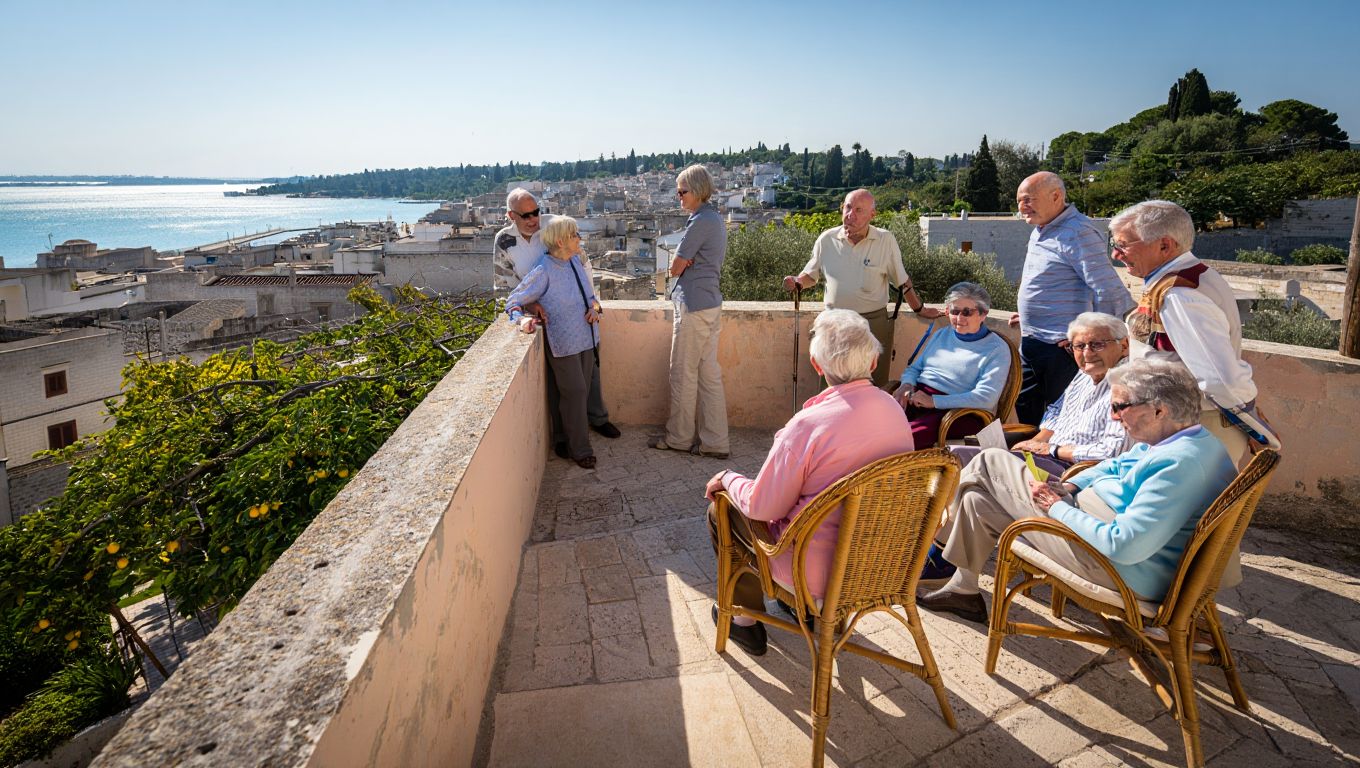
The plane banks over olive groves and pale stone, and a stripe of Adriatic blue snaps into view. For a certain kind of Irish retiree, that view has become a new routine, not a once-a-year escape.
What’s drawing them is simple math and softer light: more blue-sky days, lower everyday costs, and towns that feel intimate without feeling remote. “The light does something to you,” goes a line you hear on repeat, and after a few late-afternoon passeggiate, it sounds less like poetry and more like physiology.
The pocket of Puglia people whisper about
Trace your finger between Bari and Brindisi, then drift south toward Lecce, and you hit a region of whitewashed villages and slow, green valleys. The Valle d’Itria is a hush of trulli domes and tidy lanes—Cisternino, Locorotondo, Martina Franca—where laundry flaps and cats patrol like tiny landlords. Slide toward the coast, and the air turns salty: Monopoli, Polignano, Carovigno, Ostuni perched like a meringue in the sun.
Beaches are a daily decision, not a weekend project. Torre Guaceto’s reserve is all dunes and transparency; the Salento tip does turquoise like it has a patent. Off-season, you can hear your own footsteps on the sand, a luxury larger than any villa.
Why it’s clicking for Irish retirees
Flights now stitch Dublin and sometimes Cork to Bari and Brindisi in neat arcs, and Ryanair’s timetable reads like a retirement calendar. For EU citizens, the paperwork is largely “show up, register, breathe,” a rare bureaucratic lullaby.
Costs feel unhurried too. A morning espresso is still pocket-change theatre; market bags bulge with tomatoes that taste like sun, not fridge. “Your money stretches further” is a cliché because it’s true, especially away from the glossed seafronts.
The pace charms on contact. Shops shut for lunch and nobody apologizes. The town square is a classroom in how to age with company. “Piano, piano,” say the locals—slowly, slowly—and after a month your shoulders obey the instruction.
What homes and daily life actually cost
Inland towns serve two-bedroom lamie and small stone houses that often list in the low six figures, especially where renovation is part of the story. Polished trulli and masserie fetch bigger numbers, and postcard coastlines multiply those again.
Ownership adds the usual chorus: closing taxes, a notaio, a geometra if you’re fixing things. Renovations run on craft and calendar, not on hurry. Utilities are sane if you mind your AC in July and your heating in January; Puglia isn’t winterless, it’s just kinder.
Groceries are a weekly smile: olive oil that tastes like trees, bread that remembers its hearth. Dinner out lands under what a pub supper might cost back home, especially if you like house wine and the local catch.
Residency, healthcare, and the admin that matters
As EU citizens, Irish retirees can reside without a visa, then register locally for stay and healthcare access. Expect to apply for a tessera sanitaria, and check whether an S1 route or EU coordination suits your status; guidance shifts, so verify with Irish and Italian authorities.
Banking is workable with a codice fiscale; driving is simple with an EU license. Property buys should pass a notary’s bright light, and a bilingual lawyer is not a luxury but a seatbelt.
Daily rhythm: less schedule, more season
Mornings are for markets and errands; afternoons are for shade. “See you at six” means the evening drift—families, dogs, and gossip in gentle circles. Music can be church-bell quiet or tambourine-loud during pizzica and sagra nights. In August, the region inhales tourism; in November, it exhales silence.
Rain does visit, wind too, but the sky returns like a faithful friend. You learn to keep swimwear and a cardigan in the same bag.
A quick checklist before you leap
- Try three stays: spring for blossoms, August for crowds, winter for real life. Meet a geometra, a notaio, and a trusted agent; check cell coverage and medical access; test-drive the nearest airport run on a foggy morning.
Good places to start scouting
Ostuni is an easy first crush—views, cafés, and enough winter pulse. Ceglie Messapica swaps spectacle for food and neighborly rhythm. Cisternino and Locorotondo do balcony theatre with excellent butchers and lovely light. Carovigno is a value play near Torre Guaceto’s protected shore. In the south, Lecce delivers baroque drama and a university hum.
Pick a base, walk four streets, and listen: the dog barks, the cup clinks, the sparrows convene like tiny councilors. That soundscape tells you more than any brochure.
What could go wrong (and how to dodge it)
Heat waves can flatten plans; choose cross-ventilated homes and respectful AC. Rural bliss can slip into isolation if you don’t speak basic Italian; ten phrases unlock ten friendly doors. Renovations can sprawl; write timelines, stage payments, keep contingency cash. And yes, some towns nap so hard in winter you’ll hear your own thoughts; make sure you like your own company.
“Retired” feels like the wrong tense here. It’s more “reset,” more re-tuned. The days aren’t louder; they’re wider, with room for small rituals: a fig split open, a chair nudged into a patch of sun, the certainty that tomorrow will look a lot like today, only a little more your own.

Contact details
Address:
Farmers Forum,
36, Dominick Street,
Mullingar,
Co. Westmeath,
Ireland
Phone:
+353 (0)44 9310206
Or email us:
For technical issues please check out our FAQ's page or email - [email protected]
For general Queries email - [email protected]
Request to add event to our Calendar - [email protected]
Send us your mart reports - [email protected]
Suggestions and feedbacks - [email protected]
News Items / Press Release - [email protected]
To Advertise on Farmers Forum - [email protected]