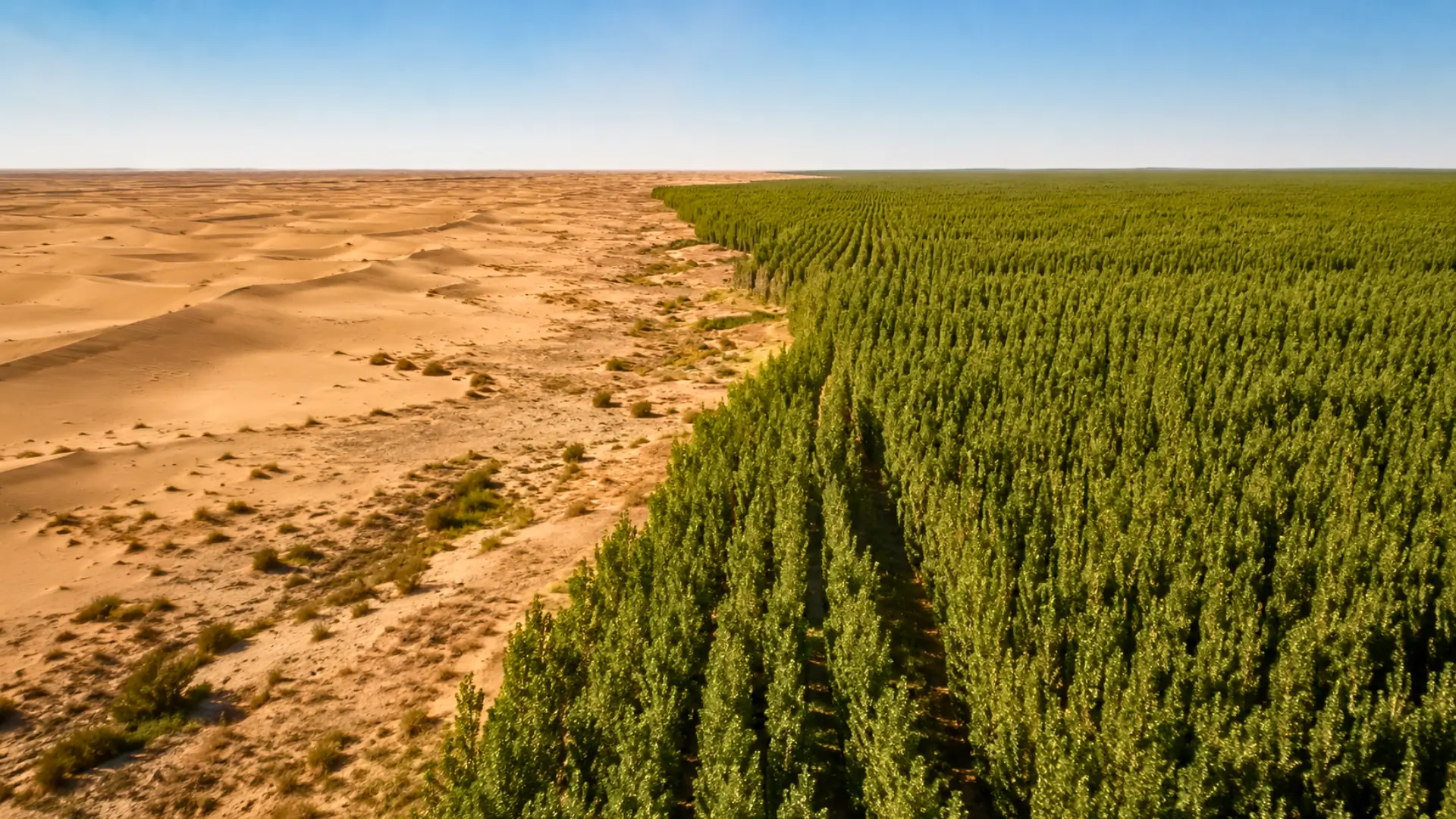
Planting billions of trees may seem like a climate imperative. Yet China shows that one reforestation effort is not equal to another. Behind the greening dunes, a recent study reveals a subtler reality: not all forests absorb carbon in the same way.
The Great Green Wall of China Has Transformed the Fight Against Desertification
In 1978, China launched an almost fantastical project: to erect a green barrier against the Gobi and Taklamakan deserts. Since then, nearly 66 billion trees have been planted under the Three-North Shelterbelt Program. The stated aim is to approach 100 billion by 2050. Few environmental policies match such scale and symbolic heft.
For a long time, this project was told mainly as an epic struggle against desertification. But when viewed from above, the story takes on a different hue. In some of Asia’s driest regions, the plantings have advanced enough to alter the vegetation cover. In places, they even convert desert margins into seasonal carbon sinks. The scenery is spectacular, almost cinematic.
Satellites Reveal That Planted Forests Dense Their Foliage Much Faster
The surprise comes from a study published in Geophysical Research Letters in 2026 by researchers at Peking University in Shenzhen. By tracking the leaf-area index from space, they observed that planted forests in China increased their leaf cover 65.8% faster than natural forests. In other words, they gain that green surface—and the CO₂ capture it represents—more quickly.
The most interesting detail, however, lies elsewhere. Even at comparable ages and environments, the plantations maintain a 4.6% lead. This difference seems tied to a very human mix. On one hand, there are fast-growing species, such as poplars or certain eucalyptus. On the other, active management reduces competition, sustains growth, and amplifies the fertilizing effect of atmospheric CO₂.
In other words, these forests do not just grow fast because they are young. They grow fast because they are designed for it. That is where the story changes. Reforestation is not a single, uniform gesture. It is a form of ecological engineering. The age of trees, the choice of species, and maintenance matter as much as the number of saplings planted.
The accelerated growth of plantations peaks quickly and reveals ecological limits
Yet this performance is not a simple victory. Researchers show that the maximum advantage of planted forests appears between 30 and 40 years, before it wanes. The sprint slows. This point is crucial. A plantation that is highly effective today does not guarantee the same absorption capacity tomorrow, especially in regions subjected to strong climatic constraints.
Other studies also remind of the other side of the coin. In the arid zones of northern China, planting trees can intensify pressure on water resources. It can also destabilize some soils or produce stands less resilient to disease, droughts, and extremes. A spectacular forest is not automatically a stable forest.
Natural Forests Remain Decisive for Sustainable Carbon Storage
That is why natural forests stay ahead in the long term. Their growth is less explosive, but often steadier, more diverse, and more robust against disturbances. They store carbon durably. They also harbor biodiversity that no standardized plantation can truly recreate.
The Chinese study thus sends a timely message to climate policy. Many models still treat forests as a single category, whereas not all reforestation efforts are equal. A young, maintained, monoculture plantation does not share the same trajectory. It does not offer the same benefits or the same risks as a natural forest or spontaneous regeneration.
Ultimately, the Great Green Wall of China fascinates less with its billions of trees than with the question it raises. In a world obsessed with numbers, counting trunks planted or hectares greening is no longer enough. We must also understand the quality of the forests we are building for the climate, their lifespans, their diversity, and their ability to endure as conditions grow harsher.

Contact details
Address:
Farmers Forum,
36, Dominick Street,
Mullingar,
Co. Westmeath,
Ireland
Phone:
+353 (0)44 9310206
Or email us:
For technical issues please check out our FAQ's page or email - [email protected]
For general Queries email - [email protected]
Request to add event to our Calendar - [email protected]
Send us your mart reports - [email protected]
Suggestions and feedbacks - [email protected]
News Items / Press Release - [email protected]
To Advertise on Farmers Forum - [email protected]