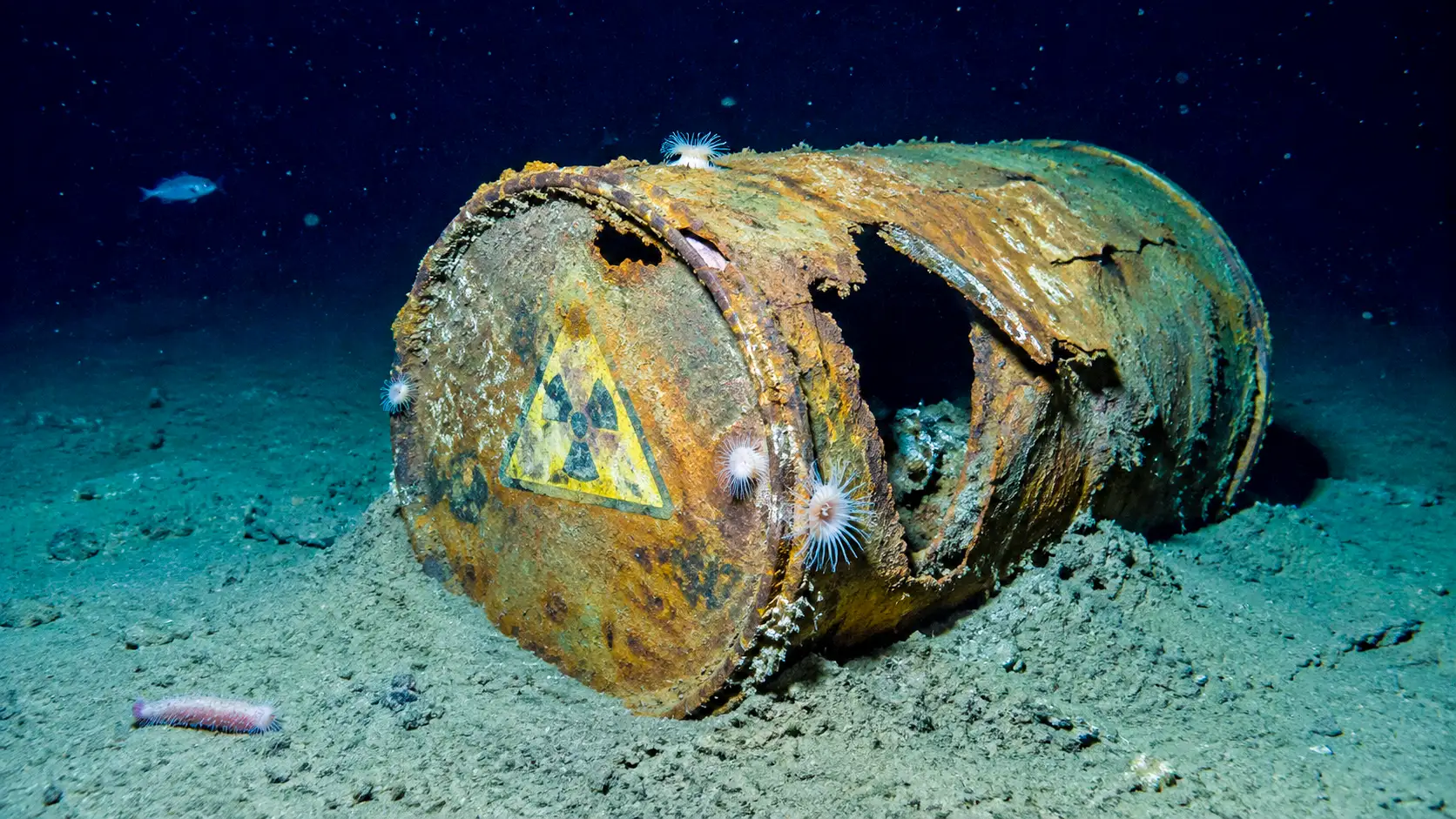
Nearly 5,000 meters below the surface, the Atlantic Ocean preserves traces of our industrial past. The Nodssum scientific mission has confirmed the rupture of submerged nuclear containers from the last century. The initial images reveal a direct radioactive leak and an unprecedented biological colonization.
A marine nuclear pollution accumulated over decades by three European nations
Between 1949 and 1982, several nations dumped more than 200,000 metal drums into the Northeast Atlantic. These 200-liter containers held radioactive residues coated in concrete or bitumen. The authorities of the time thus sought to seal the material before immersion.
The United Kingdom carried out 34 operations to submerge 140,000 containers. Belgium, for its part, evacuated 55,000 barrels. France dumped 46,000 during two campaigns. The vessels tipped these charges directly overboard toward deep-sea zones beyond 4,700 meters.
Robots, then researchers observe the deterioration of drums on the abyssal plain
In 2025, the CNRS launched the Nodssum expedition aboard the ship L’Atalante to locate the discharges across 14,500 square kilometers. The autonomous robot Ulyx carried out 16 dives and traversed 800 kilometers. Its sensors photographed 3,355 receptacles partially buried under the seabed.
This initial mapping covers about 165 square kilometers of the ocean floor. Scientists collected 5,000 litres of water and performed 345 soil cores. Furthermore, the teams captured 34 specimens of local fauna to embark on preliminary observations.
Between May and June 2026, the mission deployed the manned submarine Nautile from the Why not? ship. Researchers descended into near-total darkness at almost 4,700 meters. They observed the true condition of the metal cylinders with their own eyes.
Anomalous radiological readings confirm the leakage of the containers among the deep-sea fauna
The submersible’s cameras show structures severely degraded by the combined effects of salt and pressure. The concrete and bitumen envelope has cracked on numerous specimens. Consequently, the drums no longer retain all of the stored radioactive materials.
The onboard instruments detect radioactive activity higher than forecast. The clear presence of specific radionuclides confirms that containment failed after four to five decades. The shells designed to withstand twenty years are now showing their limits.
Despite the contamination, marine life is colonizing these industrial debris. Anemones and sea cucumbers attach their structures to the corroded metal. Additionally, amphipods and grenadiers swim around these nuclear vestiges that have become an artificial habitat.
International laboratory analyses must now assess ocean-wide dispersion
After the ships return, researchers continue their work on land. Teams from France, Germany, Norway and Spain examine sediment and water samples. The objective is to quantify radionuclides and measure their actual spread.
This abyssal study forms part of a global environmental challenge. Other underwater nuclear cemeteries exist in the North Sea, the Arctic, or in the Pacific. The protocols developed by CNRS will thus help evaluate these different submerged zones.

I worked with a scientist Paul Yevich at the EPA lab RI who discovered these nuclear waste barrels decades ago. His sample of deep sea clams showed heart tumors similar to heart cancer in children.b
Very informative Liam, surely these countries need to be shamed on the international stage
Little Wonder we’re experiencing strange anomalies in fish deformities internationally when this is being discovered . Remember fishing off south kent uk coast in the 60s by Dungeness nuclear power station at night and seeing assorted gulls and sea birds with fluorescent plumage along with fish with ugly boils and cysts on their skin !
So no surprise cancer numbers are increasing world wide !!!💀💀💀🤬🤬🤬🤬😱☠️☠️☠️