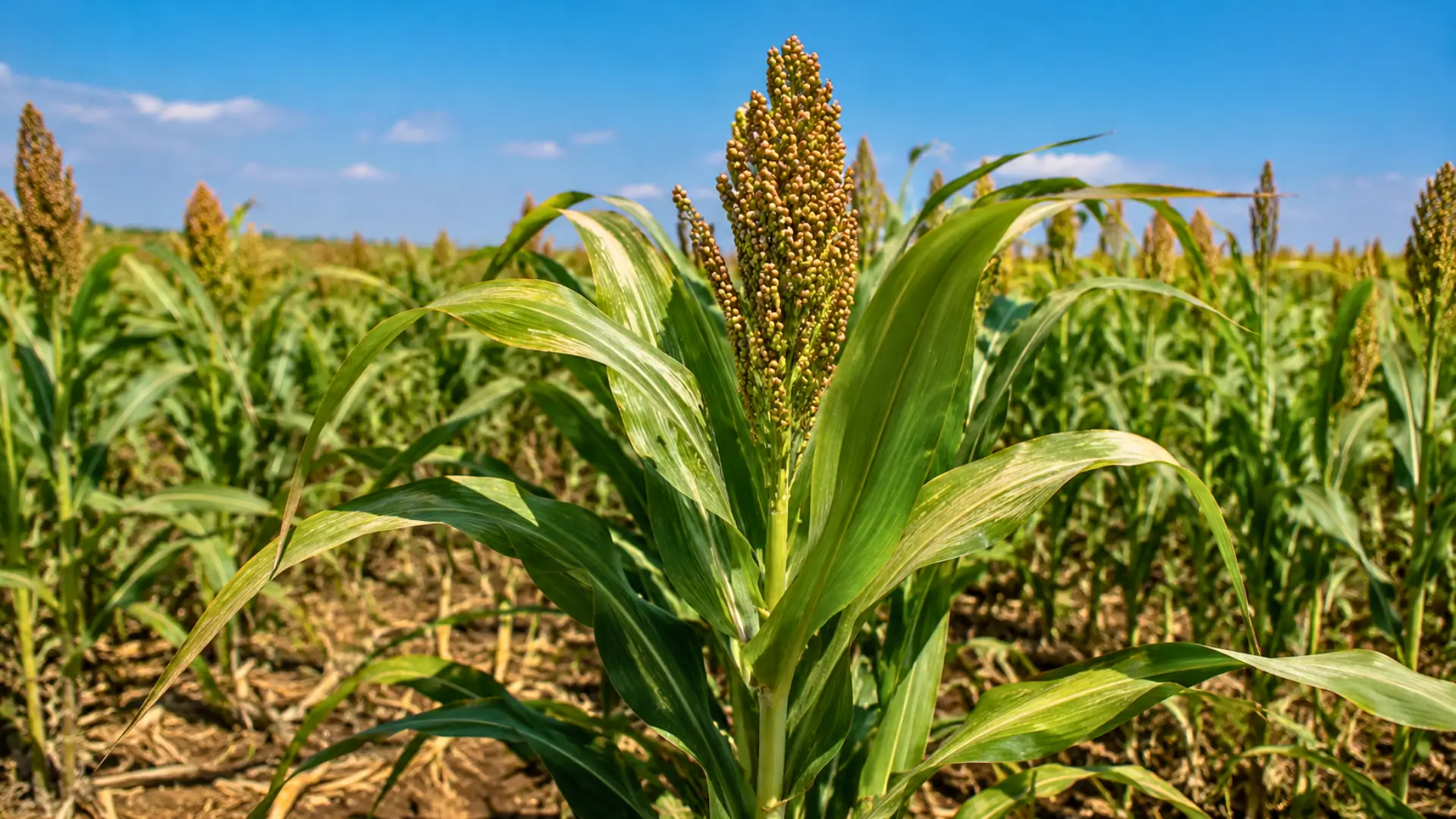
Under a blazing sun, some plants keep producing sugars while losing far less water than their neighbors. Their secret lies in an astonishing variant of photosynthesis, which evolved over time and has become valuable in the face of increasingly frequent droughts.
When heat turns ordinary photosynthesis into a true trap for plants
A leaf seems motionless, almost passive. Yet, it operates like a miniature chemical factory. In most plants, known as C3, an enzyme called RuBisCO captures CO₂ to build sugars. But when temperatures rise, it can misfire. It captures oxygen instead. This triggers an energy-costly process called photorespiration.
During drought, the plant must limit its water losses to survive. It then gradually closes its stomata, the tiny pores on the leaf surface. The air circulates less. CO₂ becomes scarce. Photorespiration rises. Sugar production slows down sharply. This happens at the moment when the plant most needs energy to resist.
Some species, however, have devised a microscopic carbon-dioxide pump
The C4 plants developed an ingenious strategy to bypass this problem. They first capture CO₂ with a dedicated enzyme. Then they shuttle it to specialized cells. There, it is highly concentrated. This biological carbon pump increases the CO₂ around RuBisCO and almost entirely minimizes capture errors.
This mechanism requires more energy than classic photosynthesis. Yet it becomes very advantageous under conditions of strong light and high heat. C3 plants suffer more. The C4 plants keep their stomata more closed. They still manage to produce sugars. This greatly reduces their water losses through transpiration.
Maize, sorghum and sugar cane hide this remarkable mechanism in their leaves
This strategy is not marginal in the plant kingdom. It is found in major crops such as corn, sorghum, millet and sugar cane. They dominate many tropical and subtropical regions. Their agricultural success owes, in part, to this form of photosynthesis that works more efficiently under intense heat and bright sun.
The sorghum is of particular interest to agronomy researchers. Several recent studies show that it withstands drought better than maize in certain arid or semi-arid regions. But this performance also depends on other factors. Soil quality, root depth and rainfall distribution play key roles.
The C4 mechanism resembles a weapon of the future, yet it has its Achilles’ heel
Reducing the opening of the stomata helps conserve water. But it also limits the plant’s natural cooling. Transpiration acts as a plant’s air conditioning. Without it, leaf temperatures can climb quickly during heat waves. This creates a new form of stress. Recent research confirms that responses to water stress vary by species.
A 2026 study in Scientific Reports shows that the C4 metabolism provides an advantage. But it does not guarantee total resistance. Extreme conditions, especially when heat and drought coincide, remain hard to endure. Another paradox: the rise in atmospheric CO₂ benefits C3 plants less than C4. Their system already concentrates this gas.
Conversely, a tighter stomatal closure can improve their water-use efficiency. But this balance remains fragile and depends on environmental conditions. Agricultural research is therefore exploring hybrid solutions for the future. It combines optimized photosynthesis, deeper roots and better water management. In a warmer and drier climate, these leaf-hidden mechanisms could become essential for global food security.

Contact details
Address:
Farmers Forum,
36, Dominick Street,
Mullingar,
Co. Westmeath,
Ireland
Phone:
+353 (0)44 9310206
Or email us:
For technical issues please check out our FAQ's page or email - [email protected]
For general Queries email - [email protected]
Request to add event to our Calendar - [email protected]
Send us your mart reports - [email protected]
Suggestions and feedbacks - [email protected]
News Items / Press Release - [email protected]
To Advertise on Farmers Forum - [email protected]