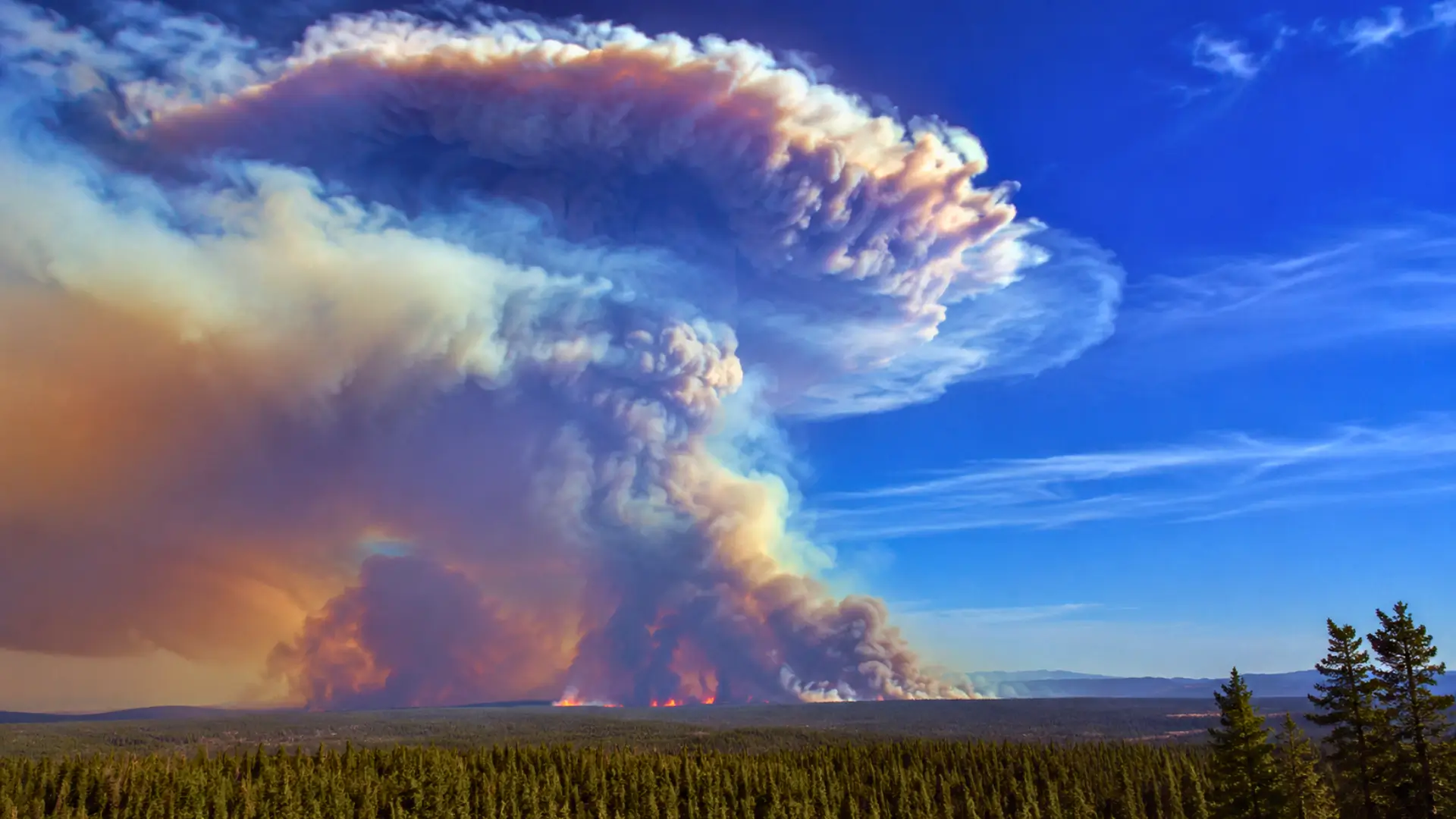
Can a wildfire alter the atmosphere thousands of kilometers away from its flames? Satellites now reveal that some smoke crosses the stratosphere, filters solar radiation, and disrupts climate balances long deemed almost unreachable.
Pyrocumulonimbus, fire-generated columns capable of piercing Earth’s stratosphere
An ordinary forest fire releases its smoke into the lower air layers, where winds and rain eventually scatter it. But when a blaze grows colossal, the heat triggers an explosive ascent. The hot air drags ash, water vapor, and particles upward at speeds capable of forging a true thunderstorm.
This monster goes by a nearly unpronounceable name: the pyrocumulonimbus, or pyroCb. Resembling a cumulonimbus born from flames, it can reach up to 15 kilometers in altitude, sometimes more, and can even cross the boundary into the stratosphere. NASA often likens it to a giant chimney, capable of ejecting pollution to places rain can no longer cleanse.
Observation satellites reveal smoke plumes on a planetary scale
From the ground, the phenomenon appears almost invisible. Satellites, however, monitor the atmosphere layer by layer using lidars and optical sensors. In June 2025, the European EarthCARE mission detected layers of Canadian smoke stretched over more than 5,000 kilometers, reaching into the high Arctic latitudes.
Observations from the major Australian fires of 2019 and 2020 revealed an even more astonishing scene. A mass of smoke heated by sunlight formed an autonomous vortex about 1,000 kilometers in diameter. It traversed roughly 66,000 kilometers in thirteen weeks, climbing progressively into the stratosphere.
The plume eventually reached about 35 kilometers in altitude, well above commercial airliners. This behavior is explained in particular by black carbon: by absorbing light, the particles heat the surrounding air and keep ascending. The smoke thus becomes, in a sense, its own atmospheric elevator.
Smoke aerosols, a solar filter with climate effects still underestimated
At such heights, the particles can persist for weeks or months. They reflect part of the solar radiation back into space, while also absorbing another portion. The result: they can slightly cool the surface while locally warming the stratosphere, with complex consequences for winds and atmospheric circulation.
Comparing with volcanic eruptions is tempting but imperfect. Volcanic sulfur mainly forms reflective aerosols, while smoke contains dark, absorbing particles. The Australian fires are estimated to have injected about one-tenth of the aerosol mass released by the Pinatubo eruption, a remarkable share for a biogenic phenomenon.
Climate models face the growing impact of megafires on the atmosphere
For a long time, models treated these stratospheric injections as rare events. That assumption is growing fragile. A study published in Science estimates that pyrocumulonimbi already influence the average amount of aerosols present in the stratosphere. More than half of several dozen powerful bursts observed would have directly crossed this atmospheric boundary.
The stakes extend beyond temperature. Smoke can alter ozone chemistry, our shield against ultraviolet rays. Following the Australian fires, researchers observed unprecedented perturbations, sometimes concentrated within vortexes loaded with particles. The ozone layer thus appears more vulnerable to megafires than previously assumed.
NASA and the Naval Research Laboratory launched in 2026 the INSPYRE mission to directly examine these smoke clouds, their particles, and their radiative effects. For while warming promotes more intense fires, those fires could in turn modify the climate system. A feedback loop, still poorly understood, is taking shape: how far will terrestrial flames reshape the sky?

Contact details
Address:
Farmers Forum,
36, Dominick Street,
Mullingar,
Co. Westmeath,
Ireland
Phone:
+353 (0)44 9310206
Or email us:
For technical issues please check out our FAQ's page or email - [email protected]
For general Queries email - [email protected]
Request to add event to our Calendar - [email protected]
Send us your mart reports - [email protected]
Suggestions and feedbacks - [email protected]
News Items / Press Release - [email protected]
To Advertise on Farmers Forum - [email protected]