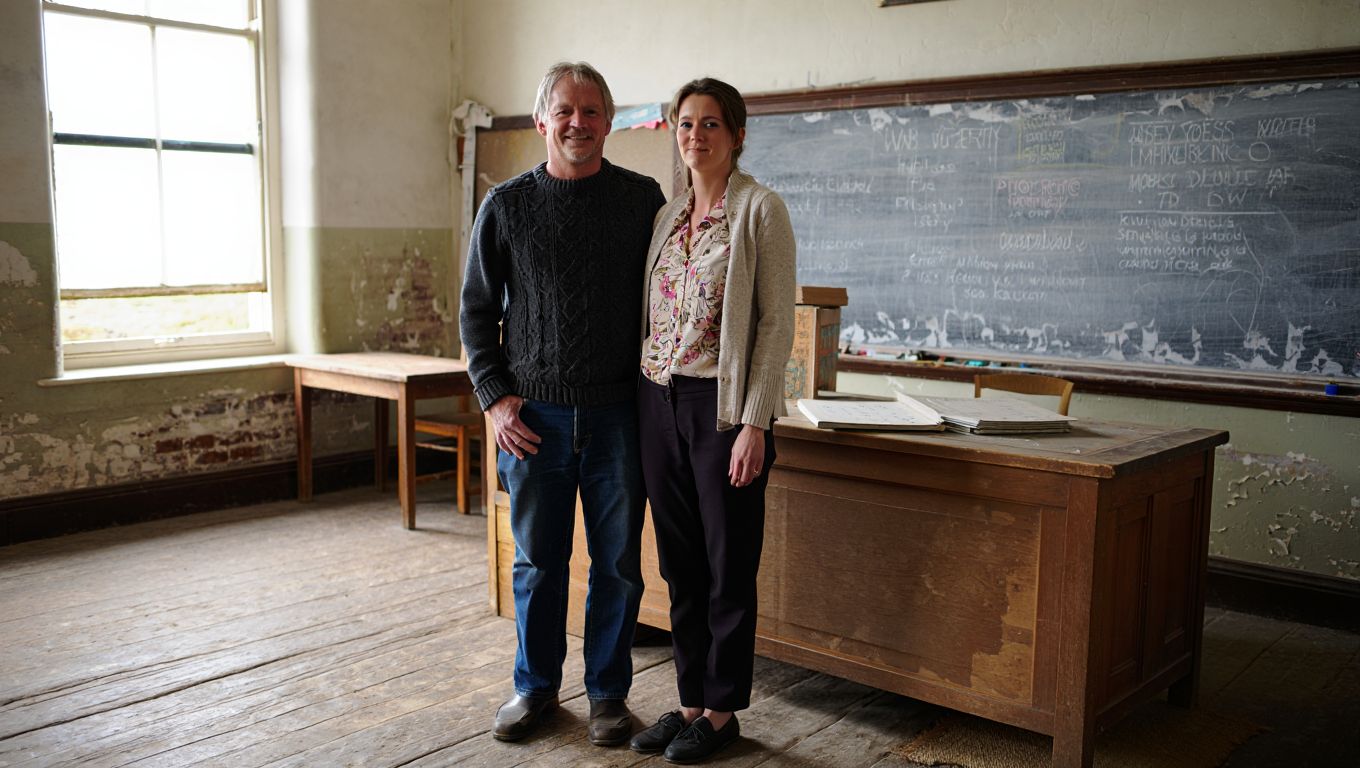
They didn’t mean to buy a schoolhouse. They meant to take a Sunday spin, a coffee, a look at the sea. But a hand-painted sign on a boreen near west Waterford tugged them off-course, and by evening a set of rusty keys clinked into their pockets. “It felt absurd and perfect,” laughed Aisling, “like finding your childhood on a clearance rack.”
Finding a home in a forgotten classroom
The place had been empty for years, the paint the color of old chalk, the yard wild with self-sown daisies. Its bell was gone but its echo lingered: varnished cubbies, a cracked map of Europe, the faint geometry of sums on a blackboard. “We walked in and heard a hush,” said Mark, “like the building was holding its breath.”
They were from Youghal, used to salt-washed stone and errands done on foot. The school sat just across the county line, a squat rectangle under a sky that felt wider than necessary. What it lacked in polish, it offered in intent: shelter, character, and the kind of bones you can actually read.
The price of a car, the value of a lifetime
The agent named a figure that sounded like a decent used hatchback. They traded spreadsheets for instinct, asked three sensible questions, and then one reckless one: “Why not us?” The math was plain. A small mortgage, time on their side, and a margin to fix what truly mattered.
“We didn’t want granite and gleam,” Aisling said. “We wanted story.” They closed in early 2023, a year stamped in their memory like a date on a school report. The first night, they camped on the floor, listening to wind press against old frames and wondering if the roof would keep its word.
From chalk dust to chimney smoke
Renovation arrived as a season of rituals. They stripped linoleum to reveal timbers, ran new wiring like quiet syntax, and patched the slate roof between sudden showers. Every fix was a sentence, every snag a patient comma.
In the heart of the big room, they set a squat stove and let it learn the room’s language. The stove answered in low, approving murmurs. “We kept the high windows,” Mark said, “because the light feels like permission.” The blackboard stayed, now a rolling map of dinners, reminders, and guest names.
What they kept, what they changed
They followed a simple rule: save the soul, improve the systems. That became a checklist they could stand behind:
- Preserve original doors, refit sashes, insulate discreetly, and make modern comforts invisible wherever possible.
They learned to live with quirks. A whisper through the eaves at midnight. A floorboard that narrates your quiet sneak. “The building tells you how to live in it,” Aisling said. “You just have to listen.”
Life in west Waterford, reimagined
Days opened with gulls and soft rain, closed with kettle steam and the small applause of turf on the grate. Their neighbors arrived like a careful chorus: a farmer with stories about the headmaster’s bicycle, a retired teacher who remembered the winter of ‘87 with a grin and a shiver.
Weekends became a dependable rhythm. Fix a latch, cycle to the shop, host a pot of soup under a suspended globe. “It’s not remote,” Mark said. “It’s specific.” They discovered the difference between quiet and silence, between being alone and being anchored.
The lessons the building taught
Space, they learned, is a kind of teacher. A long room invites long thought. A ceiling lets your worries rise and thin into air. They started placing furniture like punctuation, giving each corner its gentle purpose.
The yard taught other lessons. Thistles guard what they can’t keep. Blackberries forgive your late attention. “We planted herbs along the old path,” Aisling said, “because the children must have run that line for years.” In summer, the scent of thyme slips through a cracked window, and the room smells faintly of present and past.
Counting the real costs
The money was modest, but the labor wasn’t free. They paid with weekends, with skinned knuckles, with YouTube tutorials paused a dozen times. They avoided perfection’s trap and chose the law of enough. If a door closes sweetly, it’s enough. If the room holds winter at bay, it’s enough.
“People ask about value,” Mark said. “But what’s your unit of measure? Square feet, or the sound of rain you can finally hear?”
Why it feels like a tiny revolution
There’s a quiet defiance in buying a place others have forgotten. Not nostalgia, exactly; more like civic alchemy. You take an address meant for lessons, and you keep teaching, only now the subject is how to live.
They want more of it, not to own, but to witness: village halls with new futures, shops with lamps re-lit, a scatter of rural rooms repurposed with care instead of speed. “It’s not a template,” Aisling said, “but it’s a nudge.”
The year that kept its promise
Since moving in, the calendar has grown honest. Winter brings stove-warm evenings and drywall dust that sparkles like small constellations. Spring slides in through tall glass, and the corners wake up with quiet green. On Fridays, Mark rings a little brass bell, not for roll call but for dinner, a joke that keeps its own small magic.
“What we bought,” Aisling said, “wasn’t just four walls. It was a different pace.” And in that slower cadence, the old room has found its modern voice—less of a school, more of a home that still remembers how to teach.

Contact details
Address:
Farmers Forum,
36, Dominick Street,
Mullingar,
Co. Westmeath,
Ireland
Phone:
+353 (0)44 9310206
Or email us:
For technical issues please check out our FAQ's page or email - [email protected]
For general Queries email - [email protected]
Request to add event to our Calendar - [email protected]
Send us your mart reports - [email protected]
Suggestions and feedbacks - [email protected]
News Items / Press Release - [email protected]
To Advertise on Farmers Forum - [email protected]