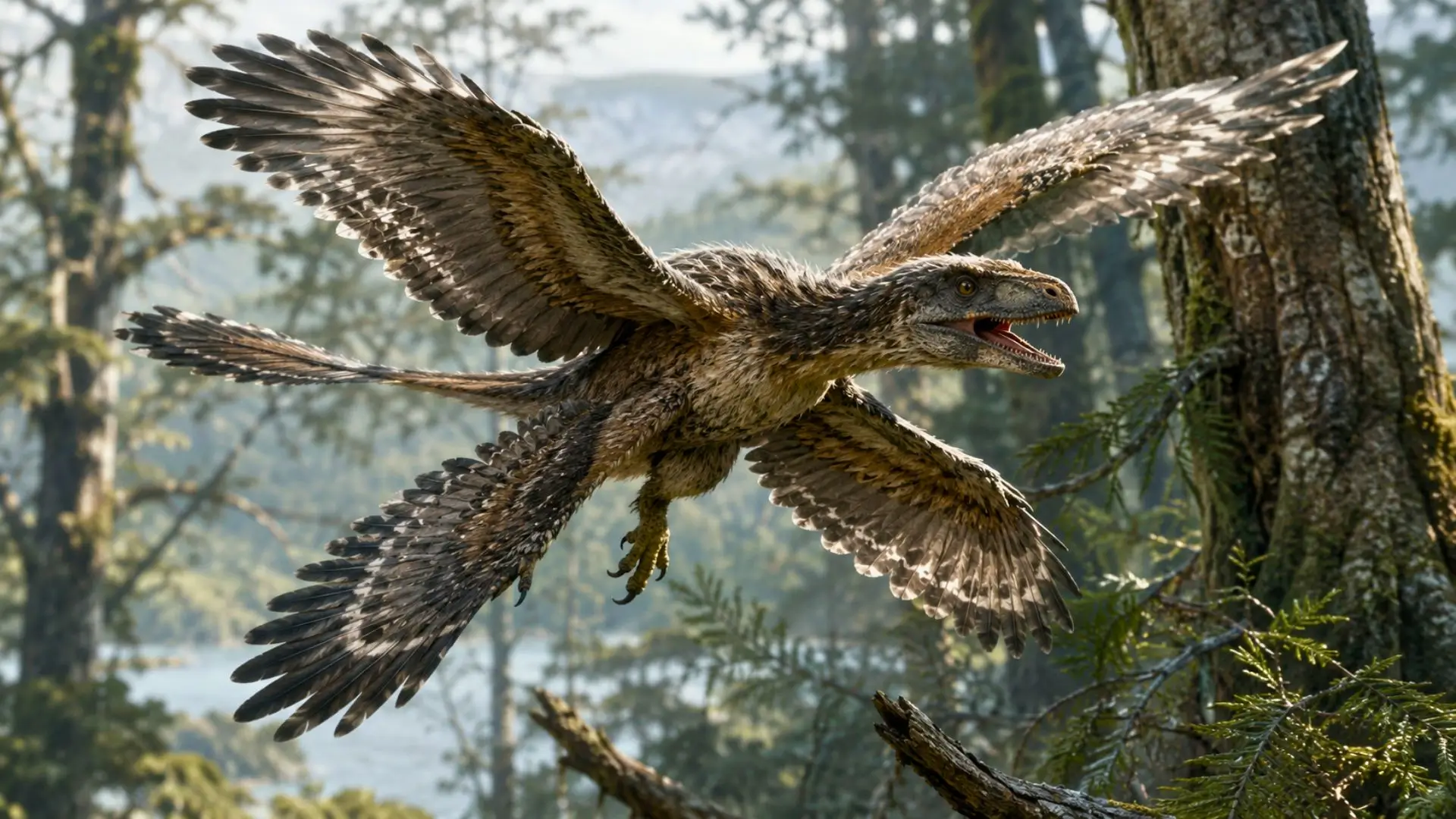
Paleontologists have identified the remains of a flying dinosaur dating back 120 million years in China. This four-winged predator, a close cousin of the Velociraptor, hunted the earliest birds in our history and sheds new light on the transition from reptiles to fliers.
A mysterious flying predator emerges from the past in the prehistoric forests of China’s Gansu Province
By examining sediments from the Xiagou Formation, scientists describe a new species dubbed Jian changmaensis in the journal Annals of Carnegie Museum. This animal lived about 120 million years ago within an ecosystem dominated by a large lake.
Consequently, this wooded area harbored a diverse fauna consisting of fish, turtles, and primitive birds. The microraptors fully exploited this environment to stalk their prey. Contrary to the giants of popular culture, these creatures were small in size and their bodies were entirely covered in feathers.
Three-dimensionally preserved bones reveal the unique anatomy of this distant Velociraptor cousin
Although the fossil is limited to a shoulder blade and a portion of the wing, its three-dimensional preservation is exceptional. Indeed, most specimens found in this region of China appear completely flattened by time, which often hampers precise anatomical analysis.
With these roughly ten-centimeter bones, researchers estimate the reptile’s wingspan at just over a meter. Thus, its build resembled that of a modern barn owl. Moreover, long feathers attached to its hind limbs gave it the silhouette of a four-winged dragon.
This discovery marks a first for the Changma Basin. Since 2002, paleontologists had recovered more than a hundred bird skeletons in the area. The appearance of this non-avian dinosaur disrupts our understanding of species distribution in this ancient lacustrine zone.
Fossil clues suggest this predator employed a hunting strategy akin to that of owls
At the excavation site, the presence of clusters of broken bones draws particular attention from experts. These formations closely resemble the pellets of regurgitation expelled by modern raptors. Owls, for instance, regurgitate indigestible elements such as the skeletons of their prey after a meal.
Although the definitive attribution remains unproven, several clues point to Jian changmaensis. This carnivore exceeded the size of the surrounding birds. Furthermore, the examination of the digestive systems of other related microraptors has already revealed fossilized remains of lizards, small mammals, and fish captured.
Thus, the scenario of a sit-and-wly strike hunting makes sense to scientists. The animal likely glided from tree to tree, mimicking the movements of today’s flying squirrels. It would then dive from the canopy to ambush and feed on the birds.
A direct biological witness to observe the evolutionary transition between dinosaurs and today’s birds
Beyond this lifestyle, this lineage holds major scientific interest. These creatures share features with both kingdoms, combining curved claws with aerodynamic feathers. Their bodies bear testimony to the physical changes guiding the evolution toward modern flight.
That is why the study of this specimen enables researchers to examine the early steps of this metamorphosis in real time. The researcher Matthew Lamanna even hopes that a future expedition will uncover the remainder of this fossilized skeleton to resolve the last mysteries surrounding its anatomy.

Contact details
Address:
Farmers Forum,
36, Dominick Street,
Mullingar,
Co. Westmeath,
Ireland
Phone:
+353 (0)44 9310206
Or email us:
For technical issues please check out our FAQ's page or email - [email protected]
For general Queries email - [email protected]
Request to add event to our Calendar - [email protected]
Send us your mart reports - [email protected]
Suggestions and feedbacks - [email protected]
News Items / Press Release - [email protected]
To Advertise on Farmers Forum - [email protected]