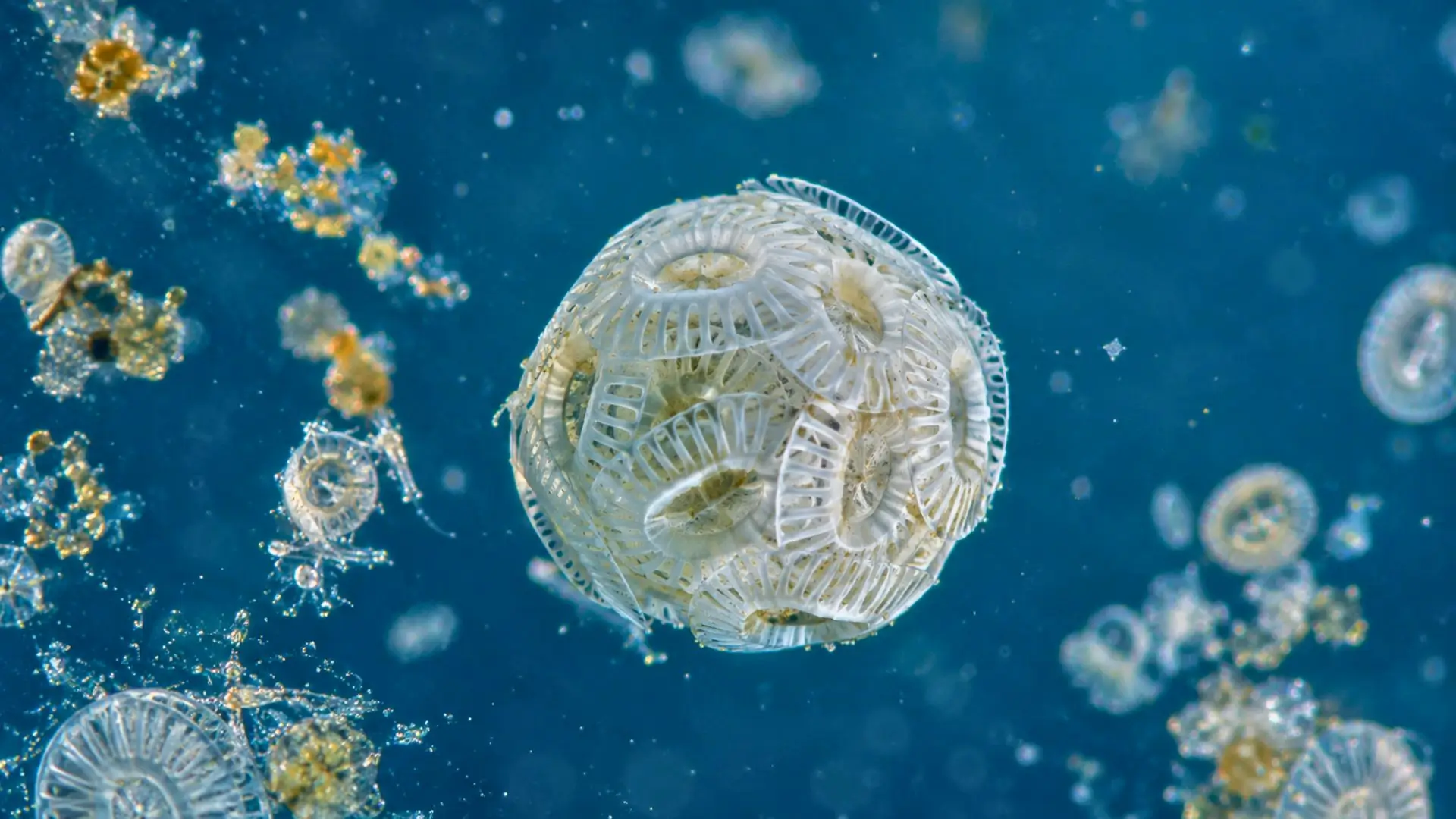
Below the surface, unseen organisms are building calcium carbonate armors that are essential to the ocean’s functioning. Yet these shells are becoming harder to manufacture. Could this microscopic shift herald a much larger upheaval in marine life and the climate?
Progressive Ocean Acidification Linked to Massive Absorption of Atmospheric CO₂
The ocean performs an immense service for humanity: it absorbs roughly a quarter of the CO₂ released by human activities. Without this colossal carbon sink, the pace of atmospheric warming would be even swifter. Yet the gas does not vanish. Once dissolved, it gradually alters the chemistry of the water.
CO₂ reacts with water to form carbonic acid, which then releases hydrogen ions. The result is a drop in the average pH of surface waters by about 0.1 units since the preindustrial era, corresponding to roughly a 30% increase in acidity. The change may seem small, but the pH scale is logarithmic.
Calcifying Microorganisms and the Central Role of Coccolithophores in the Ocean
Among the organisms affected are coccolithophores, single-celled algae that drift within the sunlit layers of the sea. Each one is encased in tiny plates of calcium carbonate called coccoliths. When assembled with remarkable precision, they form a protective mosaic that, under a microscope, resembles a sphere clad in sculpted tiles.
Their diminutive size belies a considerable influence. Coccolithophores participate in photosynthesis, support other living things, and produce a large portion of the living calcium carbonate found in surface waters. A study published in Nature Communications estimates that their calcite accounts for nearly 90% of the observed stock among the main pelagic calcareous producers.
When these organisms die, a portion of their plates sinks toward the depths. This flow of particles contributes to the carbon exchanges between the atmosphere, the surface, and the ocean floor. Their role remains intricate, because calcification can locally release CO₂, while the sinking organic matter promotes deep-sea storage.
Alteration of Calcification and Weakening of Marine Calcareous Structures
In more acidic waters, carbonate ions become less available. Yet they are among the raw materials needed to produce calcium carbonate. Some organisms must then spend more energy to build or maintain their skeletons. In several calcifying species, researchers observe disrupted growth, weakened structures, or increased dissolution.
However, the coccolithophores’ response is not uniform across species. It depends on the species, temperature, nutrients, and its capacity to adapt. Experimental work and fossil analyses reveal sometimes contrasting responses. The thinning of the plates thus constitutes a worrying signal, but not a blanket condemnation of all calcareous plankton.
Ecological and Climatic Consequences of Softer Plankton Shells in the Ocean
A shell that is only slightly thinner may seem trivial. Yet it can alter cellular protection, sinking speed, or the energy available for reproduction. On a large scale, these changes are likely to influence marine food webs, from zooplankton to fish that support many human communities.
The danger also stems from the accumulation of pressures. Acidification does not strike a static ocean: it adds to warming, deoxygenation, pollution, and nutrient fluctuations. The IPCC notes that these shifts already affect the distribution and abundance of organisms across multiple steps of the food chain.
Thus coccoliths become tiny archives of planetary change. Their thickness records the water’s composition, but also the speed at which human emissions move oceanic balances. The question may no longer be whether the sea is transforming, but how many microscopic signals must emerge before their message becomes impossible to ignore.

Contact details
Address:
Farmers Forum,
36, Dominick Street,
Mullingar,
Co. Westmeath,
Ireland
Phone:
+353 (0)44 9310206
Or email us:
For technical issues please check out our FAQ's page or email - [email protected]
For general Queries email - [email protected]
Request to add event to our Calendar - [email protected]
Send us your mart reports - [email protected]
Suggestions and feedbacks - [email protected]
News Items / Press Release - [email protected]
To Advertise on Farmers Forum - [email protected]