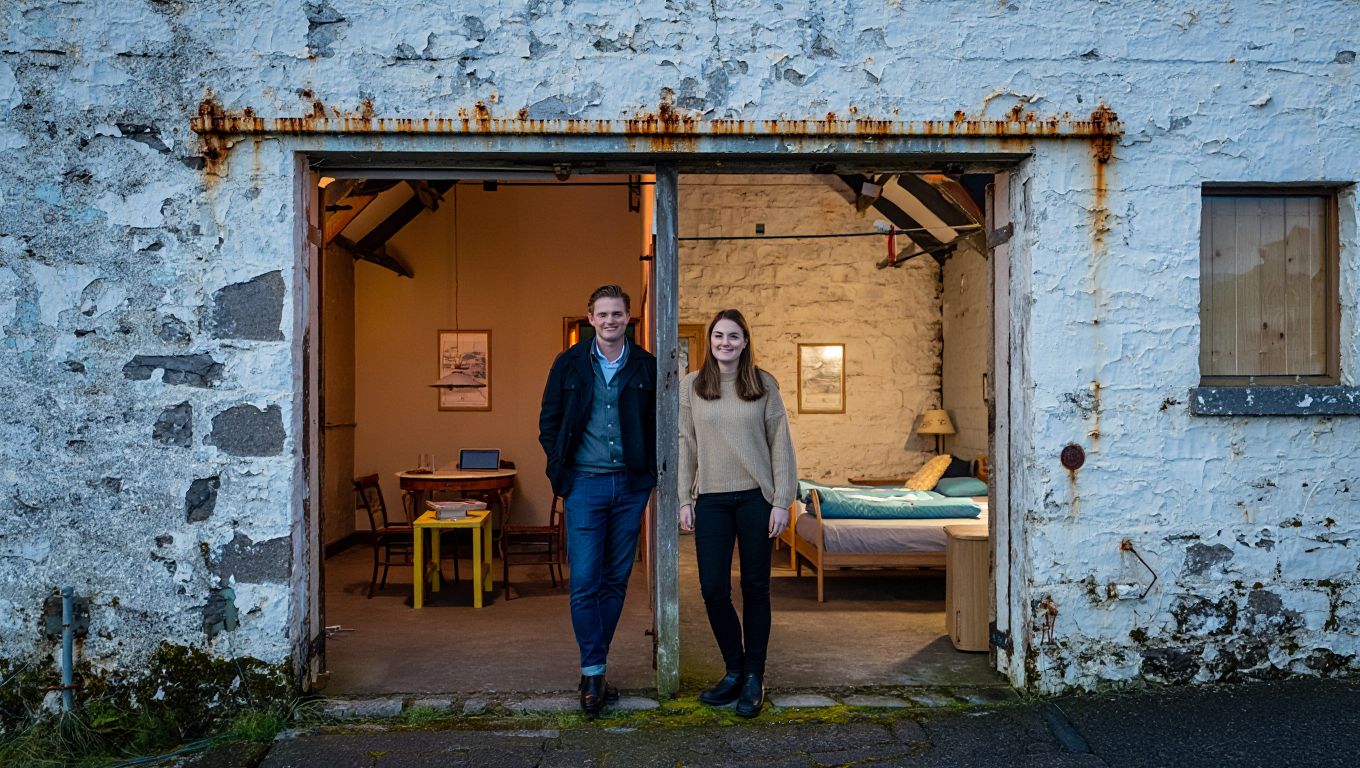
Salt hung in the air, and a gull stitched a loose line over the cove as the pair from Cashel unlocked the old boathouse door. They had traded school bells for tides, report cards for rust, and the rhythm of lessons for the metronome of waves. People shook their heads and smiled the kind of smile that hides a warning: “You’ll lose your shirt,” they said.
The leap from classrooms to coastline
They were both teachers, fluent in corridors and calendars, until the pull of the Atlantic got so loud it drowned out the intercom. “We kept circling the same map, tracing that peninsula, and then one day we stopped circling and drove,” says Maeve, her hand on the salt-scrubbed rail. Jamie, practical to a fault, laughed when the estate agent said “lifeboat station,” then stopped laughing when the wind flung open the shutters.
“Everyone told us we were mad,” Jamie says, “but the good kind of mad, the kind that keeps you awake.” They took their savings, sold the small house in Cashel, and signed for a structure more scar, more sculpture than home.
A building with a past, a future with purpose
The old station was muscle, not ornament. Granite shoulders, iron bones, a slipway once polished by timber and urgency. “We kept the boat rails,” Maeve says, “you can still follow them with your palm to the lip of the tide.” They scrubbed away flaking paint, but not the story, letting the place speak in echoes.
Inside, they carved two small rooms from the long hall, whitewashed and tight to the view. There’s a porthole over each bed, a shelf of borrowed books, and a stove that snaps like driftwood finding its voice. Every hinge was argued over, every socket measured against the spray. “We learned what ‘marine grade’ really means,” Jamie says, “and we learned it on a wet Tuesday.”
Crafting hospitality on the edge
The rooms aren’t luxe, but they’re honest. Hooks for wet coats, a kettle that flips its lid with a smile, woollen throws that carry a faint ghost of heather and smoke. Breakfast arrives in a basket: brown bread at 6 a.m., butter gold as a coin, eggs from a neighbor who raises hens with a poet’s patience.
“We don’t do TV,” Maeve says, “the water is the show.” Guests lean on the slipway wall and inventory the weather, counting whitecaps like sheep on a hillside. On clear days, a lighthouse winks its square little joke, and sometimes an otter leaves its calligraphy in the kelp.
Weather, work, and the economics of small
Romance has a bill, and the bill is paid in work. A gale can peel at the flashings, and every season chews a different edge. “We price for the year, not for a single August week,” Jamie says, “because the roof doesn’t care what month it is.”
They learned to listen to the wind, to tend the gutters like small, fussy gardens, to dry sheets in a room filled with warm rock and patient air. The numbers are spare, but they are theirs, and no school calendar could offer a line item called “porpoises at dawn.”
Year-round welcome, off-season magic
Summer is obvious, but winter is truth. The place glows low, a lantern on the shore, and travelers arrive with books and wellies and large, listening hearts. “January guests are our favorites,” Maeve says, “they arrive tired and leave newly quiet.”
There’s a ritual to the dark months: stew simmering under a lid, turf smoke feathering the gutters, a walk to the headland where the wind combs your thoughts until they lie flat and clean. “We tell people to bring layers,” Jamie grins, “and a plan to do almost nothing.”
What they’ve learned so far
- Start with what the building wants, then teach your own taste to listen.
- If the forecast says easterly, cancel the paint and fix the gutter.
- Keep the welcome simple: warmth, water, bread, and good light.
- Your neighbors are your harbor; trade fairly, ask gently, say thanks.
The community around the cove
A venture like this is never solo. There’s the baker who slips an extra loaf in winter, the boatman who knows which swell means storm, and the postmistress who runs messages like a village artery. “People were skeptical, but they were never unkind,” Maeve says, “they waited for us to show our work.”
Soon the rooms filled on weekends, then on Thursdays, then in the thin light of November. Word spread from mugs of tea and slow, admiring walks. The station became a small engine, purring into the local economy with each stay.
The long view
Some mornings, the sea lies glass-flat, and the pair feel almost forgiven. Other mornings, the horizon is all teeth, and the to-do list grows its own weather. They take turns naming the sky, keep a ledger that is part math, part prayer, and fix what they can before the next front rolls in.
“Madness got us here,” Jamie says, “but the dailiness keeps us sane.” Maeve watches a trawler turn, the wake combing the slipway into white runes, and nods. “The place is a kind of teacher,” she says, “and we are finally good students.”

How do I book this accommodation or what is the name of it please
Fantastic can I have number for them people so I can book a room please 🙏
Except they didnt.
what a beautiful read. The writer should write novels, wow so descriptive
Hi,
Love the story and project, how does one book. Is there a website?
I accidentally discovered this article, really enjoyed the writing.
What a beautiful, well written story
The very best of luck to you guys, well done
Life at a slow enjoyable pace, its what tge whole world wants and needs
Beautifully discriptive article ,so well written, the couple from Cashel made a big leap of faith but its paying off with their hard work and just making life a simple way of living for their guests, back to nature ,good food and kindness
Lifeboat station beara
Can you send me the details of accommodation that cashel couple regenerated
Best nelly