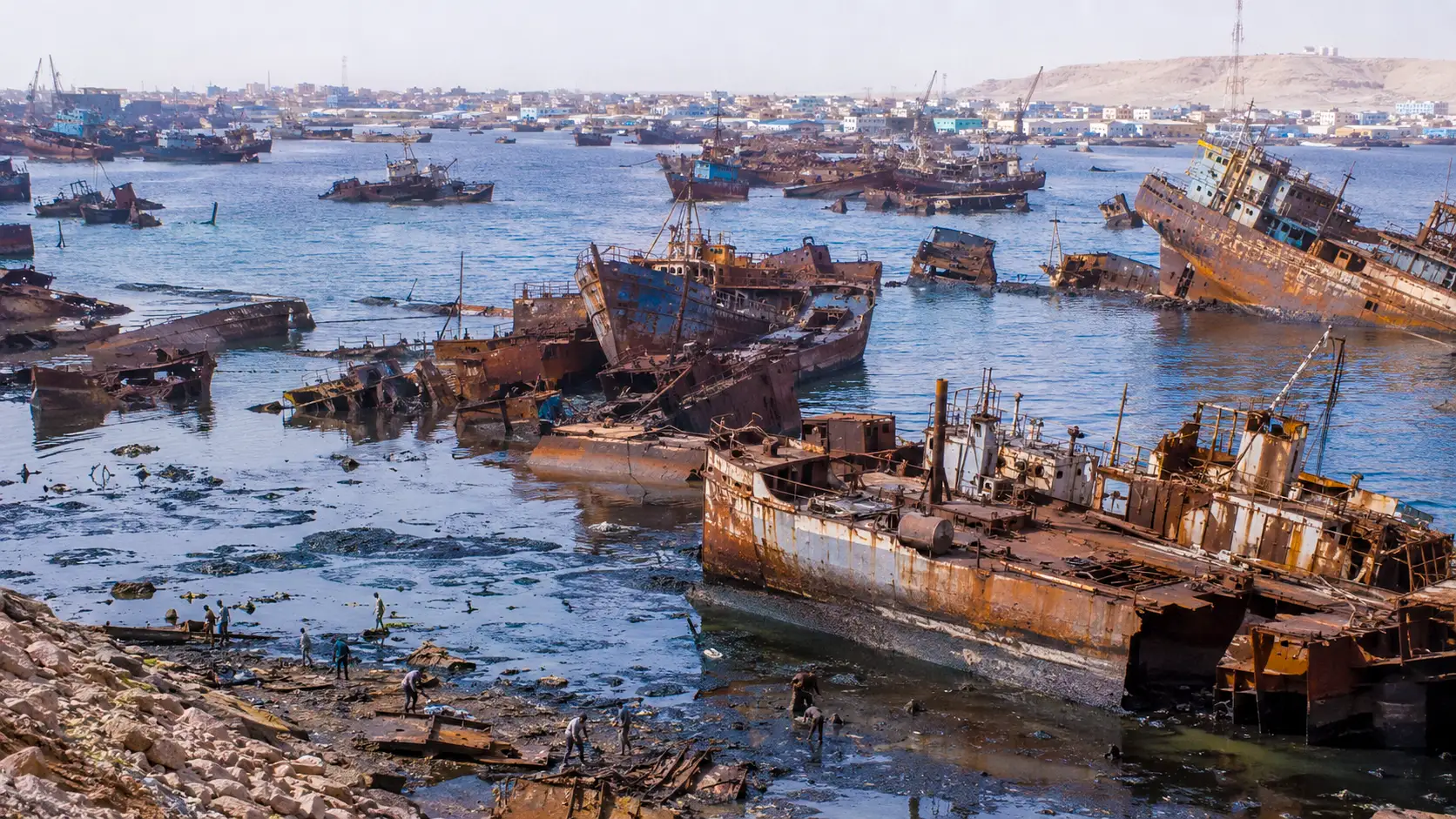
On the Mauritanian coast, about three hundred ship hulls have been rotting in the water since the 1980s. Abandoned by their owners to dodge recycling costs, these giant vessels shape an unreal landscape and profoundly threaten local ecosystems.
Nearly three hundred metal hulls are stacked just a few meters from the Mauritanian port of Nouadhibou
In the northern part of the country, the bay offers a singular maritime panorama. Weathered fishing boats share space with imposing, idle cargo ships. Their rusting metal frameworks rise from the shallow waters, in direct proximity to the town’s homes and port infrastructure.
Indeed, this site is now regarded by experts as one of the largest marine graveyards on the planet. The gradual accumulation of these ocean giants frozen in time marks the coastline with an exceptional scale and geographic spread.
Each immobilized structure reflects a path of abandonment or economic renunciation. This place constitutes a singular floating memory of global trade, where ships from very diverse origins end their lives far from their port of registry.
A low-cost ship-abandonment system took hold in Mauritania from the 1980s onward
During this period, the legal dismantling of a ship required expensive towings and adherence to strict standards. To avoid these heavy costs, many shipowners preferred to pay a simple local fee to strand their obsolete vessels in the bay.
Consequently, the lack of controls and suspicions of corruption favored the persistence of this informal economic model. The repetition of these wild deposits transformed a marginal practice into a phenomenon of broad scope, despite regular environmental warnings.
Toxic residues threaten local fishing while residents salvage the abandoned metals
Over time, the deterioration of metal under the action of salt releases harmful pollutants into the water. These hydrocarbon, heavy metal, and toxic paint infiltrations degrade the surrounding marine biodiversity, disrupting the activity of fishermen along the coast.
Yet, an informal recovery activity quickly developed around this maritime dump. Local residents cut the steel, extract cables, and resell reusable scrap to generate resources needed for their daily livelihoods.
Thus, the local population finds itself trapped in a delicate balance. Indeed, the same wrecks that provide immediate financial resources gradually destroy the fish stocks on which the entire community depends in the long term.
Dismantling operations led by specialists struggle to erase decades of pollution
To clean up the site, the Dutch company Mammoet Salvage has been commissioned to remove sixty priority structures. Teams deploy three Hitachi ZX870-3 heavy machines to cut through masses of steel weighing between 200 and 1,200 tonnes.
Nevertheless, the complete evacuation of these debris remains complex due to ecological risks during hull cutting. Despite efforts to tidy the coastline, this heavy industrial legacy will continue to mark the Mauritanian port for a long time.

Contact details
Address:
Farmers Forum,
36, Dominick Street,
Mullingar,
Co. Westmeath,
Ireland
Phone:
+353 (0)44 9310206
Or email us:
For technical issues please check out our FAQ's page or email - [email protected]
For general Queries email - [email protected]
Request to add event to our Calendar - [email protected]
Send us your mart reports - [email protected]
Suggestions and feedbacks - [email protected]
News Items / Press Release - [email protected]
To Advertise on Farmers Forum - [email protected]