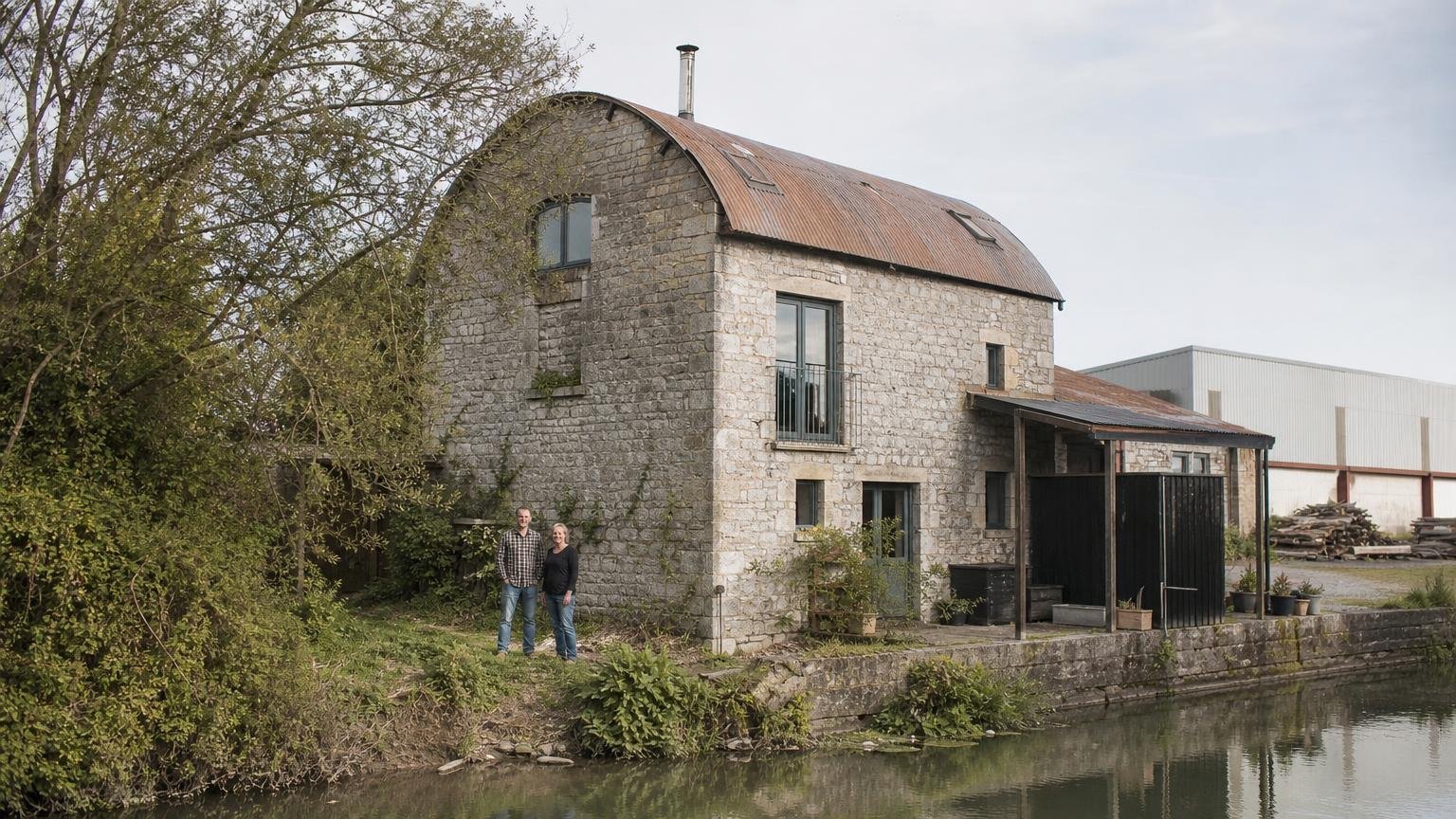
They moved in on a wet March evening, when the river was high and the last swallows had not yet circled back. For five years, Aoife and Mark have called a converted grain store on the Little Brosna home, their windows low to the water and their roofline stitched to reeds and sky. “We wanted small, not grand,” says Aoife, “and we wanted place, not postcode.”
Down by the weir
Their lane is narrow, the hedges thick with hawthorn, and the old store sits sideways to the current, its brickwork scarred but honest. You hear water before you see walls, a hush that turns thunder in winter. “Living here pulled our days into rhythm,” Mark says. “You learn the river’s moods like a neighbour’s.”
An old shell, a new spine
The building began as a grain store in the late nineteenth century, nothing fancy, just a robust rectangle with a tin hat and broad double doors. They kept the shell, stitched in a timber frame, and insulated with woodfibre and lime so the old brick could still breathe. The floors are poured concrete with a polished finish; the rafters are sanded, then oiled just enough to hold their grain.
“Whatever could be repaired was repaired,” Aoife says. “Whatever had to be new was kept humble.” A slim stove takes the evening chill, and the south wall folds open with hinged steel-framed glass to pull in light and reedsong.
The price of staying put
They bought the derelict store and its postage-stamp plot from a farmer who was “tired of foxes and kids climbing the roof.” With planning permission for residential reuse, they kept footprint and height, promising to let the river breathe with permeable paths and raised services. The entire project, from first sketch to first tea, came in under the price of an urban site. “The whole build cost less than a site in Dublin,” Mark says, not bragging, just relieved.
They spent on insulation, windows, and a drainage strategy; they saved on finishes, labouring themselves most weekends with the help of friends. “We had a rule,” Aoife says. “If it couldn’t be lifted by two people, it didn’t come in.”
Learning the water
Flood risk was the knot in the rope. A survey mapped the high line; their electrics are raised, their storage is floating, and the entrance lobby doubles as a boot room with slatted drains. In five winters, the yard has puddled and the reedbeds have filled, but the main floor has stayed dry. “We watch the upstream gauge like other people watch the weather app,” Mark says, half joking.
Rooms like sentences
Inside, the plan is simple: a long room stitched into two zones, with sleeping nests tucked behind a slatted oak screen. The kitchen is galley-narrow, a run of plywood cabinets and concrete worktop. “We chose materials that forgive our lives,” Aoife says. “We wanted to cook messy, not cook careful.”
There’s art on the brick, books on the ledge, and a desk facing water that never, quite, stops moving. In summer, they slide the doors and eat on the step; in winter, they stack kindling and listen for the owl that quarters the meadow.
Work, life, and the in-between
Mark writes software from the long table, his calls punctuated by swans and passing showers. Aoife runs workshops in the old yard, teaching people to patch lime and read grain. Their friends thought they’d miss the city, but they found a loop of small towns: coffee in Birr, timber from a sawmill upriver, theatre when the touring companies roll through.
“Distance changes your schedule,” she says. “It also changes your thresholds. When the sky puts on a show, you stop and watch.”
What they kept, what they let go
- They kept the envelope, invested in performance, and let go of gloss.
- They kept the footprint, planted for soakage, and let go of lawns.
- They kept their budget, moved at human speed, and let go of perfection.
The quiet arithmetic of place
Money is not the only line in the ledger, but theirs is clear: small space, low overheads, and the kind of comfort that comes from knowing your house by hand. They service the stove, oil the timbers, and sweep the gullies after every storm. “There’s always a task,” Mark says. “But each task teaches you the structure.”
Visitors arrive with questions—about planning, about damp, about cost—and leave with stories about herons and the particular way the river turns at dusk. It’s not a template, Aoife says, just a thread: take an old shell, listen to its limits, and make a life that is light on the ground.
Five winters, a thousand small moments
They remember the first frost that laced the meadow, the summer night the bats sketched parentheses above the door, the night the power flicked off and the stove kept their breath from ghosting the glass. “It’s ordinary,” Aoife says, “but it’s ours.”
On still mornings the Little Brosna carries their reflection like a note held long. On noisy ones it scolds and barrels past, a reminder that home is never just walls and roof, but the weather and work that bind you to a place. And when dusk settles, the old store looks new again, its windows lit like lanterns, the river saying what it’s always said: stay close, move lightly.

Contact details
Address:
Farmers Forum,
36, Dominick Street,
Mullingar,
Co. Westmeath,
Ireland
Phone:
+353 (0)44 9310206
Or email us:
For technical issues please check out our FAQ's page or email - [email protected]
For general Queries email - [email protected]
Request to add event to our Calendar - [email protected]
Send us your mart reports - [email protected]
Suggestions and feedbacks - [email protected]
News Items / Press Release - [email protected]
To Advertise on Farmers Forum - [email protected]