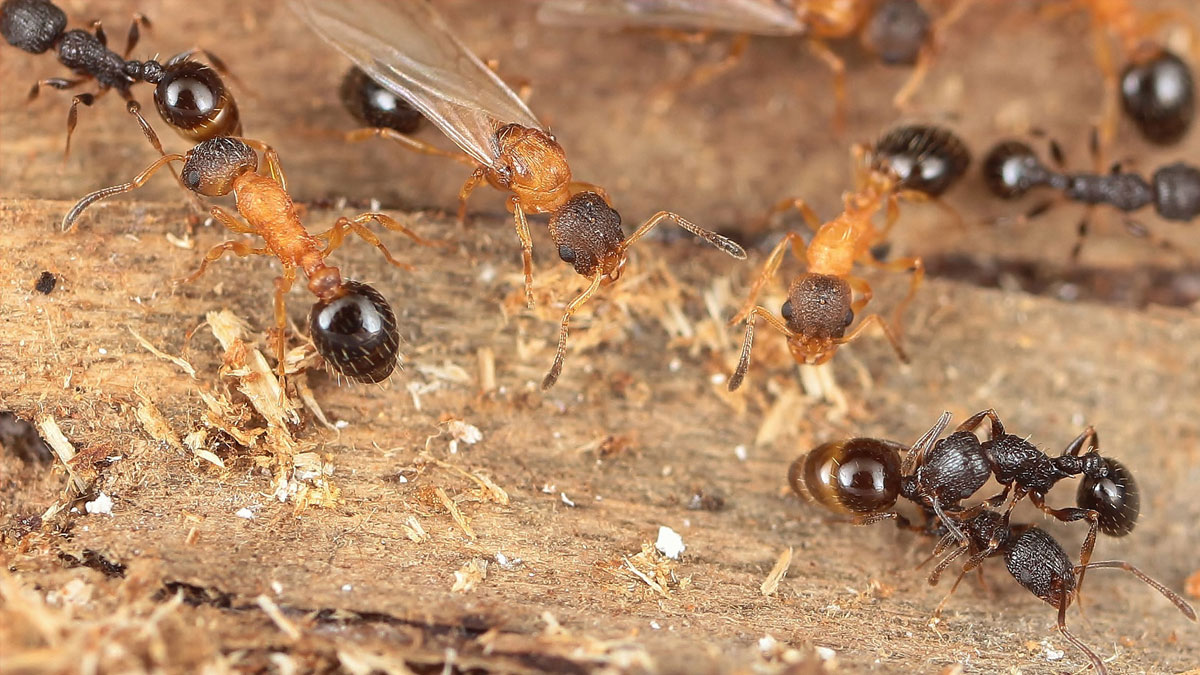
Des expériences impliquant les représentantes d’une espèce de fourmi parasite japonaise ont confirmé qu’il s’agissait exclusivement de reines, se reproduisant via parthénogenèse.
Temnothorax kinomurai
Generally, ant colonies typically consist of a queen, workers, and males with very short lifespans, who die soon after mating. For decades, there had been suspicion that the species Temnothorax kinomurai produced only queens, but definitive proof had not yet been obtained.
These insects seize the nests of the closely related Temnothorax makora, killing the host queen and some workers by stinging them. They then reproduce asexually through a process known as parthenogenesis, which essentially yields clones. The T. makora workers subsequently tend the larvae until they hatch.
In work published in the journal Current Biology, Jürgen Heinze, from the University of Regensburg, and his colleagues collected six groups of T. kinomurai, used to form laboratory colonies. Careful examination confirmed the complete absence of males, and that the offspring they produced consisted exclusively of queens.
A parasitic species of ant from Japan is the first ever found to have done away with both males and female workers – instead every individual is a queen that tries to take over the nests of other species. https://t.co/bE1HLx9wXw
— New Scientist (@newscientist) February 28, 2026
Of the 43 specimens given the opportunity to take control of colonies of T. makora, seven succeeded their “coup d’État,” giving rise to 57 descendants that were genetically identical to them.
A risky but rewarding strategy
As Heinze explains, invading colonies of other species is a risky strategy. But it often proves advantageous in the case of T. kinomurai.
“When parthenogenesis evolves as a result of a random mutation, as in T. kinomurai, queens can produce up to 100 clones, without needing to mate,” he summarizes. “The chances of perpetuating the species are then much higher than in species that reproduce sexually.”
According to the researcher, the behaviors documented represent the most advanced form of social parasitism observed in ants, underscoring the remarkable flexibility of these fascinating insects.
Previously, scientists had documented another fascinating strategy in a parasitic species, involving the emission of chemical compounds that drive the workers of a colony to kill their queen.

Contact details
Address:
Farmers Forum,
36, Dominick Street,
Mullingar,
Co. Westmeath,
Ireland
Phone:
+353 (0)44 9310206
Or email us:
For technical issues please check out our FAQ's page or email - [email protected]
For general Queries email - [email protected]
Request to add event to our Calendar - [email protected]
Send us your mart reports - [email protected]
Suggestions and feedbacks - [email protected]
News Items / Press Release - [email protected]
To Advertise on Farmers Forum - [email protected]