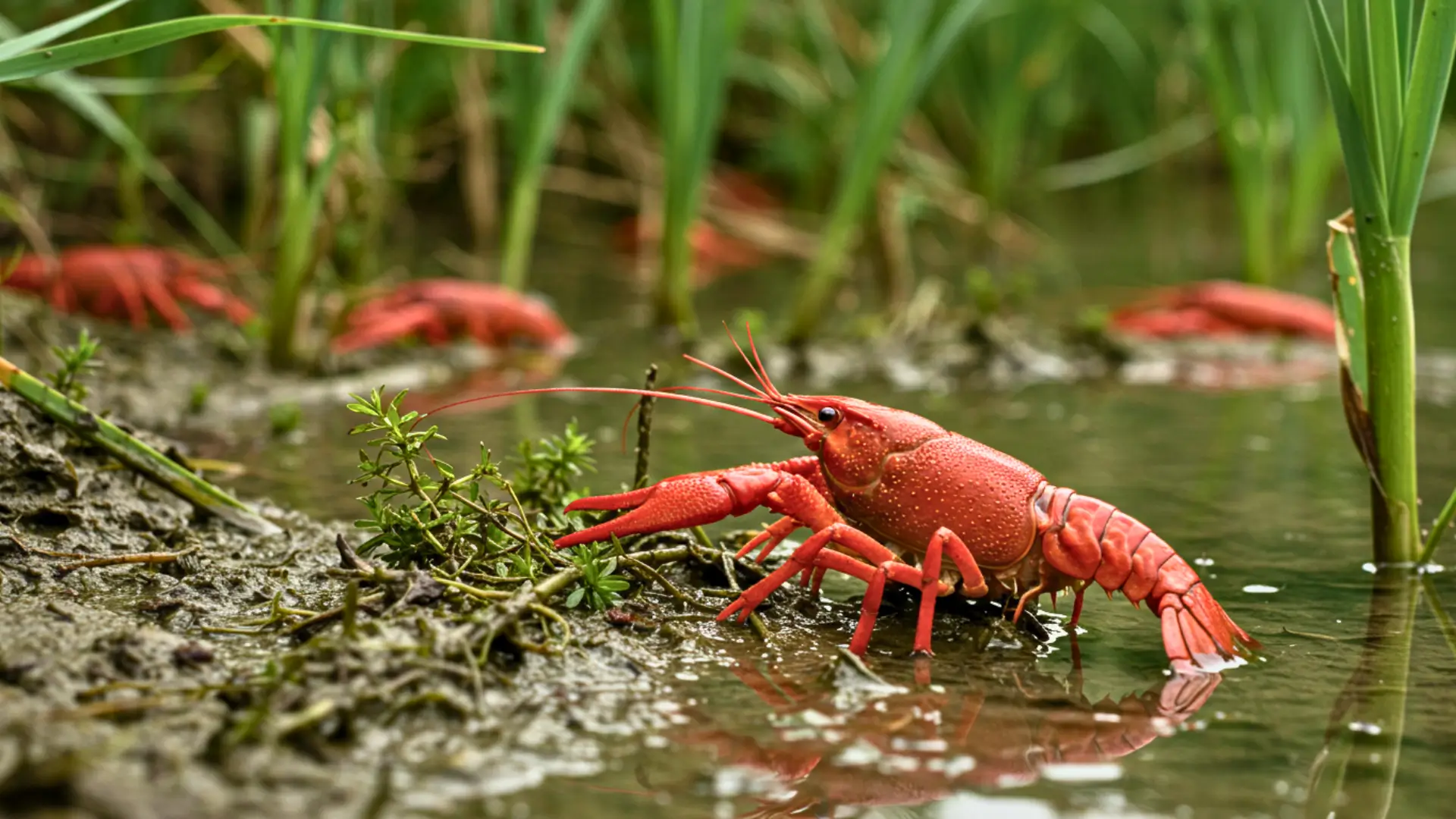
Introduced to France in the 1970s for culinary use, the Louisiana crayfish now colonizes rivers, wetlands, and gardens. Its remarkable adaptability makes this species a genuine ecological challenge for biodiversity and the management of aquatic habitats.
The Louisiana crayfish’s exceptional adaptability across French aquatic environments
The players in the food trade imported the Louisiana crayfish in the 1970s. Since then, the species has readily acclimated to European aquatic settings. This American crustacean tolerates wide temperature fluctuations. It also withstands low oxygen levels in water and long dry spells.
Its survival strategy also rests on its ability to dig deep burrows in damp soils. When conditions become harsh, the creature hides there for several weeks. This technique helps it avoid heat, frost, or a lack of water.
A rapid reproduction and an omnivorous diet that accelerate habitat colonization
The spread of the red crayfish also hinges on highly effective reproduction. A female can produce several hundred eggs. She can also reproduce multiple times a year when the environment remains favorable.
This demographic dynamic enables the species to quickly colonize new habitats. Agricultural ditches, lakes, marshes, and rivers become favorable territories. Flooded zones also provide ideal conditions for this highly adaptable crustacean.
In addition to its rapid reproduction, the animal possesses an omnivorous diet. It consumes aquatic plants, invertebrates and insect larvae. Fish eggs also figure in its diet. This dietary diversity facilitates its establishment in numerous ecosystems.
Aquatic ecosystems weakened by a highly competitive invasive species
The massive presence of the invasive crayfish disrupts natural equilibria. By consuming large amounts of aquatic vegetation, it gradually degrades certain habitats. Many fish and amphibians nonetheless rely on these environments as refuges and breeding grounds. This ecological pressure also creates direct competition with the European native crayfish.
Pollution already weakens these local species. The progressive loss of their natural habitats further increases their vulnerability. More concerning still, the species carries a parasite responsible for the crayfish plague. This fungus rapidly kills European species. Their bodies have no natural defense against this pathogen.
Intensive fishing and ecological management: strategies to curb the expansion in France
In response to this spread, several regions encourage intensive fishing of the Louisiana crayfish to limit its proliferation. The aim is to reduce local populations while raising public awareness about the ecological risks associated with this invasive species.
Some communities are also testing ecological management actions. Local authorities monitor wetlands more closely. They also launch habitat restoration projects. Managers of aquatic environments also inform fishermen to curb its spread.

Contact details
Address:
Farmers Forum,
36, Dominick Street,
Mullingar,
Co. Westmeath,
Ireland
Phone:
+353 (0)44 9310206
Or email us:
For technical issues please check out our FAQ's page or email - [email protected]
For general Queries email - [email protected]
Request to add event to our Calendar - [email protected]
Send us your mart reports - [email protected]
Suggestions and feedbacks - [email protected]
News Items / Press Release - [email protected]
To Advertise on Farmers Forum - [email protected]