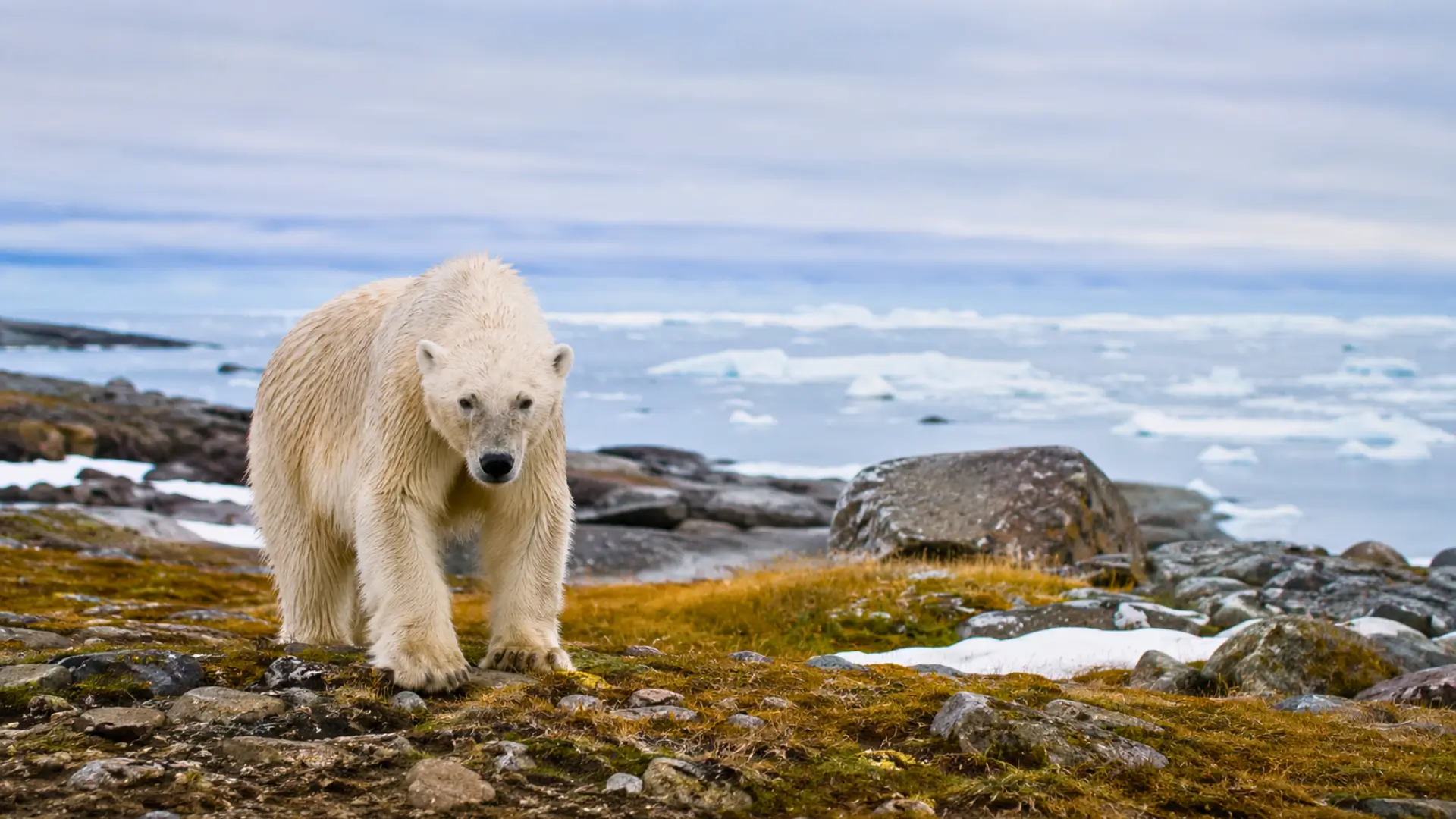
When the ice disappears for longer periods, the polar bear loses not only its hunting ground. It loses time, energy, and then weight. A recent study shows that even the most intuitive strategies no longer suffice. And perhaps that is where the story becomes frankly alarming.
The Lengthening of Ice-Free Summers Upends Polar Bear Survival
For a long time, the image seemed almost straightforward: a predator built for ice, forced to wait for its return to resume hunting seals. Yet, in the western Hudson Bay, Manitoba, that waiting period stretches out. Now, the ice-free summer lasts longer, and this shift changes everything, even down to the intimate mechanics of survival.
It’s not simply a question of landscape. The polar bear is a behemoth built for fat, not for nibbling on whatever it finds on the tundra. Indeed, where a grizzly can diversify its diet, the polar bear depends on one highly specific, rich, dense, almost irreplaceable resource: seals captured from the sea ice.
Tracking Twenty Bears Reveals an Energy Loss Impossible to Compensate
To understand what is at stake on land, researchers at the Alaska Science Center of the USGS observed twenty polar bears for 19 to 23 days, from August to September, between 2019 and 2022. For this, they combined cameras, GPS collars, measurements of energy expenditure, and pre/post weights: until now,如此精细的夏季监测少有尝试。
The result, published on February 13, 2024, in Nature Communications, cuts short a seductive idea. On average, the bears studied lost nearly a kilogram per day. In other words, even when they moved little, even when they explored, even when they tried to eat, the energy balance remained unfavourable.
The detail is, however, even more striking. Some males spent more than 40% of their time looking for something to swallow: berries, grasses, kelp, carcasses of birds or caribou. Meanwhile, others laid down to conserve their energy. In the end, only one bear managed to gain weight, thanks to a rare stroke of luck: the carcass of a marine mammal washed ashore.
Terrestrial Diet Cannot Replace Hunting Seals on the Ice
In recent years, a hypothesis has repeatedly resurfaced: what if the polar bear eventually adopted a behavior closer to that of a grizzly? On paper, the idea is intriguing. Yet in practice, the body tells a different story. A male polar bear can reach about 600 kilograms, with energy needs that are not comparable.
That is precisely where the comparison cracks. Grizzlies know how to exploit varied terrestrial resources, whereas the polar bear remains extremely specialized. Yet its metabolism demands prey that are very high in lipids, and the land offers only a makeshift menu. In short, enough to sustain a little, not enough to endure seasons without ice that keep growing longer.
In Hudson Bay, the Most Vulnerable Bears Are Already Paying the Price of Warming
This study does not exist in a vacuum. In the western Hudson Bay, the polar bear population has already declined by about 30% since the 1980s, while the ice-free season has lengthened by several weeks. Thus, what sensors report aligns with what field observations have shown for decades: reserves are being depleted faster.
Not all bears will pay the same price, however. Researchers emphasize particularly that young individuals and females with cubs are the most exposed. When energy is scarce, it is often the most fragile organisms that falter first. Hunger never strikes in perfectly equal measure, even among apex predators.
Perhaps the most troubling aspect lies in this quiet reversal. For a long time, the polar bear served as a symbol of climate change because it seemed to summarize a distant threat. Now it embodies something else: a very concrete biological limit. From then on, the question is no longer only whether it will adapt, but how long a ice-hunting predator can still endure on a land that has never truly fed it.

Contact details
Address:
Farmers Forum,
36, Dominick Street,
Mullingar,
Co. Westmeath,
Ireland
Phone:
+353 (0)44 9310206
Or email us:
For technical issues please check out our FAQ's page or email - [email protected]
For general Queries email - [email protected]
Request to add event to our Calendar - [email protected]
Send us your mart reports - [email protected]
Suggestions and feedbacks - [email protected]
News Items / Press Release - [email protected]
To Advertise on Farmers Forum - [email protected]