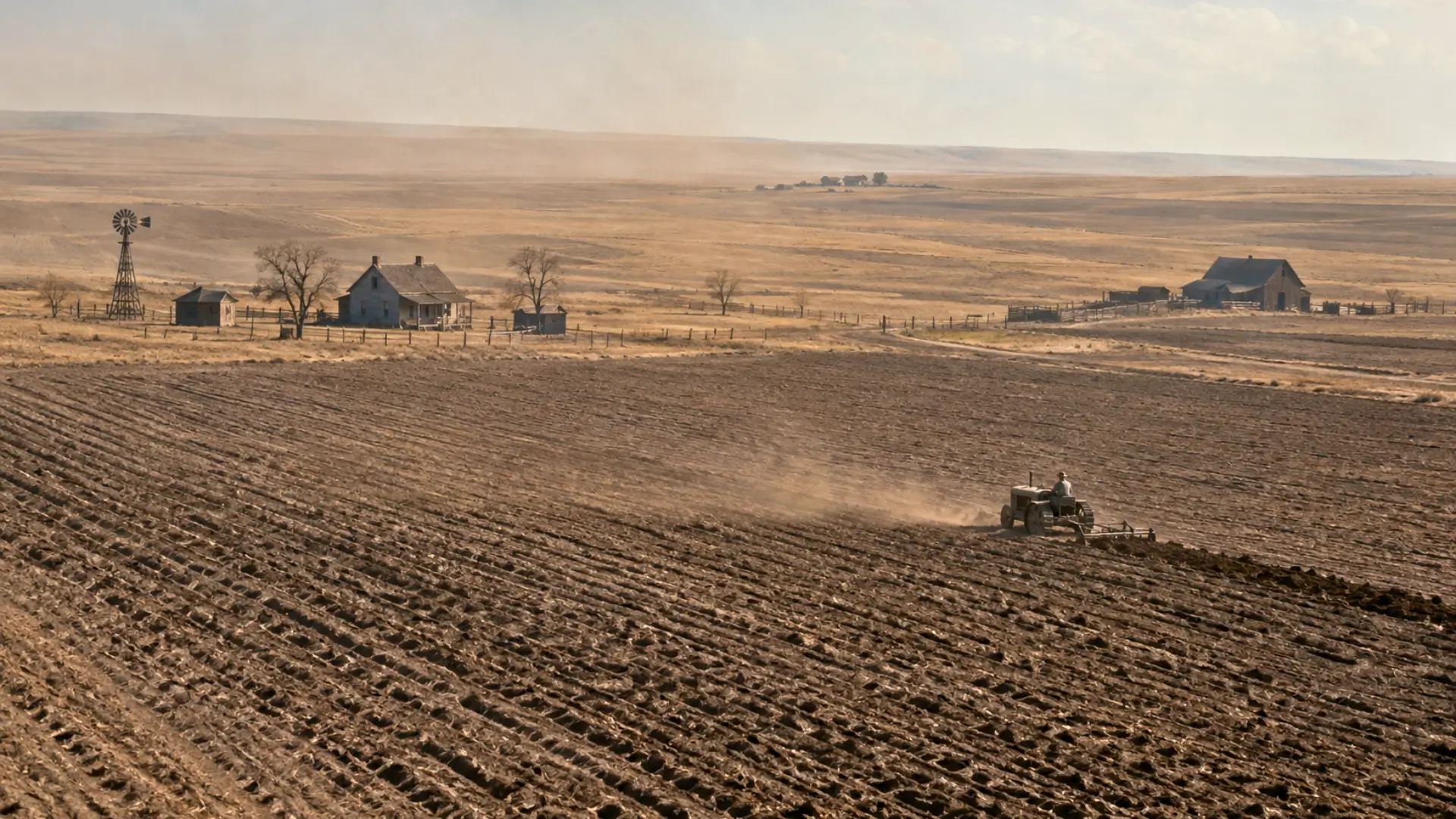
How could wheat fields send their soil to the middle of the Atlantic? In the 1930s, a combination of drought, mechanization, and intensive tillage turned the American Great Plains into a gigantic dust factory.
Before the catastrophe, millions of acres of prairie seemed destined for wealth
At the dawn of the twentieth century, wheat looked like a tremendous opportunity. World War I spurred demand. Prices encouraged production, and machines allowed work to go faster. In the Great Plains, the natural prairie receded. Tractors and plows opened surfaces that had been untouched.
In the 1920s, expansion ran wild. More than 33 million acres, about 13 million hectares, were turned over in a region already fragile. The grasses of the prairies were not merely decorative. Their deep roots stabilized the soil. They also helped it endure droughts and violent winds.
When the rain disappears, bare fields become a gigantic dust reservoir
Then the sky closed in. Starting in 1931, several droughts struck the Plains. The crops withered. They left behind dry, crumbly, exposed soil. Climatic studies by NASA have since revealed a striking fact. The drought of 1934 was exceptionally severe, even by the standards of centuries.
The problem isn’t solely climatic. The National Drought Mitigation Center also points to poor farming practices. The exploitation of marginal lands further weakened the region. Some conservation techniques were abandoned. The disk plow, highly effective at turning over the prairie, also removed the vegetal cover that held the soil in place.
When crop prices collapsed during the Great Depression, the trap closed. To offset losses, some farmers cultivated more land. Produce more to earn less seemed logical in the short term. Yet the soil was already vulnerable. Deprived of vegetation and exposed to the wind, it became a catastrophe waiting to happen.
In May 1934, 350 million tons of earth literally crossed the United States
On May 9, 1934, dust began rising above the Great Plains. The winds carried it eastward. The cloud thickened as it traveled. In two days, around 350 million tonnes of particles would have reached the eastern coast. A mass difficult to imagine on a human scale.
In New York, the dust infiltrated everywhere and greatly reduced visibility. But the phenomenon became almost surreal over the ocean. Ships located about 300 miles from shore reported deposits on their decks. The soil torn from the American plains truly reached the Atlantic.
The “Black Sunday” finally makes soil erosion a national affair
On April 14, 1935, another wall of dust engulfed the Great Plains. This “Black Sunday” sometimes reduced visibility to near zero. Entire communities plunged into darkness in broad daylight. It is in the wake of these storms that the term “Dust Bowl” settled permanently into the American lexicon.
Washington then understood that erosion affected more than a handful of farmers. In April 1935, the government created the Soil Conservation Service, the ancestor of today’s Natural Resources Conservation Service. New practices spread. Terracing, crop rotations, contour plowing, and vegetative cover became weapons against erosion.
These practices helped make subsequent droughts less destructive. The return of rainfall also played a crucial role. The Dust Bowl thus reminds us of a rule that still holds: fertile soil is not an inexhaustible resource. A few seasons can undo what ecosystems took centuries to build.

Contact details
Address:
Farmers Forum,
36, Dominick Street,
Mullingar,
Co. Westmeath,
Ireland
Phone:
+353 (0)44 9310206
Or email us:
For technical issues please check out our FAQ's page or email - [email protected]
For general Queries email - [email protected]
Request to add event to our Calendar - [email protected]
Send us your mart reports - [email protected]
Suggestions and feedbacks - [email protected]
News Items / Press Release - [email protected]
To Advertise on Farmers Forum - [email protected]