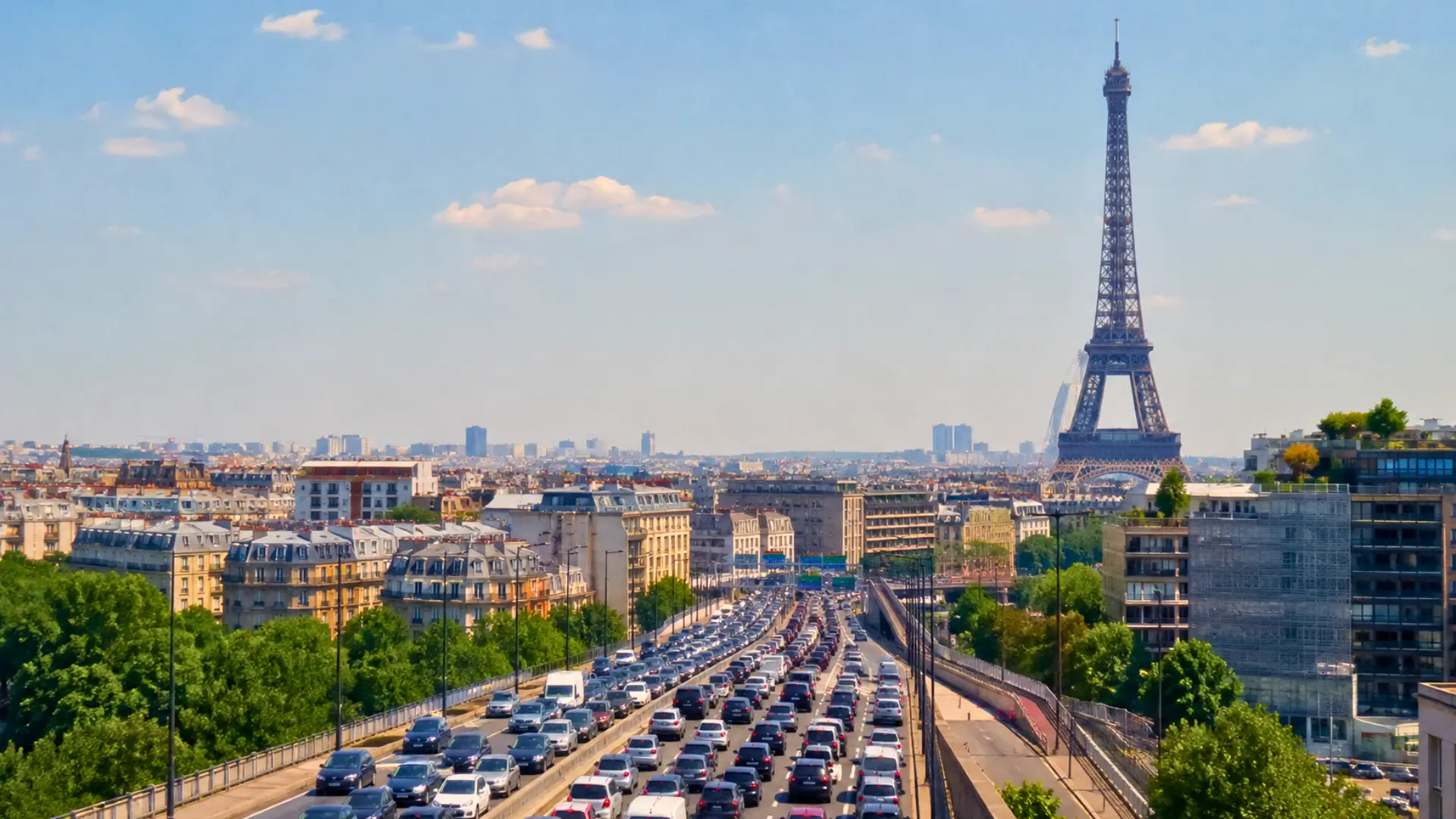
For ten days, an invisible pollutant accompanied the Île-de-France heatwave, reaching as high as 240 µg/m³. Why is ozone, valuable at high altitudes, dangerous near the ground? The exceptional June 2026 episode mainly reveals what hotter summers could change.
Ten days under invisible pollution, a scenario rarely observed so early in the year
From June 18 to 27, 2026, the Île-de-France region experienced an episode unusually tenacious. Airparif recorded concentrations ranging between 160 and 200 µg/m³ for several days. The level then climbed to 240 µg/m³ on June 27. Such persistence remains rare for this time of year.
The meteorological backdrop was steeped in extremes. France endured an early and sustained heatwave, from June 17 to 30. On June 24 and 25, the national 24-hour average temperature rose to 30 °C for the first time since 1947. The atmosphere thus gathered nearly all the conditions necessary for ozone formation.
Up there it protects us, down here ozone becomes an aggressor to the lungs
The strangeness begins with a chemical paradox. In the stratosphere, tens of kilometres above, the ozone layer filters part of the ultraviolet rays. Closer to the ground, this very molecule changes its role. Tropospheric ozone becomes harmful to living beings.
Even more surprising, no chimney directly emits this pollutant. Ozone appears when the Sun transforms a cocktail of precursor pollutants. This mix includes nitrogen oxides and volatile organic compounds. Traffic, industry and combustion supply the ingredients. The solar radiation then triggers the chemical reaction.
Hot, bright, and lightly windless afternoons thus create an ideal ground. Heat accelerates the reactions. Stagnant air also prevents the pollutant from dispersing. Santé publique France notes that heat and pollution can combine their effects. The risks related to ozone therefore rise on days of very hot conditions.
A tiny molecule capable of triggering a real reaction in the respiratory tract
Ozone does not form dramatic fog or black smoke. Yet its strong oxidizing power can irritate the airways. It can also provoke inflammation. Cough, breathing difficulties and reduced lung function are among the possible effects. Children, individuals with asthma and athletes remain particularly vulnerable.
Health data adds another dimension to the problem. Anses associates ozone exposure with the aggravation of asthma. It also notes more emergency-room visits. Santé publique France estimates that chronic exposure to ozone could be linked to almost 500 respiratory deaths per year in France. This figure concerns only deaths related to this pollutant’s impact on respiration.
There is, however, a crucial nuance. Peak concentration levels have fallen over the decades. Airparif recalls 282 µg/m³ in August 2003, compared with 357 µg/m³ in July 1994. The decline of certain precursors demonstrates that anti-pollution policies yield results. Yet ozone remains difficult to control.
This June record may already tell us something about Île-de-France summers of tomorrow
Climate change complicates this improvement. The warm, sunny episodes favor photochemical reactions. The fight against ozone therefore risks becoming longer and more intricate. Airparif already notes a trend that differs from that of other polluting agents in the Île-de-France region. Ozone levels do not show a sustained long-term decline.
During peak periods, it is wise to reduce strenuous outdoor physical activity. Cooler moments are preferable. Following air-quality bulletins also helps limit exposure. But individual actions alone are not enough. It is essential to curb emissions from combustion, as they supply the precursors to which ozone indirectly feeds.
The June 2026 episode reads less like a meteorological curiosity and more like a real, large-scale warning. Record heat, persistent sunshine and photo-chemical pollution converged unusually early. If such situations become more frequent, we will need to rethink how we manage heatwaves. The question will stop being merely how to endure the heat, and will instead concern what air to breathe during these episodes.

Contact details
Address:
Farmers Forum,
36, Dominick Street,
Mullingar,
Co. Westmeath,
Ireland
Phone:
+353 (0)44 9310206
Or email us:
For technical issues please check out our FAQ's page or email - [email protected]
For general Queries email - [email protected]
Request to add event to our Calendar - [email protected]
Send us your mart reports - [email protected]
Suggestions and feedbacks - [email protected]
News Items / Press Release - [email protected]
To Advertise on Farmers Forum - [email protected]