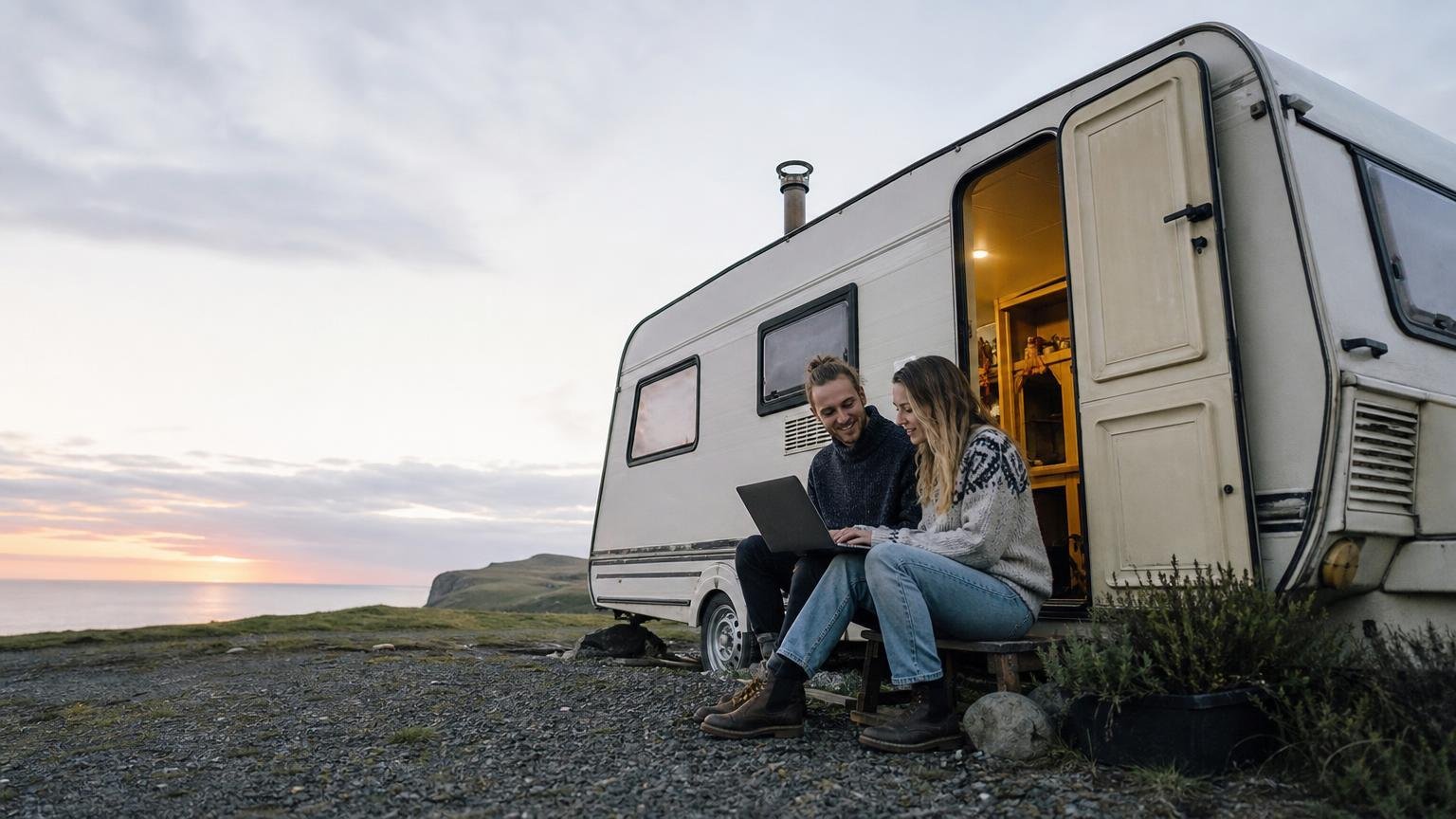
They were both 26, both tired of splitting rent with strangers, and both itching for a swap of skyline for sea. In the end, Orla and Ciarán didn’t just move neighbourhoods; they traded an overfull Dublin house share for a white caravan perched on a Mayo headland, where gulls spiral and broadband hums. “We wanted to feel space again,” Orla said, “and hear something other than traffic through the window.”
The caravan is small, the horizon endless, and their work—UX design for her, content strategy for him—travels neatly inside laptops and a weatherproof router. “We still clock our hours,” Ciarán said, “but the clock feels kinder when the Atlantic is your screensaver.”
Leaving a crowded city for a bigger sky
Dublin’s rents had crept from worrying to absurd, and the flat’s fourth housemate was mildew in the bathroom. “It wasn’t just the money,” Orla said. “It was the noise, the queue for the kettle, the permanent sense of being temporary.”
They’d always talked about decamping west, but it took a single Sunday drive in February—rain on windscreen, gulls like paper kites—to seal the deal. A fortnight later, they’d found a second-hand caravan, a sympathetic landowner, and a sliver of clifftop that felt like a promise.
Turning a caravan into a living, breathing home
The caravan’s first gift was silence; its first challenge was damp. They stripped vinyl, resealed windows, and tucked insulation behind thin walls. A wedge of oak became a fold-down desk, and fairy lights—cliché but gentle—softened the wind’s edge.
Power comes from solar panels and a cautious battery bank, topped up by a quiet generator on stubborn days. Water is a blend of rain collection and a neighbour’s outdoor tap, with a compact filter that hums like a distant bee. A composting loo made its case on day one: simple, practical, not nearly as grim as the internet warns.
“We wanted something light-touch,” Ciarán said. “If we leave, the ground should look unchanged, apart from a few flattened daisies.”
Work that rides the weather, and weather that sets the pace
They ordered a satellite dish after the third Zoom froze mid-nod. Now the latency is low, the speeds are honest, and meetings rarely blink. Mornings start with coffee steaming against a cold pane, a quick scan of swell charts, and a pact: work first, ocean later.
Storm weeks are a different beast. The caravan shudders like a drum, and conversation turns to checklists and charge levels. “You feel the weather here,” Orla said. “It’s not outside your life; it’s part of it.” On calmer days, seals bob like grey punctuation, and the afternoon light makes their to-do lists kinder.
What it costs, and what it saves
The numbers told a simple story. Two rooms in the capital versus a rolling tin room with a vast view. They broke it down on an envelope, then typed it up with tea rings drying at the edges.
- Caravan purchase: €7,800; monthly site contribution to landowner: €150; broadband: €95; power (solar plus generator fuel): €35–€60 depending on weather; total living costs down roughly 40–50% from Dublin’s baseline.
“The money mattered,” Ciarán admitted, “but the real dividend is hours we don’t commute, and evenings that start with sky rather than screens.”
Neighbours, gulls, and finding your own pace
Community here is smaller, but not thin. The nearest town is a drive, but the shopkeeper knows their names, and the surf-club WhatsApp is lively on windy Fridays. They learned to bring their own containers to the fish van, and to say thanks with fresh bread still warm in the bag.
They also learned to set boundaries. “Working where you live can blur the edges,” Orla said. They mark quitting time with a walk along the cliffs, phones in pockets, talk loosening like shoelaces. The goal isn’t to work less, but to work with more texture, more air beneath the hours.
Hard truths on a windy ledge
Not every day is Instagram. Mornings can be raw, condensation beads like tiny arguments, and a flung gust can rattle nerve and shelf. Repairs are constant, deliveries can go astray, and a week of rain turns the track to pudding.
They’ve made rules. Keep three days of water, four days of food, and one day of unplanned joy. Charge devices by midday, stack towels on the heater, and never pretend a storm is smaller than it is. “Resilience is a muscle,” Ciarán said. “You build it by using it.”
What living on the edge taught them
They’ve become fluent in small workarounds and big skies. Success looks less like square footage and more like a tide chart on the fridge, like dinner eaten with sandy hair and an open door. “I used to chase the next thing,” Orla said. “Now I chase a patch of light across the floor and call that enough.”
Asked if they’ll stay, they smile like people who’ve learned not to make forever promises. “We’ll ride the season,” they said, “and keep the caravan honest and our work good.” For now, the wind is talkative, the kettle sings, and the world arrives on a silver dish, then leaves them to the sound of their own breathing.

Contact details
Address:
Farmers Forum,
36, Dominick Street,
Mullingar,
Co. Westmeath,
Ireland
Phone:
+353 (0)44 9310206
Or email us:
For technical issues please check out our FAQ's page or email - [email protected]
For general Queries email - [email protected]
Request to add event to our Calendar - [email protected]
Send us your mart reports - [email protected]
Suggestions and feedbacks - [email protected]
News Items / Press Release - [email protected]
To Advertise on Farmers Forum - [email protected]