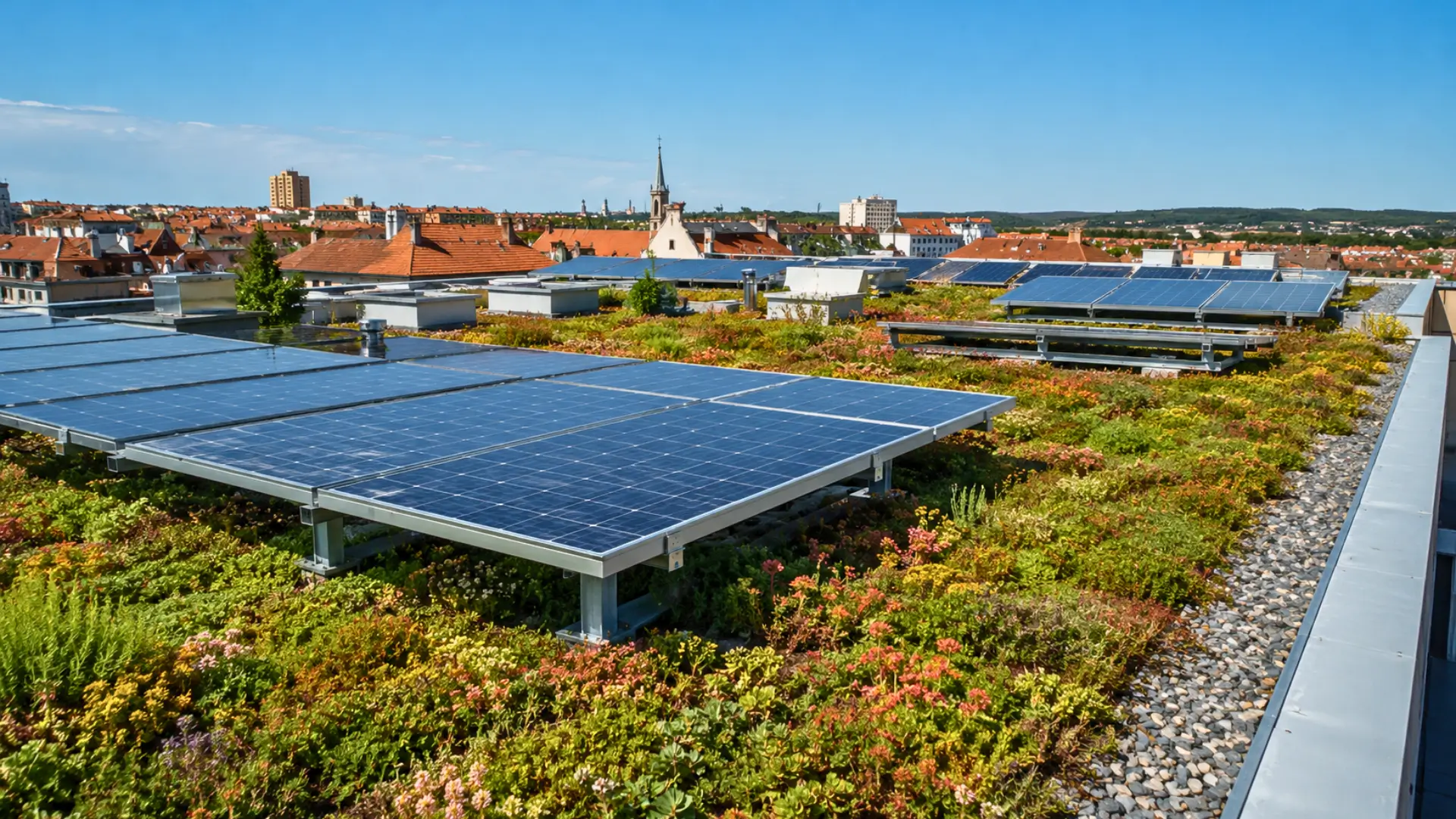
Under a blue sky and heat bearing down on the roof tiles, it would seem that solar panels should be breaking records. Yet, during heat spikes, production can dip. And what if the best defense wasn’t a fan or expensive technology, but a carpet of plants?
Summer heat reduces solar yield well before temperature records are reached
At first glance, the equation seems unbeatable. The harder the sun shines, the more a panel should produce. Yet, on a rooftop in mid-July, the useful light is often accompanied by penalizing heat. Photovoltaic cells love radiation. They tolerate overheating far less, which disrupts their operation and gnaws away at the expected gain.
The reference threshold for panels is set around 25°C under standard test conditions. Beyond that, power declines gradually. The IEA PVPS reminds us that performance depends directly on the module temperature. For many silicon panels, the loss runs at about 0.3 to 0.5% per extra degree.
On a dark roof, the gap quickly becomes dramatic. Even with air at 30°C, the surface temperature of a module can climb much higher. Depending on the configuration, it can reach very severe levels. The NREL notes that poorly ventilated modules heat up more. This reduces both immediate output and, in the long run, the lifespan of the components.
A green roof cools the roof and shields the panels from overheating
That’s where an almost counter-intuitive idea comes into play. Instead of directly cooling the panel with mechanical systems, some projects bet on the entire roof. A green roof acts as a living buffering layer. It limits the heating of the membrane, reduces the heat stored in the materials, and cools the air right beneath the panels.
The most fascinating mechanism carries a somewhat scholarly name, evapotranspiration. Plants absorb water and then release part of it as vapor. This process consumes thermal energy. It thus helps refresh the surrounding air. The EPA notes that a vegetated roof can be up to 31 °C cooler on the surface than a conventional roof.
The biosolar roof pairs low-growing plants and panels to better withstand summer
In recent years, this alliance between panels and vegetation has moved from the experimental realm into concrete urban design. It goes by a simple name, the biosolar roof. The idea isn’t to blanket the roof with a jungle of greenery. It is to install a low, robust green cover, capable of withstanding wind, drought, and the partial shade created by the panels.
Plants such as sedum, certain hardy grasses, or creeping thyme are often cited. Indeed, they require little substrate and minimal maintenance. More importantly, they shield the roof from thermal swings, help retain some rainwater, and provide a haven for pollinators. So it’s not merely a thermal accessory, but a small functional ecosystem.
Research from the University of Technology Sydney, frequently cited in biosolar roof literature, shows that this pairing can also improve production during hot periods. Some syntheses mention gains of the order of a few percent. They vary with climate, irrigation, panel height, and the nature of the roof. Not magic, but a tangible advantage as heatwaves multiply.
This alliance of vegetation and solar also addresses the heatwaves that set in
This approach attracts attention because it tackles several problems at once. In cities, roofs accumulate heat and feed urban heat islands. A vegetated roof mitigates this effect. At the same time, the panels generate local electricity when the demand for air conditioning rises. Two different solutions, brought together on a few square meters.
A biosolar roof requires a compatible structure, reliable waterproofing, and suitable vegetation. Its installation must also limit shade on the modules. But as heatwaves settle in, this approach signals a quiet shift in modern engineering. Imitating living systems helps make technology more resilient. On tomorrow’s roofs, performance may well push upward between the panels.

Contact details
Address:
Farmers Forum,
36, Dominick Street,
Mullingar,
Co. Westmeath,
Ireland
Phone:
+353 (0)44 9310206
Or email us:
For technical issues please check out our FAQ's page or email - [email protected]
For general Queries email - [email protected]
Request to add event to our Calendar - [email protected]
Send us your mart reports - [email protected]
Suggestions and feedbacks - [email protected]
News Items / Press Release - [email protected]
To Advertise on Farmers Forum - [email protected]