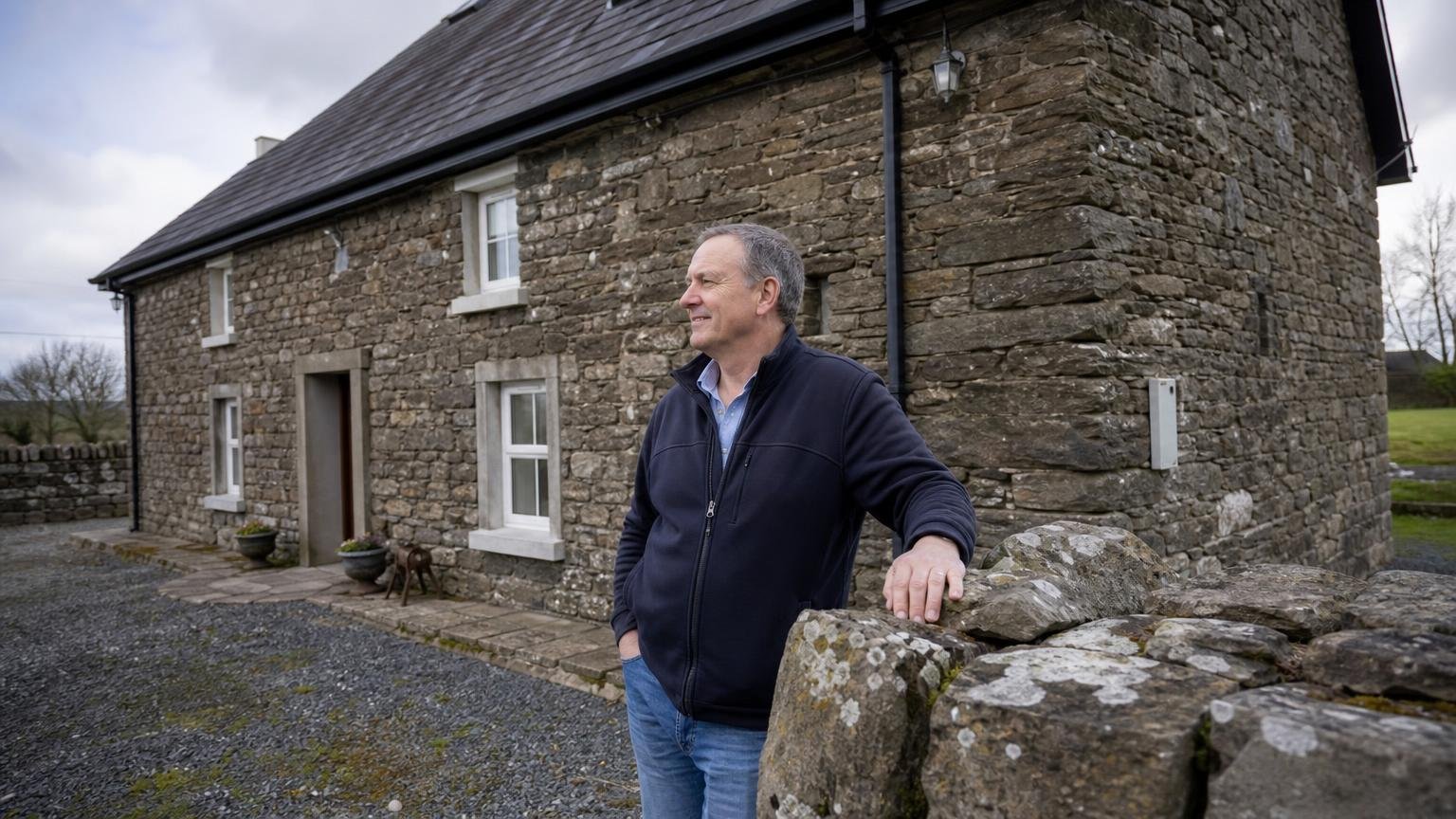
The first winter, the wind came down off the bog and pushed at the new door, and he stood there with his hands on the latch as if steadying a boat. The walls didn’t flinch; they simply held. “Stone remembers,” he used to say, and by the end of that season we believed him in our bones.
He had fetched each block from the field where the cowshed sank into nettles, patiently. Damp mornings, he’d lever a corner, tap loose the lime, and carry it up the lane, one wheelbarrow at a time. A boy could watch a man do that and learn to measure days not by hours, but by the weight of what he moved.
Inheritance of Stone
He called the salvaged stones by names: sleepers, singers, keepers. Sleepers were the broad ones for the bed of the wall; singers had a ring when tapped; keepers were those you trust in the corners where a house must be true. “Never rush a corner,” he muttered, “that’s where the weather looks in.”
Ferbane sat out there, low on the plain, with the Brosna nudging past and the old peat works dozing on the horizon. People said the place was soft and wet, but he loved the honest damp that kept the moss green and the cowshed standing long enough to be reborn.
The Craft in His Hands
He mixed lime with sand, slow and sour, until the spade met a quiet give that told him it would cure true. “Cement is a shout,” he’d say, “but lime is a conversation.” The plumb bob swung, a small planet on a string, and he’d wait for its stillness before he set the next lift of stone.
Two feet is not for show, he insisted; it’s for weather and time and the knock of children on winter afternoons. The trowel flashed, but the work was mostly listening—listening to what the rock wanted and what the house could carry without complaint.
Rooms That Breathe
Summer came and the rooms stayed cool, like a well where the air turns over in its own sleep. In January, you’d bank a fire, close the door, and feel the warmth soak the walls the way rain soaks a field. “Let the stones drink,” he’d say, “and they’ll give it back when the dark turns early.”
Sound changed in there—rain on slate turned softer, voices grew round, and even the radio’s sharp news arrived with its corners worn down. He swore the house made us quieter, not smaller, just more measured. “It’s not a big house,” he once smiled, “it’s a deep one.”
Neighbours and Doubts
Some thought he was mad, building with old rubble when blocks came stacked on a tidy pallet. “You can buy a straight line,” a neighbour joked, “but you can’t buy patience.” He nodded, put down his bucket, and showed him how a long string can be truer than any new spirit level.
The parish watched the gable rise, one course at a time, like a tide edging up a shore. He worked between showers, and when the sky cleared, the lime shone a little sugar-white against the basalt. “You pay for cheap twice,” he’d say, “once at the till, once when the wind comes.”
Lessons in the Walls
He never wrote a manual, but the house held a syllabus. We learned to keep a kettle singing and a brush by the door. We learned that what lasts is often what fits the place it’s in.
- Build with what you have, where you are
- Trust the slow cure over the quick fix
- Put your best stone in the corner
- Make room for the future inside the past
- Let the house teach its own rhythm, not the clock’s
What Endures
Years later, a fine crack eased along the parlour reveal, and he smiled like a man noticing a child’s new height. “Settle, then,” he said, and pressed fresh putty into the seam with a thumb no softer for its age. Outside, the gable wore a thin beard of lichen, a map of mornings you could read with your hand.
He kept the old cowshed key on a nail by the range, a small iron question no one had the courage to answer. “We carry our own scaffold,” he liked to say, meaning the body, the tools, the quiet stubbornness that keeps a job from stopping one inch short.
Across the Threshold
When he died, we found his tape folded at the same old mark, the span he called a good door. There was sand in his boots and lime in the crease of his hat, and the last stone he touched sat patient in the porch, waiting for its place. “Mind the edge,” he’d always warn, “that’s where the story starts.”
And so the house learned to hold without him, as if its own weight had become a kind of promise. On storm nights, the rafters still sigh, and the thick walls keep a steady counsel. You can stand in the hall, hand on the plaster, and feel it—heat ebbing and returning, time piling up like a neat stack of slates in a dry corner.
We live there still, under a roof he set with his eye and a weather that pays him respect. Children run the length of the kitchen and thump into the mass with laughter that doesn’t quite echo. And when the wind leans on the door, we lean back, gently, trusting what he built, and what the stones still quietly know.

Contact details
Address:
Farmers Forum,
36, Dominick Street,
Mullingar,
Co. Westmeath,
Ireland
Phone:
+353 (0)44 9310206
Or email us:
For technical issues please check out our FAQ's page or email - [email protected]
For general Queries email - [email protected]
Request to add event to our Calendar - [email protected]
Send us your mart reports - [email protected]
Suggestions and feedbacks - [email protected]
News Items / Press Release - [email protected]
To Advertise on Farmers Forum - [email protected]