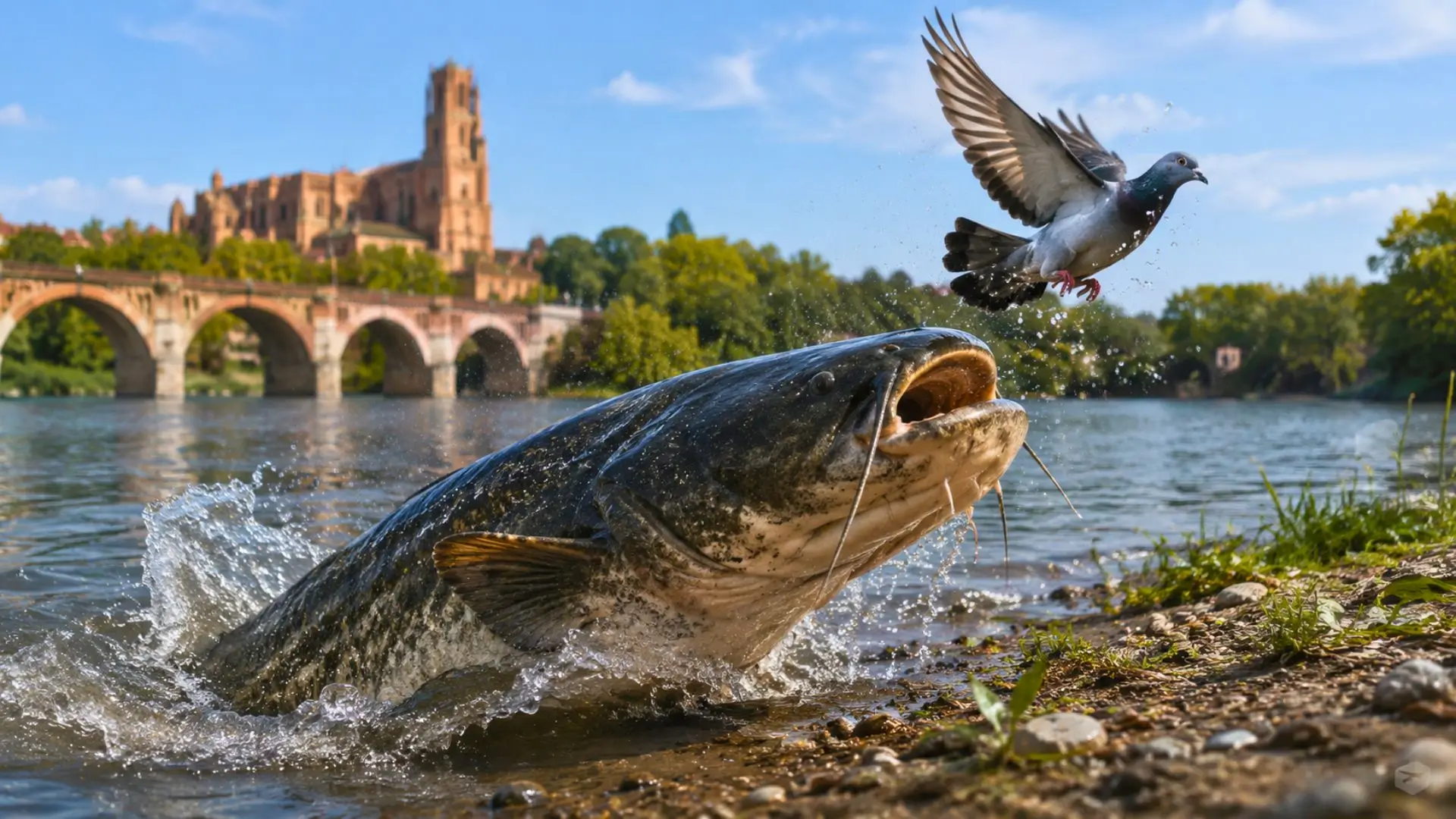
By deliberately beaching themselves on the bank, some freshwater fish imitate the great predators of the sea. In the Tarn region, researchers filmed massive catfish leaping from the water to seize pigeons. This unprecedented behavior reveals an astonishing capacity for adaptation.
Scientists document an unprecedented voluntary beaching strategy by freshwater fish in Albi
The study published in the scientific journal PLoS ONE details a rare biological phenomenon. In Albi, fish propel themselves onto the bank to catch terrestrial prey. The scientists dubbed these predators the freshwater orcas because of their method.
Warned by local fishermen, Frédéric Santoul’s team set up rigorous monitoring. From a bridge overlooking the Tarn, biologists at the Functional Ecology and Development Laboratory recorded forty-five attacks. Their analyses reveal a particularly high success rate.
Indeed, around 28 % of the assaults end with the capture of a bird. This efficiency places these aquatic animals on par with many terrestrial hunters. The speed of the strike is astonishing, since the entire action lasts only between one and four seconds.
A highly developed sensory system allows this fish to detect the movements of birds along the riverbank
Observations show that the predator completely ignores motionless birds. Consequently, researchers deduce that vision plays a secondary role. The fish relies instead on the physical disturbances of the water caused by the movements of birds coming to drink.
To detect these signals, the animal uses its six sensitive barbels as well as its lateral line. These anatomical tools capture the slightest surface ripple. Thus, as soon as a pigeon stirs at the riverbank, it unintentionally transmits its exact position to the hunter waiting in the shadows.
Freshwater giants, some individuals fully specialize in pigeon hunting
Introduced into the Tarn in 1983, the Wels catfish is a giant capable of reaching 2.50 meters in length and weighing around 100 kilograms. A record individual even reached 2.74 meters in 2017. Yet not all members of this species share this hunting habit.
The team of researcher Julien Cucherousset demonstrated a marked specialization through isotopic analyses. While some catfish abandon birds, others depend on them heavily. For these latter individuals, city pigeons now account for nearly 80 % of their overall diet during the warm season.
A local behavioral adaptation that disrupts the ecological balance of French rivers
This shift in habits does not occur in the native regions of this fish from Eastern Europe. This major change demonstrates a local behavioral invention, acquired and shared on site. The species exhibits remarkable plasticity in the face of newly colonized environments.
Environmentally, this unprecedented predation raises fundamental questions among biologists. The situation could reflect an imbalance in traditional aquatic resources. Consequently, scientists wonder whether the rising fish population might saturate the river’s nutritional carrying capacity.
Although this predator occasionally preys on other birds elsewhere, the beached-hunting technique remains unique to the city of Albi. Thus, before the eyes of passersby and near the Sainte-Cécile Cathedral, a species is rewriting its own rules of evolution.

Contact details
Address:
Farmers Forum,
36, Dominick Street,
Mullingar,
Co. Westmeath,
Ireland
Phone:
+353 (0)44 9310206
Or email us:
For technical issues please check out our FAQ's page or email - [email protected]
For general Queries email - [email protected]
Request to add event to our Calendar - [email protected]
Send us your mart reports - [email protected]
Suggestions and feedbacks - [email protected]
News Items / Press Release - [email protected]
To Advertise on Farmers Forum - [email protected]