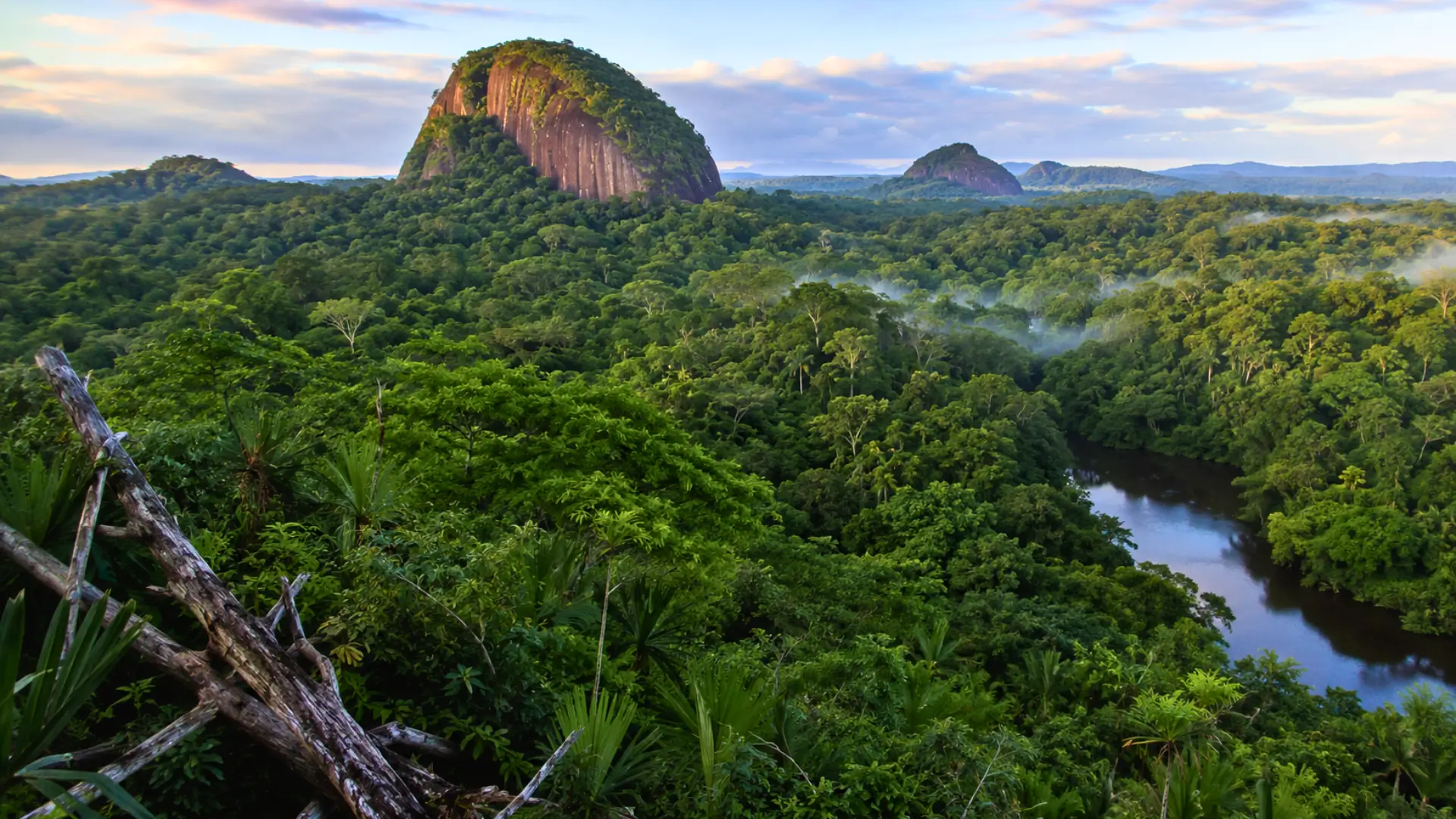
On the surface, it looks like only an administrative announcement. In reality, the creation or extension of nine forest biological reserves raises a far broader question: what happens when a country finally decides to let certain pieces of forest live without it, or almost?
Protecting a forest is also preserving centuries of natural evolution
The figure is striking at first glance: 157,000 additional hectares are placed under strengthened protection, according to the Ministry of Ecological Transition. More importantly, almost all of this rests on a single name, Armontabo, in Guyana. By itself, the site spans 156,290 hectares of tropical forest and granite inselbergs now safeguarded. Thus, this is not a green band-aid. It is a real shift in scale.
In an integral biological reserve, the forest is no longer thought of as scenery. It is no longer a resource to optimize either. On the contrary, it becomes a world in free evolution, observed over time. From then on, fallen trunks, windthrows, vines, mushrooms, slow rivers: everything that seems disorderly here regains a central ecological value, almost as a rebuke to the obsession with control.
From Guyana to the Vosges, nine reserves reveal the diversity of French forests
The announcement isn’t limited to the French Amazon. Indeed, far more modest sites, yet just as revealing, appear on the map. There is Bannes-Ravines in the Vosges, Chamalière-Peyre-Ourse in the Cantal, Chatte-Pendue in Bas-Rhin, or the Jumelles d’Ornes and Vau des Loups in the Meuse. Moreover, each name seems to come straight from an old geographer’s notebook.
These areas may seem tiny compared with the vastness of Guyana. Yet, 83 hectares in Seine-et-Marne or 100 hectares in Meuse can weigh very heavily for local biodiversity. For example, an old peri-urban broadleaf forest, an ancient massif rich in deadwood, a beech forest at altitude: these are often living archives, patient, fragile and irreplaceable.
There is even, within this disparate geography, a form of an unexpected national narrative. In fact, France’s forested landscape is not a single green block. It juxtaposes Mediterranean forests, montane spruce forests, wetlands, and humid tropical forest. Moreover, by extending the managed reserve of the Somail peatlands, the State reminds us of one simple thing: depending on the case, effective protection requires letting things unfold, and sometimes intervening with finesse.
Integral and directed reserves, two protections that transform forest life
The heart of the scheme rests on a simple idea: reduce human pressures where the environments are the most precious. For this, the National Forestry Office distinguishes two models. On one side, the integral biological reserves let natural dynamics run their course. On the other, the directed reserves undertake active management to preserve habitats or sensitive species.
In practice, this changes very concrete things. Thus, a forest left in peace preserves more old trees, cavities, humidity, deadwood and microhabitats. And these are precisely the elements sought by insects, cavity-nesting birds, mosses, bats and many other discreet organisms. In short, protection concretely alters how living beings move, hide and reproduce.
With 157,000 hectares protected, France accelerates without yet reaching its target
This decision comes in a context that is less comfortable than it might seem. In June 2026, the ministry indicates that France now covers 6.43% of its land area under strong protection, up from 6.2% previously. Yet the official objective remains far more ambitious: 10% by 2030. This commitment is part of the national biodiversity strategy and continues from COP15.
Put differently, the announcement is important, but it does not close the matter. It shows especially that the fight now plays out between political acceleration and ecological slowness. An old forest does not reconstitute at the pace of a mandate. It requires decades of continuity, sometimes centuries. Meanwhile, climate pressures, diseases and fragmentation advance much faster.
The most fascinating detail may be here: protecting a forest is not only about saving trees. It is also about accepting to preserve invisible processes, slow successional trajectories, balances whose usefulness does not always become apparent immediately. Finally, at a moment when everything must produce, prove, and be profitable, these reserves tell a different story. Some riches are valuable only because they endure.

Contact details
Address:
Farmers Forum,
36, Dominick Street,
Mullingar,
Co. Westmeath,
Ireland
Phone:
+353 (0)44 9310206
Or email us:
For technical issues please check out our FAQ's page or email - [email protected]
For general Queries email - [email protected]
Request to add event to our Calendar - [email protected]
Send us your mart reports - [email protected]
Suggestions and feedbacks - [email protected]
News Items / Press Release - [email protected]
To Advertise on Farmers Forum - [email protected]