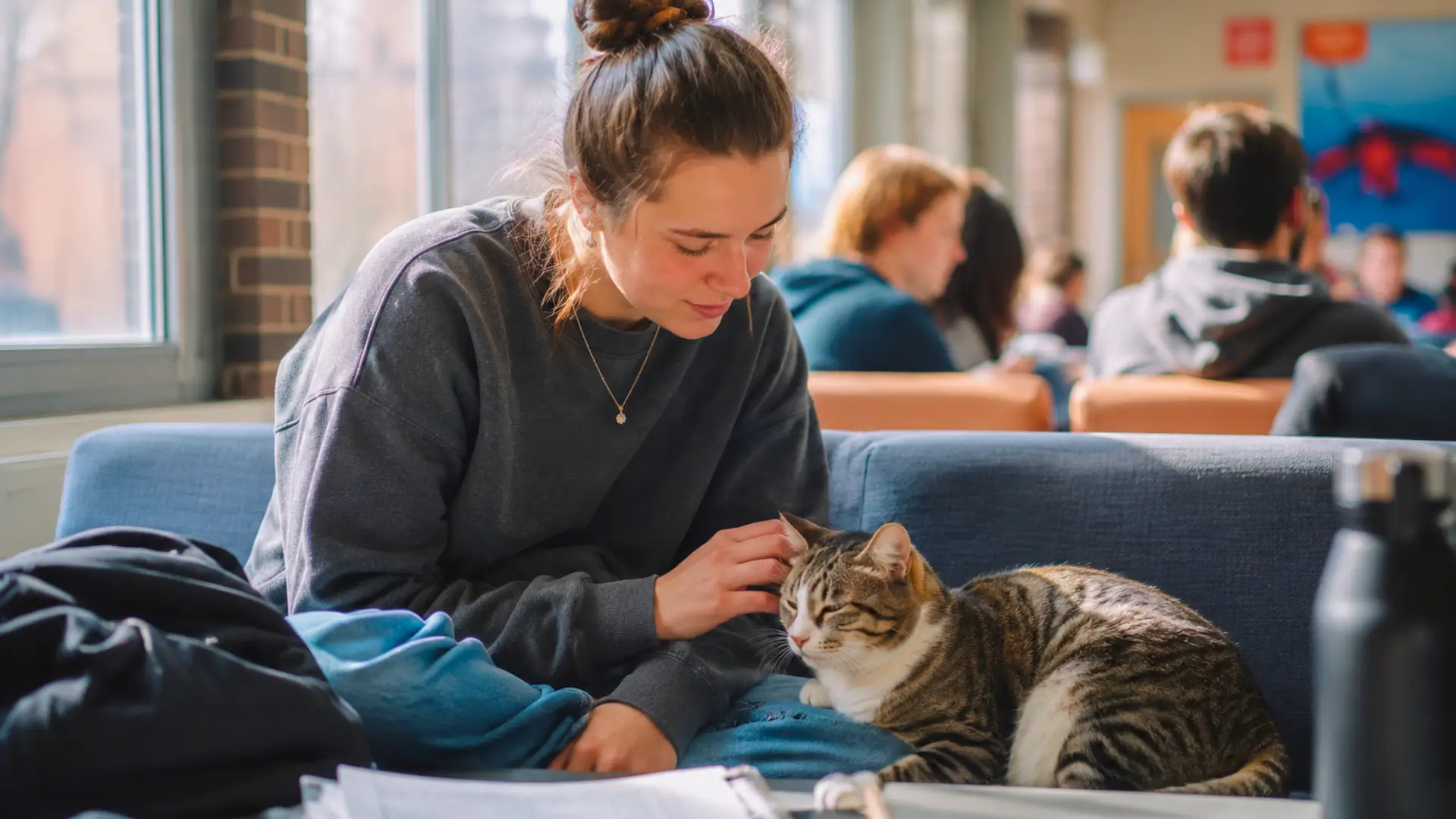
Why do some people instinctively seek out a cat when the pressure rises? A wide university-wide survey reveals that a particular emotional trait predicts this attraction. Even more surprisingly, these sensitive profiles could be those for whom feline companionship provides the most precious comfort.
A dog-dominated focus in university stress-relief programs
In universities, animal-assisted stress-relief sessions often resemble a cheerful parade of Labradors. Yet cats are typically absent. Thus, more than 1,400 people, students and staff from over twenty institutions, were surveyed about their interest in feline visits.
Indeed, the study, published in the scientific journal Anthrozoös, began from a surprising finding: more than 85% of animal-assisted university programs relied solely on dogs. From there, researchers Patricia Pendry and Joni Delanoeije sought to understand who requested cats, and especially why.
A heightened emotionality as a key predictor of attraction to cats
The result does not simply reveal two opposing camps. It isn’t merely dog lovers versus cat lovers. On the contrary, interest in felines was chiefly linked to a strong emotionality, a trait corresponding to a stable tendency to feel certain emotions intensely.
Thus, participants with the highest emotionality scores were more drawn to encounters with cats. Moreover, this relationship remained evident after accounting for other factors. This includes having previously lived with a feline, gender, or the interest in canine programs.
However, caution is warranted regarding quick conclusions. Indeed, frequent petting of a cat does not allow for a definitive personality assessment. The study primarily measures a declared preference, not a diagnosis. Nevertheless, it suggests that highly sensitive individuals recognize in the cat a presence suited to how they feel.
Measurable stress-relief effects after only a few minutes of contact
This attraction could be explained by biological mechanisms. Indeed, in another experiment at Washington State University, students interacted with animals. Thus, after only ten minutes, their saliva cortisol levels decreased notably.
Furthermore, the repetitive stroking and the warmth of the fur play a significant role. Moreover, paying attention to a calm animal helps divert anxious thoughts. Admittedly, the mechanism remains complex. Nevertheless, purring is not a medicine, but this sensory pause can help calm stress.
Furthermore, contrary to some common beliefs, the cat is not necessarily distant. On the contrary, it offers an interaction built on closeness and pauses. Thus, it approaches, accepts a few strokes, then retreats. For a sensitive person, this non-intrusive rhythm may feel more soothing than a constant presence.
A soothing relationship that could reshape wellness approaches
The results were similar among students and staff. Indeed, university status mattered little. It was mainly individual characteristics that made the difference. However, allergies or fear of cats reduced interest, without erasing the link with emotionality.
Therefore, this discovery could shape wellness programs. Even today, they remain very dog-centered. Thus, offering several animals could attract more people. However, it is essential to select suitable cats and ensure the animal’s welfare.
So what does this urge to stroke a cat after a tough day reveal? Perhaps not a deep secret about personality. Rather, it expresses more of an intuitive form of self-regulation. In the end, the cat, with its calmness and boundaries, could offer a valuable space to certain temperaments.

Contact details
Address:
Farmers Forum,
36, Dominick Street,
Mullingar,
Co. Westmeath,
Ireland
Phone:
+353 (0)44 9310206
Or email us:
For technical issues please check out our FAQ's page or email - [email protected]
For general Queries email - [email protected]
Request to add event to our Calendar - [email protected]
Send us your mart reports - [email protected]
Suggestions and feedbacks - [email protected]
News Items / Press Release - [email protected]
To Advertise on Farmers Forum - [email protected]