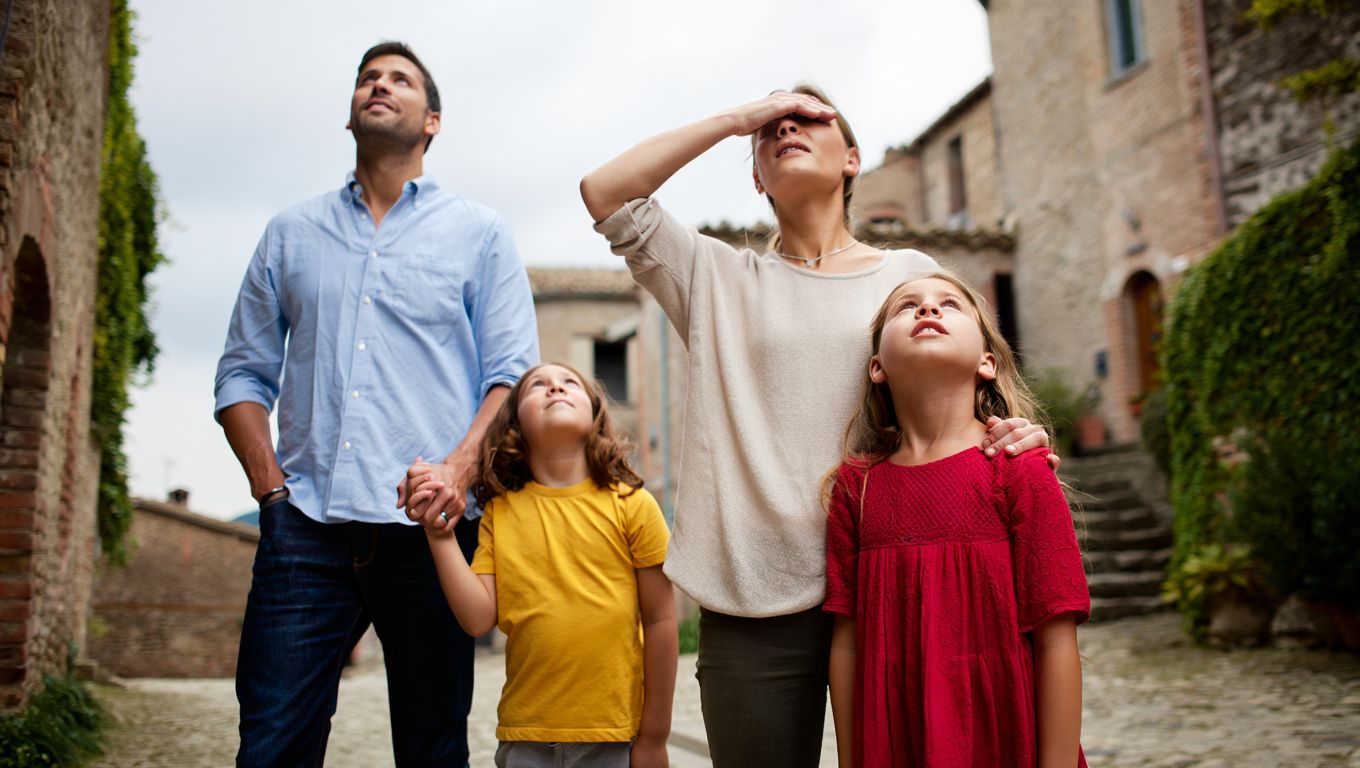
They arrived with boxes of books, raincoats from home, and a notion that southern light would be a simple upgrade. September corrected them with its angle, a slant that feels like an extra sense, all shimmer and hush. “It’s the same sun, but it behaves differently,” Nuala says, palms open to the hills like she’s explaining a shy friend.
Five years on, the season still ambushes them at four in the afternoon, when shadows turn blade-thin and the valley lifts into gentle gold. The streets go quiet, shutters half-lidded, and each stone seems to drink honey. It isn’t dramatic, just insistent.
Leaving a sky they understood
Back in Dundalk, light wore a jacket most of the year, a practical companion that knew when to pack it in. It spread evenly, democratic over brick, sea, and road. September there meant fresh notebooks and first drizzle, familiar as a pub’s back room.
Here in the Marche, September is an editor, crossing things out, underlining others, making the day read like an urgent note. Peaks of the Sibillini go paper-thin, edges inked in a quiet blue. “It’s like someone tilted the world,” Conor says, “and let the light run to the corners.”
The village and its quiet rehearsals
They learned the rhythms not by studying, but by tripping over them, then laughing the lesson into memory. Bells mark time that a phone can’t hold, carrying through olive groves like soft thrown coins. The piazza exhales at six, the passeggiata gathers, fluorescence of peach skins and stories.
September’s light tries on personalities across the day. Morning is a whisper, cobbles damp, swallows signing the sky with careless ink. Evening leans in, conspiratorial, the Adriatic sending back a glow that knows your first and middle names.
What the light does to ordinary things
“We keep thinking we’ll get used to it,” says Nuala, looking at the washing line like it might speak. “But then a shirt becomes a sail, and the terrace becomes a stage.” Grapes fatten, figs split, and the cat turns to a strip of licorice.
Under this slanted hush, errands go cinematic: the fish van’s horn, the butcher’s calendar waving a saint’s hand, a receipt bright as a priest’s collar. Even their children walk more slowly, as if stepping across freshly poured light.
Borrowed rituals, kept honestly
They tried not to make a museum of their old life, or a theme park of the new. Instead, they stitched tiny habits into the month’s bright fabric.
- A late afternoon coffee taken in silence, then a slow passeggiata past the same three doors, counting the vines that finally outgrew their stakes.
They keep the list short on purpose, so the light can do its own work. Anything more would feel like picking pockets from a generous neighbor.
When the sun goes to ground
There are days the tramontana bullies in, clarifying every ridge like glass rubbed clean. And others when damp rises from the fields, laying a veil on the valley that the light can’t quite lift. “It’s the not-knowing I love,” says Conor. “Weather reports miss the small truths.”
September in the Marche is pastoral but never sleepy. It has the farmer’s steady hands, the painter’s suspicious eye. By eight, the hills are church-quiet; by noon, everything is opera.
How they measure time now
They don’t count by school terms or bank holidays, not really, not any more. Time is peach fuzz, pressed between thumbs; time is the slow drift of smoke from a neighbor’s first bonfire. The calendar hangs, but the light does the telling.
In Dundalk, dusk was a period. Here, it’s a semicolon, promising a softer second thought. The kids say dinner tastes different outside, as if the plates have learned another language.
What September asks in return
This light is not all gift, even if it arrives wrapped in late-summer paper. It exposes the dust on the sill, the crack in the jug, the seam where you meant to finish a story. It invites you to choose the thing you will actually attend to.
They’ve learned to leave some plans unfinished, to meet the day where it tilts. “I don’t want to manage every hour,” Nuala says. “I want to be slightly undone by them.”
The way home changes its shape
Home now is an address pinned by swallows, a gate that yawns open like a sleepy dog. But it’s also the unspooled grey at Carlingford Lough, the tidy hedges of old Sundays. The light doesn’t choose for them; it braids both strands and asks them to keep walking.
On certain evenings the valley goes to amber, a tone that tastes faintly of almonds. Somewhere a tractor mutters a last sentence, and all the windows become small polite fires.
Why they still look up at four
They pretend they are working through the afternoon, that emails and school notes set the tempo. But the page pales and the margin widens, and they lift their heads in unison. “It happens every year,” Conor laughs, “like the village taps the glass.”
If you ask what has kept them here, they won’t say price per kilo of tomatoes, or the square meters of the kitchen. They’ll point at the hillside, then at the thin gold river sliding over it, quick as a secret passed hand to hand. And they’ll tell you they’re still learning to be bright enough to hold it, and quiet enough to let it pass.

Contact details
Address:
Farmers Forum,
36, Dominick Street,
Mullingar,
Co. Westmeath,
Ireland
Phone:
+353 (0)44 9310206
Or email us:
For technical issues please check out our FAQ's page or email - [email protected]
For general Queries email - [email protected]
Request to add event to our Calendar - [email protected]
Send us your mart reports - [email protected]
Suggestions and feedbacks - [email protected]
News Items / Press Release - [email protected]
To Advertise on Farmers Forum - [email protected]