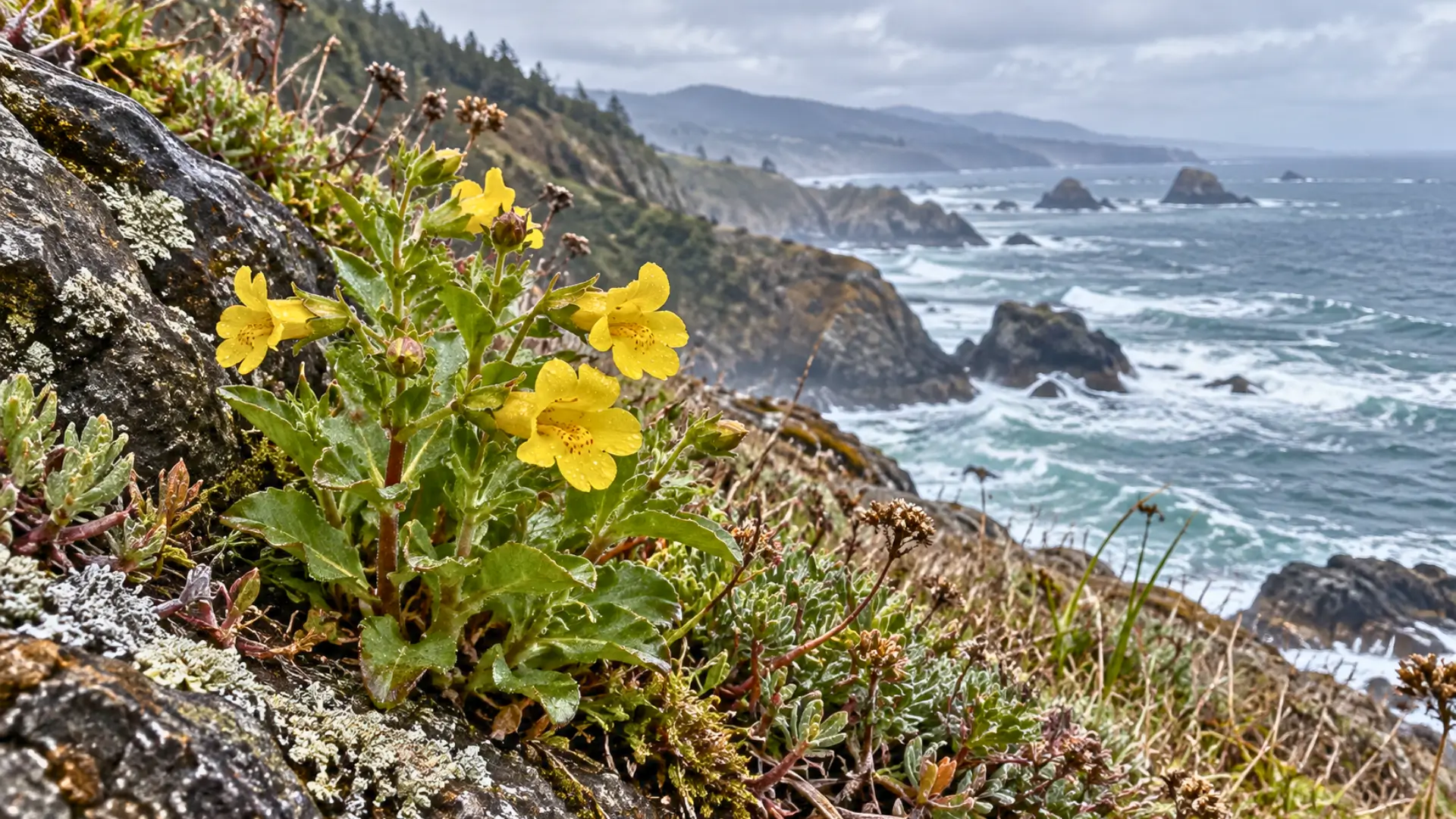
On cliffs battered by the Pacific, a small yellow flower regularly receives droplets of saltwater capable of burning ordinary vegetation. Yet it thrives. Researchers have just discovered that its resilience rests on multiple defenses, activated almost like a plant security system.
On the Pacific cliffs, a seemingly fragile flower defies an invisible foe
At first glance, the yellow monkeyflower doesn’t look like a fortress of vegetation. This small plant grows along the coasts of California and Oregon. The wind continually carries salty spray. For many plants, these droplets damage the leaves. They disrupt cells and accelerate desiccation.
The phenomenon is intriguing. Populations of the same species live inland. They tolerate salt much less well. Biologists from the Michigan State University compared five pairs of coastal and inland populations. Their study, published in 2026 in American Journal of Botany, reveals a more complex adaptation than expected.
Once the saline water is deposited on its leaves, the yellow mimulus nearly shuts out sodium
To reproduce the ocean’s assaults, researchers sprayed the plants with saltwater. The solution mimicked natural conditions. After treatment, inland leaves housed an internal sodium concentration 2.8 times higher. Coastal leaves contained far less. The gap is therefore substantial.
Coastal populations of mimulus possess a first line of defense. They limit sodium entry after the spray deposition. Researchers examined the stomata and the leaf surface. They also observed how water adheres to the surfaces. The exact mechanism, however, remains to be identified.
The plant also has a second safeguard. Its coastal leaves are more succulent. They therefore hold more water per unit area. They also lose less water after exposure to salt. This reserve could dilute sodium or keep it contained within certain cells.
Even when salt manages to enter, its tissues resist longer before dying
The researchers then bypassed the first barrier. They cut leaf fragments and placed the tissues directly in contact with sodium. The coastal populations fared even better. Their cells showed higher salt tolerance. Necrosis also appeared later.
These results were also published in the American Journal of Botany. This combination changes the plant’s image. The mimulus does not possess merely a single ‘impenetrable’ leaf. It employs multiple layers of protection. It blocks part of the salt, retains more water, and limits damage. This strategy resembles a true defense in depth.
Plus surprenant encore, la plante semble avoir adapté son calendrier aux colères de l’océan
Another study reveals a third tactic. Coastal populations tend to bloom later in the season. They thus await a calmer, less windy period. In spring, the spray causes more necrosis. The plants then produce fewer flowers and seeds.
Evolution has thus not only altered the mimulus’s physiology. It also appears to have tuned its reproductive rhythm. The plant avoids the harshest spray, blocks part of the sodium, and tolerates the rest. Three distinct responses target the same threat. This discovery goes beyond the fate of a Pacific flower.
La montée du niveau marin et les fortes houles pourraient accroître l’exposition des plantes au sel. Les intrusions salines menacent déjà certains sols agricoles. Comprendre ces défenses pourrait aider à sélectionner des cultures plus résistantes. Les chercheurs cherchent maintenant les gènes responsables de cette adaptation.

Contact details
Address:
Farmers Forum,
36, Dominick Street,
Mullingar,
Co. Westmeath,
Ireland
Phone:
+353 (0)44 9310206
Or email us:
For technical issues please check out our FAQ's page or email - [email protected]
For general Queries email - [email protected]
Request to add event to our Calendar - [email protected]
Send us your mart reports - [email protected]
Suggestions and feedbacks - [email protected]
News Items / Press Release - [email protected]
To Advertise on Farmers Forum - [email protected]