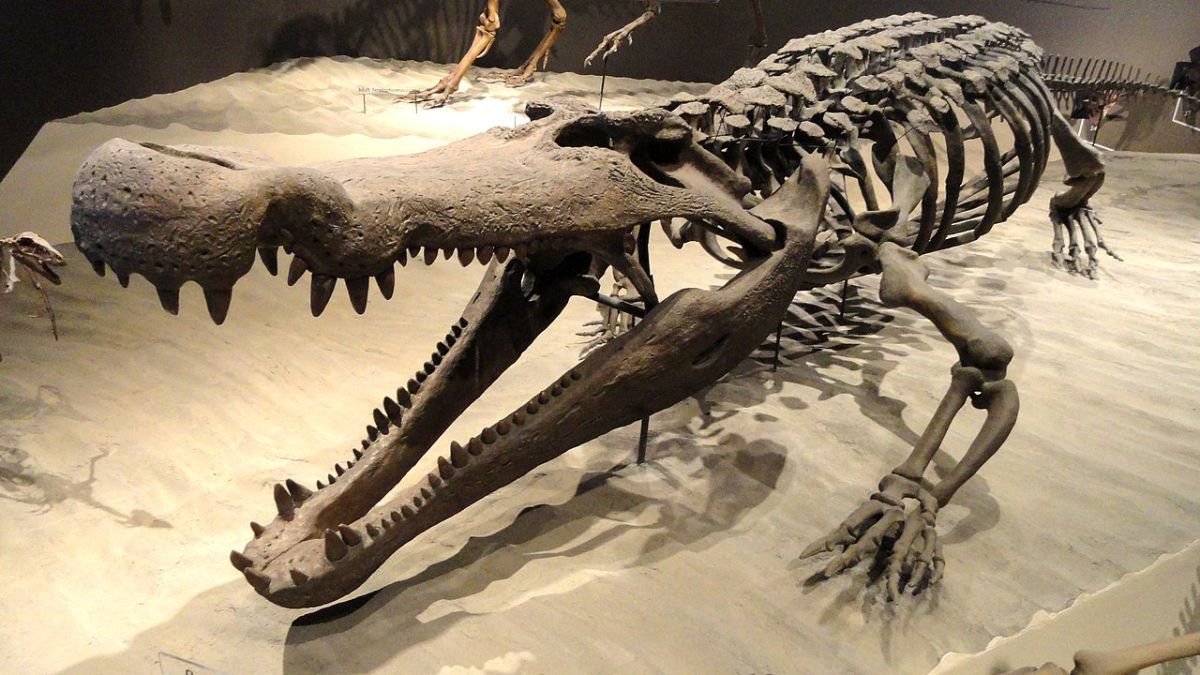
An English fossil studied for more than a century has just revealed a secret no one anticipated. Under ultraviolet light, its fossilized skin displays a pattern that could represent the oldest known trace of camouflage observed in an ancestor of today’s crocodiles.
More than a hundred years and a simple ultraviolet lamp were needed for this fossil, long kept in a museum collection, to finally disclose what it truly concealed. The specimen belongs to Montsecosuchus depereti, a small crocodylomorph of the atoposaurid family that roamed the swamps of the Early Cretaceous about 125 million years ago, long before crocodiles as we know them today emerged.
A site that never stops revealing its secrets
The fossil comes from Pedrera de Meià, in the province of Lleida, Catalonia, a quarry linked to the Pedrera de Rúbies formation, renowned for the exceptional preservation of its Early Cretaceous fossils. First described in 1915 under the name Alligatorium depereti before being reclassified into the Montsecosuchus genus, this specimen had already been the subject of several studies, without anyone suspecting the extent of what remained hidden in the rock.
Our colleague TopActu also revisits this discovery, offering a broader look at what such finds reveal to paleontologists about the survival strategies of prehistoric predators.
What ultraviolet light reveals
Fluorescence under UV has become a valuable tool in paleontology in recent years, capable of highlighting organic structures that the naked eye—let alone with a magnifying lens—fails to discern in the surrounding rock. Fossilized tissues, especially those rich in certain residual organic compounds, respond differently to ultraviolet light depending on their composition, creating a contrast invisible under natural light but clearly readable under UV.
Applied to this specimen, the technique revealed an astonishingly well-preserved skin, cartilage, as well as distinctive marks along the animal’s tail. Researchers also detected what could be skin sensory structures and elements of the respiratory system—soft tissues that hardly fossilize under normal conditions.
The oldest camouflage known in a crocodylomorph?
The most striking feature remains the presence of alternating bands along the body, a pattern that could correspond to a form of camouflage. If this interpretation is confirmed, it would be the oldest coloration directly documented in a crocodylomorph lineage, the group that includes modern crocodiles and all of their extinct Triassic-era ancestors.
This discovery, published in the Zoological Journal of the Linnean Society, reminds us how much our image of extinct species remains largely shaped by their bones alone. Color, skin texture, patterns—everything that makes an animal truly resemble what it was in life—almost always disappears with the soft tissues. Each exception, like this one, forces us to reassess how we imagine these creatures.

Contact details
Address:
Farmers Forum,
36, Dominick Street,
Mullingar,
Co. Westmeath,
Ireland
Phone:
+353 (0)44 9310206
Or email us:
For technical issues please check out our FAQ's page or email - [email protected]
For general Queries email - [email protected]
Request to add event to our Calendar - [email protected]
Send us your mart reports - [email protected]
Suggestions and feedbacks - [email protected]
News Items / Press Release - [email protected]
To Advertise on Farmers Forum - [email protected]