In one of the world’s busiest seas, scientists today are tracing invisible life without nets, trawls, or dives. Their weapon fits in a few liters of seawater. And what it reveals could change the way we monitor the impact of future wind farms.
In the English Channel, a future wind farm takes shape in a sea still poorly understood
The English Channel often presents itself as a geographic given, almost a familiar backdrop. Yet beneath this surface, through which 20 % of global maritime traffic passes, knowledge remains incomplete. This is especially true for the fish and crustaceans that inhabit it. Thus unfolds the paradox of a sea that is highly trafficked, yet still partly mysterious.
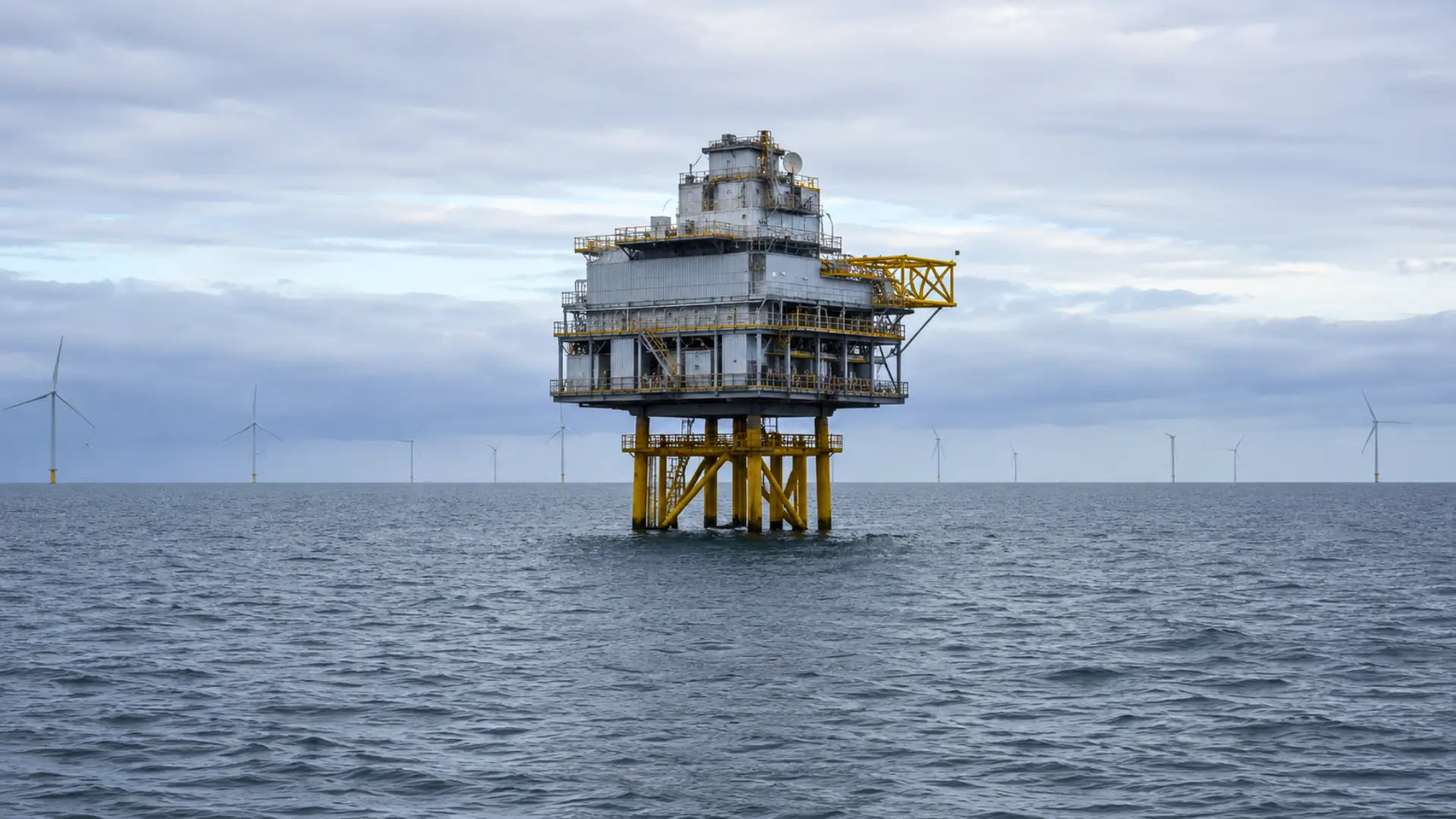
In this already crowded landscape, the offshore wind farm project Manche Normandie plans to install 37 to 47 turbines by 2032. The energy promise is clear. Yet one question remains, quieter and far more delicate. What happens to marine species when such infrastructures become a durable fixture in their environment?
That is precisely where Biodivmanche comes in, a program coordinated by Noémie Coulon, a postdoctoral researcher at the Marbec Laboratory in Montpellier. For four years, the team compares several zones: exploited areas, construction sectors, surveyed sites, and reference sites. The objective is clear: to understand how biodiversity reacts before, during, and after the arrival of the wind turbines.
Environmental DNA enables inventorying marine species without disturbing them
The chosen method is almost romantic in its fascination. Instead of capturing animals, scientists collect the environmental DNA they leave behind in the water. This fleeting signature then allows them to detect rare, deep, elusive, or protected species. Yet many still escape traditional inventories.
This approach changes the scene of observation. Now, it is not about forcing encounters with living beings, but letting the environment tell what passes through it. During the campaign conducted this year, 101 filtrations were carried out across about thirty sites. In parallel, measurements of temperature, salinity, and depth helped link the species to their habitat.
Fuchsia-pink underwater robots collect data up close to the seabed
On the deck of the vessel, the image is almost as striking as the method. In large black crates lie small, tapered devices, fuchsia-pink, almost pulled from a science-fiction film. They are AUVs, autonomous underwater vehicles. Thus, they follow a programmed path and collect data right at the seafloor.
Several times a day, these torpedoes dive, vanish, and return with a harvest of information invisible to the naked eye. The scene speaks clearly of today’s science. It may not be as spectacular as a heroic expedition, but it is also more precise, more patient, and devastatingly effective for observing without disturbing.
The ship itself tells another evolution. To limit the mission’s carbon footprint, the team relies on the cooperative Skravik. It thus boards the Morskoul, a 14.5-meter catamaran powered by sail. Even research into marine energies now seeks to reduce its own environmental cost.
Between refuge and disturbance, wind turbines could redistribute marine life
The results, precisely, do not point to a simple scenario. On one hand, wind farms could become spaces of reduced human pressure. For some species, they might play a relatively protective role. On the other hand, they can also disturb other animals, notably rays and sharks, sensitive to the electromagnetic fields generated by submarine cables.
This blend of hope and uncertainty is the very value of Biodivmanche. The project does not merely count species. It also seeks to understand which groups advance, which recede, and in what context. Then, by publishing these results on an online mapping platform, it sheds light on the difficult cohabitation between the energy transition and living worlds.
As the sea becomes a strategic space for producing decarbonized electricity, another requirement emerges. First, observe before developing. Next, measure before asserting. Finally, make visible what had not been visible. In the English Channel, a few traces of DNA are now enough to remind us that a sea is never empty, even when it seems perfectly tamed.

Contact details
Address:
Farmers Forum,
36, Dominick Street,
Mullingar,
Co. Westmeath,
Ireland
Phone:
+353 (0)44 9310206
Or email us:
For technical issues please check out our FAQ's page or email - [email protected]
For general Queries email - [email protected]
Request to add event to our Calendar - [email protected]
Send us your mart reports - [email protected]
Suggestions and feedbacks - [email protected]
News Items / Press Release - [email protected]
To Advertise on Farmers Forum - [email protected]