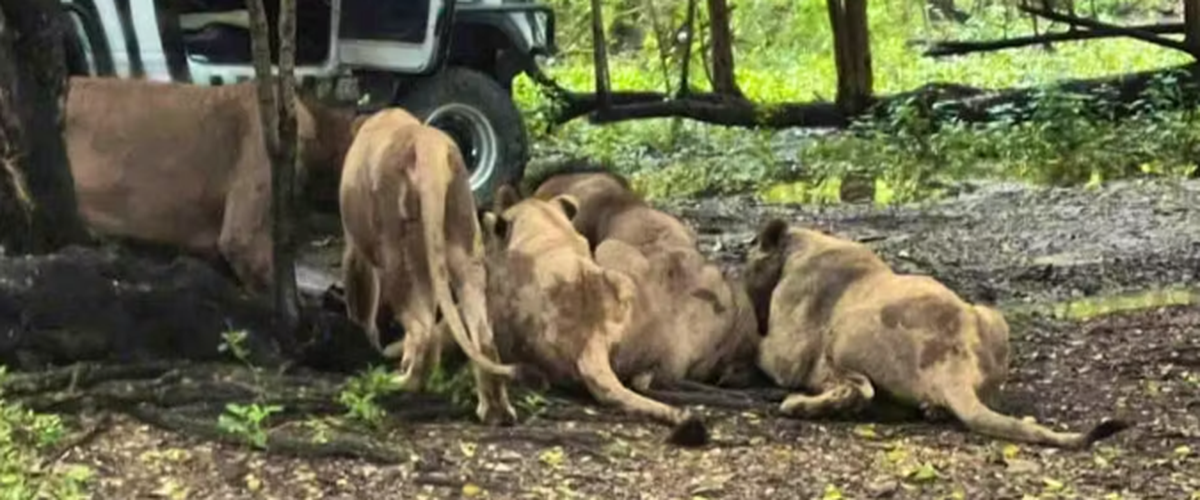
The scene unfolded inside a popular wildlife park in Bangkok, where a veteran employee lost his life after a sudden encounter with a pride of lions. Colleagues and visitors were left shocked, and the incident has sparked urgent questions about safety standards and staff protocols. Authorities confirmed that the victim, who had worked at the park for more than three decades, was performing routine duties when the animals converged. Officials say six or seven lions were involved, and an investigation is now underway.
A shocking attack in a major attraction
Safari World Bangkok markets itself as one of Asia’s largest zoological parks, offering close-up experiences with tigers and lions for about 1,200 baht (roughly 37 dollars). The park’s model relies on proximity, presenting predators in a setting meant to feel natural and immersive. That promise collided with grim reality when the lions moved as a group and overpowered the longtime employee. Emergency teams arrived quickly, but the outcome was tragically final.
Witness accounts and immediate response
A visitor described an eerie calm before the attack. “He stepped out of a vehicle alone, with his back to the animals. He stood for about three minutes, then a lion approached slowly and grabbed him from behind. He didn’t scream,” said Tavatchai Kanchanarin, who spoke to local television. Park staff tried to intervene as the situation escalated with multiple lions involved. First responders secured the area as shocked guests were ushered to safety and given assistance.
A veteran keeper and a familiar routine
Authorities identified the victim as a zoo employee who usually handled feeding and daily care. He had worked at the facility for more than 30 years, a tenure that underscores both his experience and the risks inherent in managing powerful predators. Colleagues said the day’s tasks were routine, with standard movement in and out of service areas. Investigators will examine whether a gate, vehicle, or radio protocol broke down at a critical moment.
Officials seek answers
“The victim was an employee who regularly fed the lions,” said Sadudee Punpugdee of the Department of National Parks, who confirmed that six or seven animals were likely involved. Officials are reviewing surveillance footage and staff logs to reconstruct the sequence. The findings will inform both internal reforms and any action by Thai authorities. In the meantime, sections of the park remain closed as teams assess enclosures, routes, and emergency procedures.
Safety culture under scrutiny
The park’s website promises close encounters with lions, tigers, and other species, marketed as “free-roaming” in naturalistic habitats. That proximity is a selling point and a liability, especially when human routines intersect with predatory instincts. Experts note that even well-trained teams face unpredictable behavior when animals are startled, crowded, or agitated. Robust barriers, clear sightlines, and enforced “no lone worker” policies are essential safeguards.
What investigators will likely examine
- Whether a “two-person rule” was in effect and properly documented
- The status of gates, locks, and double-door safety systems
- Radio checks, line-of-sight protocols, and escort procedures
- Animal grouping and feeding-time management
- Emergency response speed, deterrents, and extraction tools
The broader context in Thailand
Thailand allows private ownership and captive breeding of big cats under specific regulations, and the number of captive lions has risen in recent years. Nearly 500 registered lions are held in zoos, breeding facilities, themed cafés, and some private homes. That growth has sharpened debates over welfare, oversight, and the public’s appetite for “up close” wildlife experiences. Advocates argue that stricter inspections and standardized staff training are long overdue measures.
Balancing access and risk
Wildlife attractions walk a narrow line between educational access and unacceptable danger. Close-up feeding tours attract visitors and revenue, yet they heighten exposure to risk if anything deviates from plan. Best practices stress layered barriers, time-buffered entry and exit, and continuous monitoring of animal behavior. The goal is to maintain guest engagement while reducing the chance of a catastrophic event.
Grief, accountability, and next steps
Colleagues are mourning a respected supervisor whose experience anchored daily operations for decades. The park faces difficult questions about training refreshers, fatigue, and whether routine bred complacency. Regulators will likely push for tighter controls, and industry peers may reassess their own handling and show formats. For visitors, the tragedy is a stark reminder that “wild” is not a theatrical prop, and that respect for boundaries is more than a brochure line.
As the investigation continues, one truth is already clear: even in controlled settings, big cats retain the speed, power, and instincts that make them formidable and unpredictable. Matching that reality with rigorous design and disciplined protocols is not optional—it is the foundation of every safe, ethical wildlife experience.

Contact details
Address:
Farmers Forum,
36, Dominick Street,
Mullingar,
Co. Westmeath,
Ireland
Phone:
+353 (0)44 9310206
Or email us:
For technical issues please check out our FAQ's page or email - [email protected]
For general Queries email - [email protected]
Request to add event to our Calendar - [email protected]
Send us your mart reports - [email protected]
Suggestions and feedbacks - [email protected]
News Items / Press Release - [email protected]
To Advertise on Farmers Forum - [email protected]