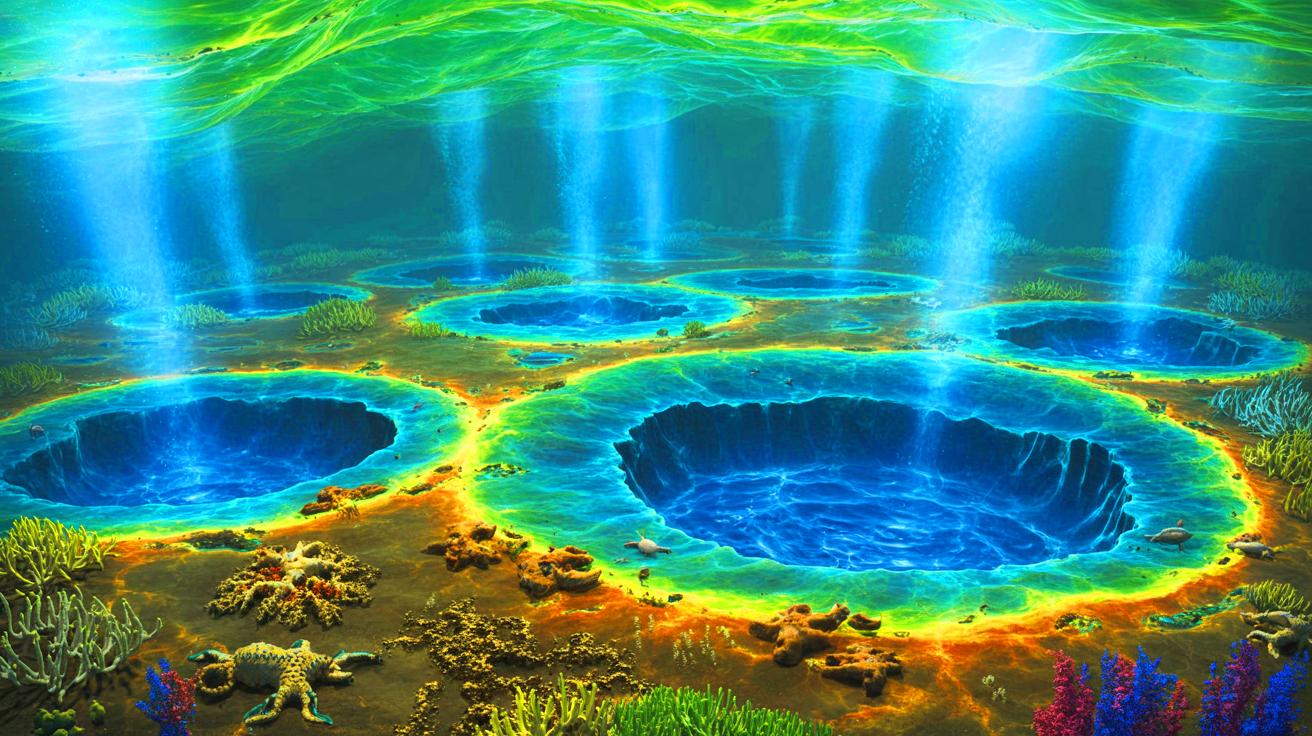
The recent discovery of an exceptional hydrothermal system in the western Pacific by the Institute of Oceanology of the Chinese Academy of Sciences (IOCAS) has opened a new chapter in our understanding of abyssal geochemical processes. This field, named Kunlun, located near the Mussau trench, features geological characteristics never seen before. Using the manned submersible Fendouzhe, researchers have highlighted hydrogen emissions of unprecedented magnitude, challenging conventional geochemical models. This exploration offers a fascinating glimpse into the intricate interactions among seawater, mantle rocks, and the hydrothermal dynamics that shape the world’s deep oceans.
Impressive features of the Kunlun field
The Kunlun hydrothermal field, tucked in the western Pacific, comprises twenty expansive circular depressions. Some craters exceed a kilometer in diameter, forming a complex network across the Caroline plate. This distinctive morphology evokes natural chimneys that channel fluids from the Earth’s depths. Covering an area of 11.1 square kilometers, the site far surpasses the famed Lost City of Atlantis, both in size and geological complexity. These intriguing characteristics make Kunlun a natural laboratory for studying geochemical processes unfolding far from human observation.
Shocking discovery: “Unforeseen microbial life aboard!” How this could change everything for marine science
The crucial role of serpentinization
At the heart of Kunlun’s hydrothermal activity lies a key geochemical process: serpentinization. This phenomenon involves a chemical reaction between seawater and mantle rocks rich in olivine. The interaction yields serpentine minerals and liberates substantial quantities of molecular hydrogen. Measurements conducted via Raman spectroscopy have revealed concentrations reaching up to 6.8 millimoles per kilogram in the hydrothermal fluids. The site’s annual hydrogen emission is estimated at 480 billion moles, representing at least 5% of the world’s marine abiotic hydrogen production. This substantial contribution underscores Kunlun’s significance in the broader dynamics of the oceans.
Do tomatoes really come from America? “Impossible!” exclaims a French historian in astonishment
Hydrothermal fields: natural laboratories
Hydrothermal fields, such as Kunlun, are active zones on the seafloor where heated seawater escapes from the depths. As it seeps through fractures in the crust, the water warms upon contact with magma and becomes enriched in minerals. These mineral-laden fluids rise toward the surface, forming vents or chimneys with sometimes intricate structures. Temperatures can range from a few degrees to over 400 °C, notably for the “black smokers.” These systems deposit metal sulfides and other minerals by precipitating when they meet cold seawater, thereby creating unique geochemical archives rich in information.
Scientists claim to have discovered at 9,450 meters depth “a life that defies all human logic” and upends science
The unique abyssal ecosystems
Hydrothermal fields host unique ecosystems that rely on chemosynthesis rather than photosynthesis. These abyssal oases shelter highly specialized microbial and animal life, independent of sunlight. These ecosystems offer a window into the limits of life on Earth and may potentially illuminate the search for life elsewhere in the universe. Studies of these systems highlight the crucial role they play in shaping the chemical composition of the oceans, influencing global biogeochemical cycles, and enriching our understanding of extreme environments.
The discovery of the Kunlun hydrothermal field in the western Pacific raises a host of exciting questions for researchers. What implications will this finding have for our understanding of abyssal geochemical processes? How do these systems influence global biogeochemical cycles, and what do they reveal about the boundaries of life on our planet and perhaps elsewhere?

Contact details
Address:
Farmers Forum,
36, Dominick Street,
Mullingar,
Co. Westmeath,
Ireland
Phone:
+353 (0)44 9310206
Or email us:
For technical issues please check out our FAQ's page or email - [email protected]
For general Queries email - [email protected]
Request to add event to our Calendar - [email protected]
Send us your mart reports - [email protected]
Suggestions and feedbacks - [email protected]
News Items / Press Release - [email protected]
To Advertise on Farmers Forum - [email protected]