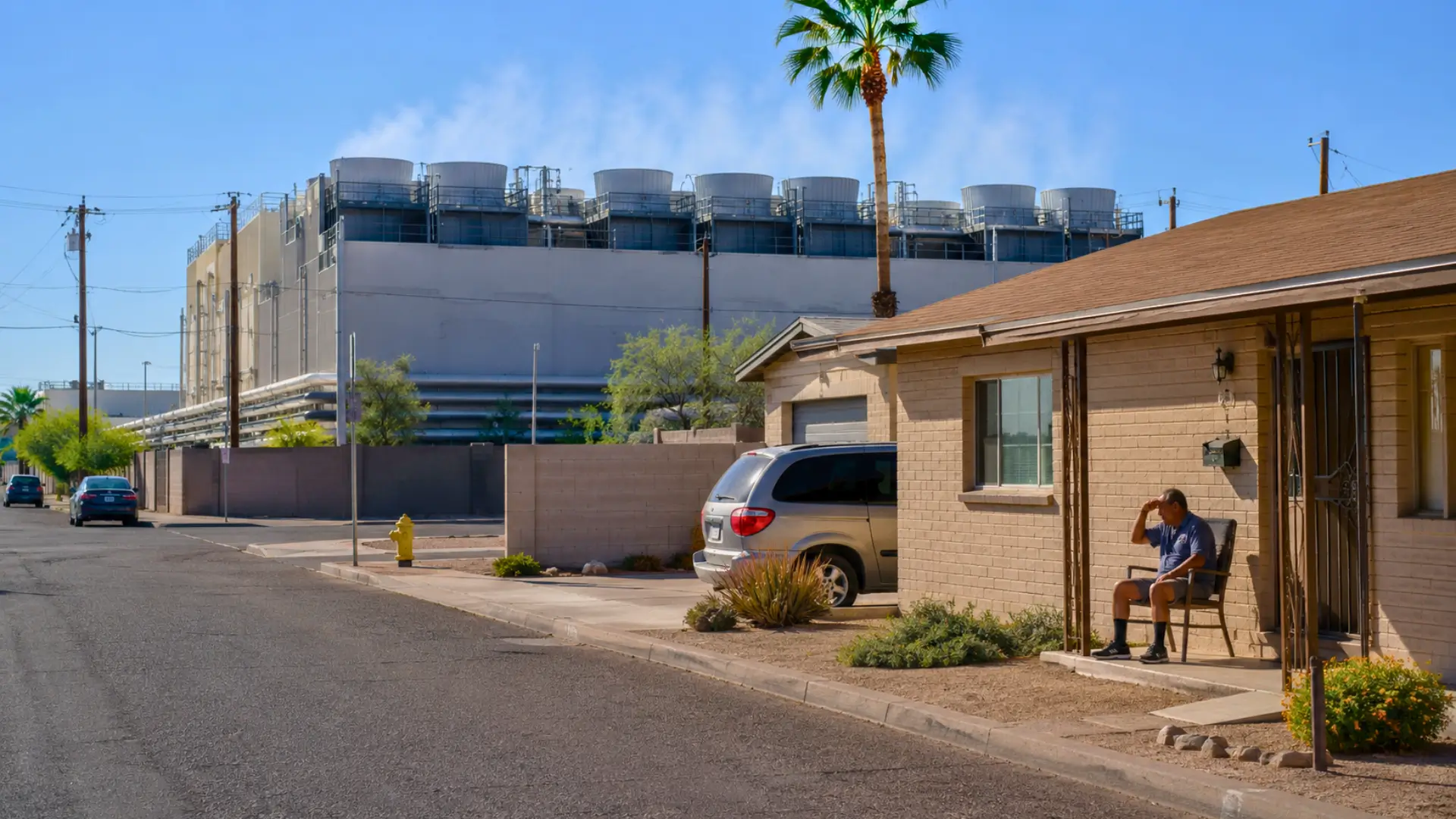
In the American city where asphalt can already feel scorching, a study has measured a long-suspected effect: data centers generate enough heat to alter the temperature around them. In Phoenix, this invisible warmth climbs into residential streets.
A Local Increase in Temperatures That Directly Impacts Residents’ Health
Phoenix didn’t really need another heater. In summer, the capital of Arizona basks under a pale sky. Days regularly exceed 40 °C. More importantly, nights hardly cool the walls anymore. In this setting, a few extra degrees aren’t just weather trivia. On the contrary, they are a public health issue.
That is precisely where researchers from the Arizona State University followed the thermal trail of data centers. Their study, published in the ASME Journal of Engineering for Sustainable Buildings and Cities, relies not only on a computer model. Indeed, it also draws on field measurements taken around buildings filled with servers.
Mobile measurements reveal a thermal plume around data centers
Between June and October 2025, Phoenix sometimes looked like an open-air oven. Yet the researchers chose this extreme period to install temperature sensors on vehicles. Then, these cars circulated near the data centers. Afterwards, they traversed the neighboring neighborhoods.
The teams therefore compared several urban zones. On one side, the sectors downwind of the installations. On the other, streets less exposed to the hot air exhaust. Thus, the heat wasn’t guessed from afar. Rather, it was tracked almost step by step, right along the pavement.
The result gives a measurable chill, even in the desert. In some areas, temperatures near the facilities exceeded 0.7 to 2.2 °C compared with other similar zones. In other words, a day already suffocating at 48 °C can locally approach 50 °C. Yet, no cloud was responsible.
Behind the cloud, machines discharge heat comparable to thousands of homes
The word cloud conveys a light, almost vaporous sense. Yet behind vacation photos, streaming, and artificial intelligence calculations, there are hangars full of machines. And these infrastructures must stay cool. To achieve this, they rely on powerful cooling systems, sometimes water-intensive.
The surprise of the study lies not only in this heat, but also in its scale. According to the researchers, the heat rejected by a single large data center can exceed that produced by 40,000 households. Consequently, these anonymous buildings resemble less a mere logistics box.
The problem becomes sharper near inhabited neighborhoods. In Phoenix, several sites studied are located close to residential areas. For residents, the effects can thus be very tangible. Homes become harder to cool. Bills rise as well. Moreover, exposure increases during extreme heat events.
The rise of AI forces cities to rethink the placement of data centers
The question goes far beyond Phoenix. With the rise of artificial intelligence, computing needs are exploding. In parallel, data centers are multiplying in the United States as elsewhere. Moreover, power demand could still climb by 2030. Consequently, every siting decision becomes more sensitive than it was a decade ago.
The researchers are not saying that we should shut down the Internet, of course. They instead urge urban planners to treat these buildings as thermal infrastructures. After all, roads, parking lots, and factories already shape the temperature of cities. Thus, the orientation of exhausts, vegetation, distances from homes, and heat recovery become decisive choices.
Still, these choices must be anticipated before construction. Data from NOAA and the National Weather Service already remind us that Phoenix is setting alarming heat records. Tomorrow, however, our AI systems, our videos, and our archives will rely on real, tangible buildings. So remains a burning question: where to place this heat that an entire neighborhood can feel?

Contact details
Address:
Farmers Forum,
36, Dominick Street,
Mullingar,
Co. Westmeath,
Ireland
Phone:
+353 (0)44 9310206
Or email us:
For technical issues please check out our FAQ's page or email - [email protected]
For general Queries email - [email protected]
Request to add event to our Calendar - [email protected]
Send us your mart reports - [email protected]
Suggestions and feedbacks - [email protected]
News Items / Press Release - [email protected]
To Advertise on Farmers Forum - [email protected]