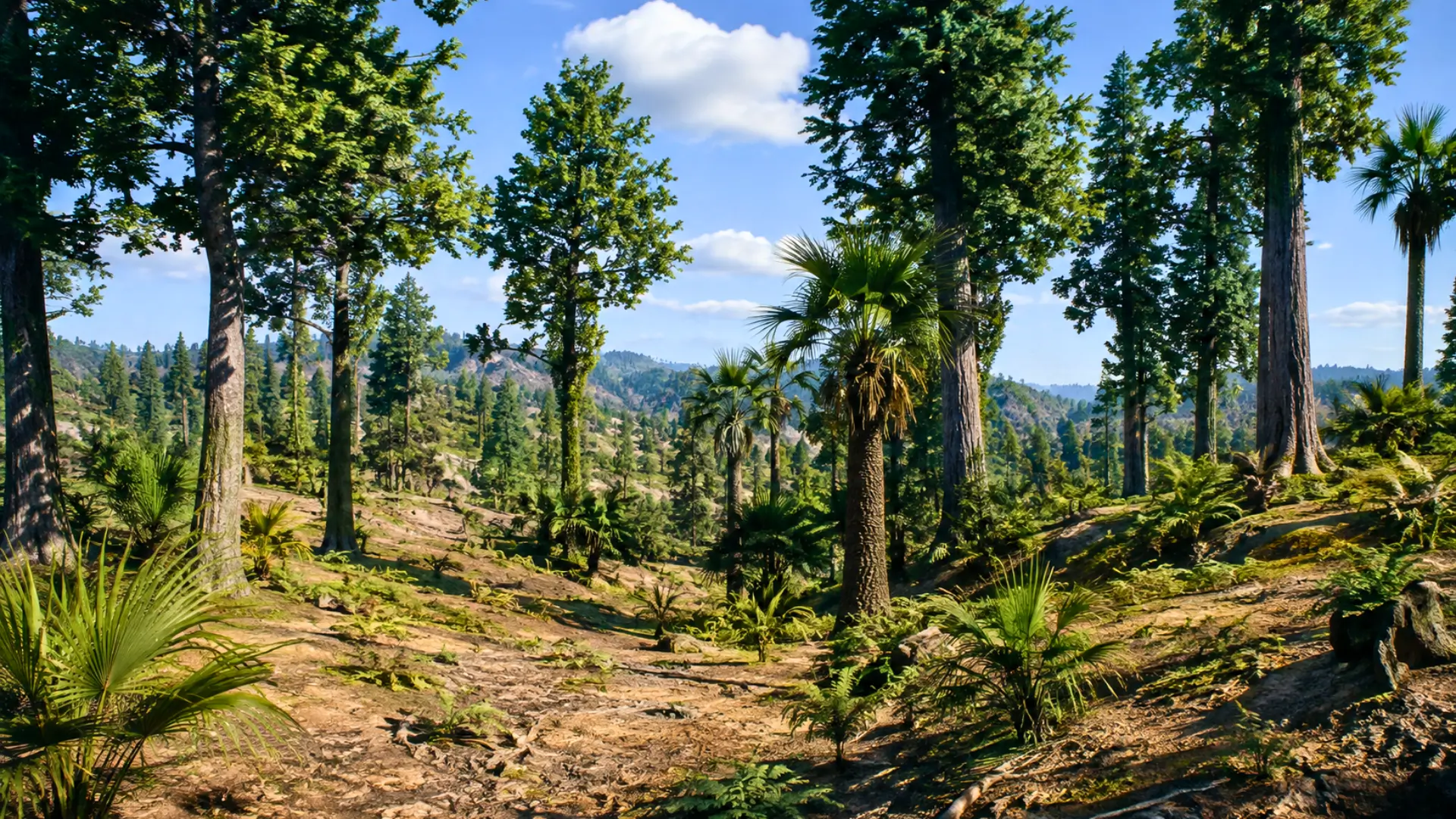
Could a forest take a hundred millennia to heal? Wyoming fossils show that about 56 million years ago, several degrees of warming initially boosted the trees, then abruptly opened up the canopy, permanently reshaping the landscape.
In Wyoming, a lush forest faced a climate that became unrecognizable
The landscape would today feel almost surreal. In what would become Wyoming, vast forests blended progenitors of redwoods, black walnuts, and elms. They also sheltered plants adapted to mild climates. Then comes the Paleocene-Eocene Thermal Maximum, about 56 million years ago. The atmosphere becomes heavily laden with carbon.
What is most striking is that the trees do not immediately wither. At first, higher CO₂ seems to boost growth. The forest even thickens. But this upside hides a trap. As temperature and aridity rise, the CO₂ advantage vanishes. Heat imposes its own rules.
Cells smaller than a grain of dust told the story of the canopy’s collapse
To reconstruct the look of these vanished forests, researchers did not rely solely on counting fossil leaves. They studied their microscopic cuticles. These protective films can endure in sediments for tens of millions of years. The shape of their cells reveals the light the leaves received.
A leaf growing beneath a dense canopy does not develop the same cells as one exposed to direct sun. Scientists compared thousands of fossil cells with those from modern Central and South American forests. They thereby created a forest-density indicator, based on leaf surface area.
The result is striking. According to the study published in August 2026 in Science, the leaf cover falls by roughly 60% in a few thousand years. The forest becomes far more open. The soils receive more light and rain. The water cycle changes, and erosion speeds up.
When trees recede, ferns and palms suddenly enjoy a warmer world
A forest collapse does not automatically turn the landscape into a desert. In the Hanna Basin, fossils reveal a dramatic reshaping of vegetation. Ferns colonize the newly exposed spaces. Palms and other thermophilic plants push northward as well.
This evolution tells a core reality. A forest can stay green yet become ecologically very different. The disappearance of the large trees shifts shade, humidity, and carbon storage. It also weakens soils. According to the US Geological Survey, these changes destabilized the landscape on a scale far beyond a few woodland patches.
The most vertiginous number isn’t the temperature, but the 100,000 years that followed
Yet the climate eventually settles down. Over very long timescales, chemical weathering of rocks removes CO₂ from the atmosphere. The climate gradually cools. Water becomes more available again and canopies can close again. But this recovery is not measured in decades, nor even in millennia.
The data show that the return of a dense forest took more than 100,000 years. A climate episode can thus destabilize an ecosystem relatively quickly. Its rebuilding requires an interval nearly inconceivable on human timescales. Resilience exists, but it does not guarantee a rapid return to the original state.
The comparison with today should remain prudent. The continents, species, and climate of the Eocene were different. Yet these fossils reveal a troubling mechanism. Beyond a certain threshold, heat and drought neutralize the benefits of CO₂. A very current question remains: would we recognize this threshold before crossing it?

Contact details
Address:
Farmers Forum,
36, Dominick Street,
Mullingar,
Co. Westmeath,
Ireland
Phone:
+353 (0)44 9310206
Or email us:
For technical issues please check out our FAQ's page or email - [email protected]
For general Queries email - [email protected]
Request to add event to our Calendar - [email protected]
Send us your mart reports - [email protected]
Suggestions and feedbacks - [email protected]
News Items / Press Release - [email protected]
To Advertise on Farmers Forum - [email protected]