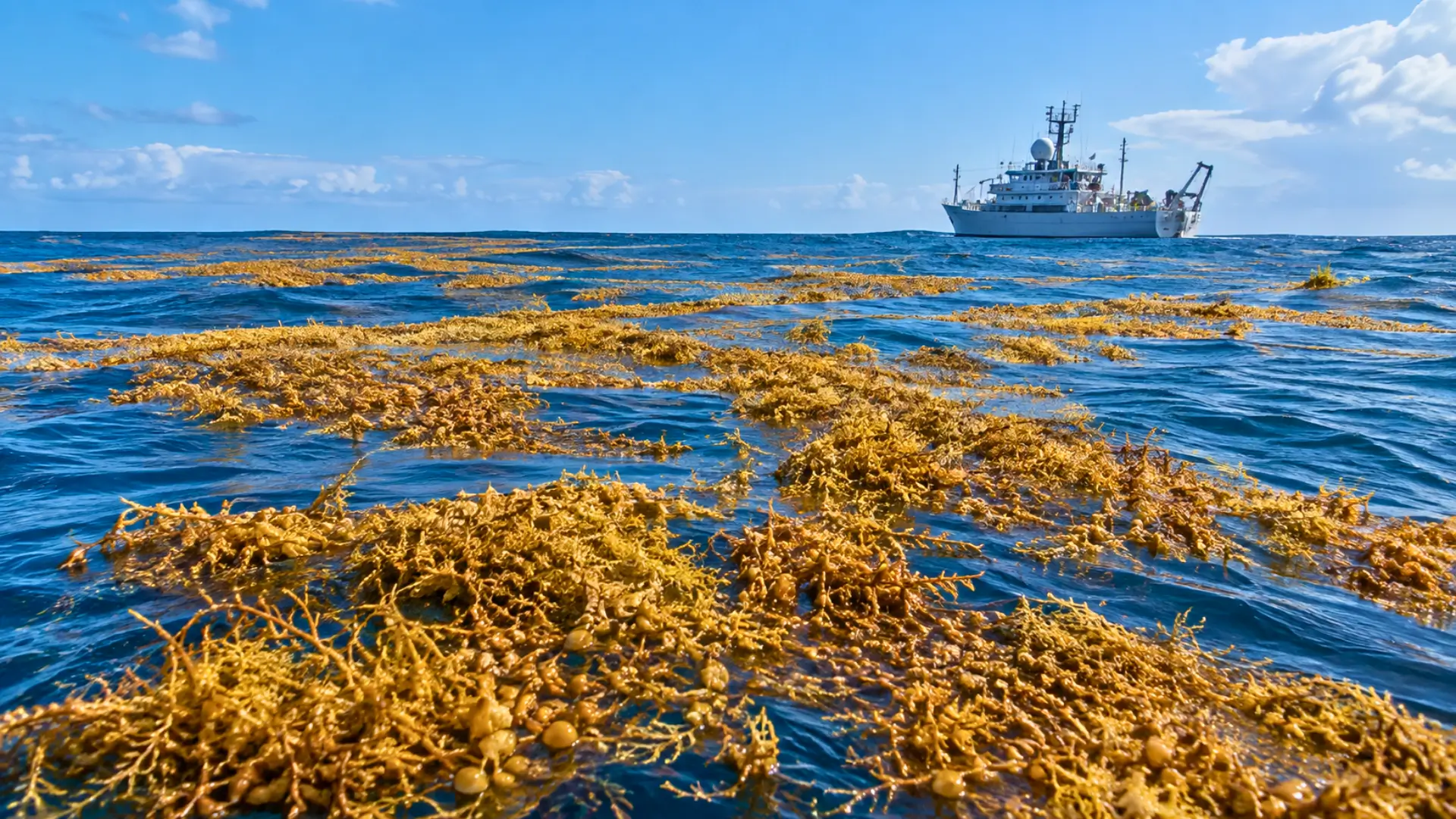
In 2025, a record-breaking mass of sargassum overwhelmed the tropical Atlantic and the Caribbean. But where does the nourishment come from that could feed such a gigantic plant? Centenarian corals have just revealed an oceanic mechanism more surprising than expected.
For years, attention had turned toward the Amazon and agricultural fertilizers
In spring 2025, satellites tracked an extraordinary phenomenon. By May, roughly 37.5 million tonnes of sargassum were floating in the Atlantic, the Caribbean, and the Gulf of Mexico. By July, a University of South Florida estimate reached 38 million tonnes, a level unseen in modern records.
Since the appearance of the Great Atlantic Sargassum Belt in 2011, suspicions have mainly pointed toward nutrients delivered by major rivers, agriculture, and deforestation. These factors can play a local role, but a study published in Nature Geoscience shows that they do not, on their own, explain the enormous year-to-year variations observed.
The main fuel actually rises from the depths of the equatorial Atlantic
The scenario proposed by the researchers starts well away from tourist beaches. Near the equator, winds foster a process called upwelling: waters from below the surface rise and bring excess phosphorus into the upper layers of the ocean. The currents can then transport these nutrient-rich waters toward the tropical North Atlantic.
This detail profoundly alters the narrative. The essential fuel behind massive blooms does not necessarily stem from a gigantic, terrestrial fertilizer tap. A large portion of the phenomenon is tied to the natural circulation of the ocean, whose intensity fluctuates with winds and the major climatic modes of the Atlantic.
The study notably shows that periods of stronger equatorial upwelling correspond to more available phosphorus. In the models analyzed, the combination of nitrogen fixation and climate variability explained a large portion of the observed sargassum biomass fluctuations since 2011, better than adding several alternative nutrient sources.
On the sargasses lives a microscopic partner capable of supplying them with nitrogen
Another piece of the puzzle had to be solved: phosphorus alone is not enough to generate so much living matter. Sargassum also needs nitrogen. At their surface, they harbor tiny allies, nitrogen-fixing bacteria, some of which are cyanobacteria. They convert molecular nitrogen into biologically usable compounds.
This partnership gives the algae a serious edge when waters are rich in phosphorus but relatively poor in assimilable nitrogen. The bacteria can provide nitrogen directly to their host. With the phosphorus rising from the depths, the sargasses then have both elements, enabling spectacular growth under conditions where other organisms are more limited.
To trace the thread of this story, scientists used an unexpected archive: cores taken from Caribbean corals. Their organic matter retains the isotopic signature of the nitrogen available at the time of growth. The researchers thus reconstructed regional variations in nitrogen fixation between 1900 and 2021.
Corals aged about 120 years preserved the chemical memory of these proliferations
The data reveal oscillations over decades, linked to shifts in atmospheric and oceanic circulation in the Atlantic. Periods of enhanced upwelling coincide with greater nitrogen fixation. The exceptional sargassum episodes of 2015 and 2018 are even associated with the highest fixation levels in the series studied.
The stakes extend far beyond scientific curiosity. When they strand, these algae can smother coastal habitats and release hydrogen sulfide as they decompose. The 2025 record underscored the scale of the challenge for Caribbean territories, their tourism, and their cleanup efforts. Satellites now allow these masses to be tracked almost in real time.
One decisive question remains: what will become of this mechanism in a warmer ocean? The study’s authors stress that the future of sargassum will depend largely on how warming will alter the winds and the equatorial upwelling. The next invasion could thus begin well before beaches, in the hidden movements of the deep Atlantic.

Contact details
Address:
Farmers Forum,
36, Dominick Street,
Mullingar,
Co. Westmeath,
Ireland
Phone:
+353 (0)44 9310206
Or email us:
For technical issues please check out our FAQ's page or email - [email protected]
For general Queries email - [email protected]
Request to add event to our Calendar - [email protected]
Send us your mart reports - [email protected]
Suggestions and feedbacks - [email protected]
News Items / Press Release - [email protected]
To Advertise on Farmers Forum - [email protected]