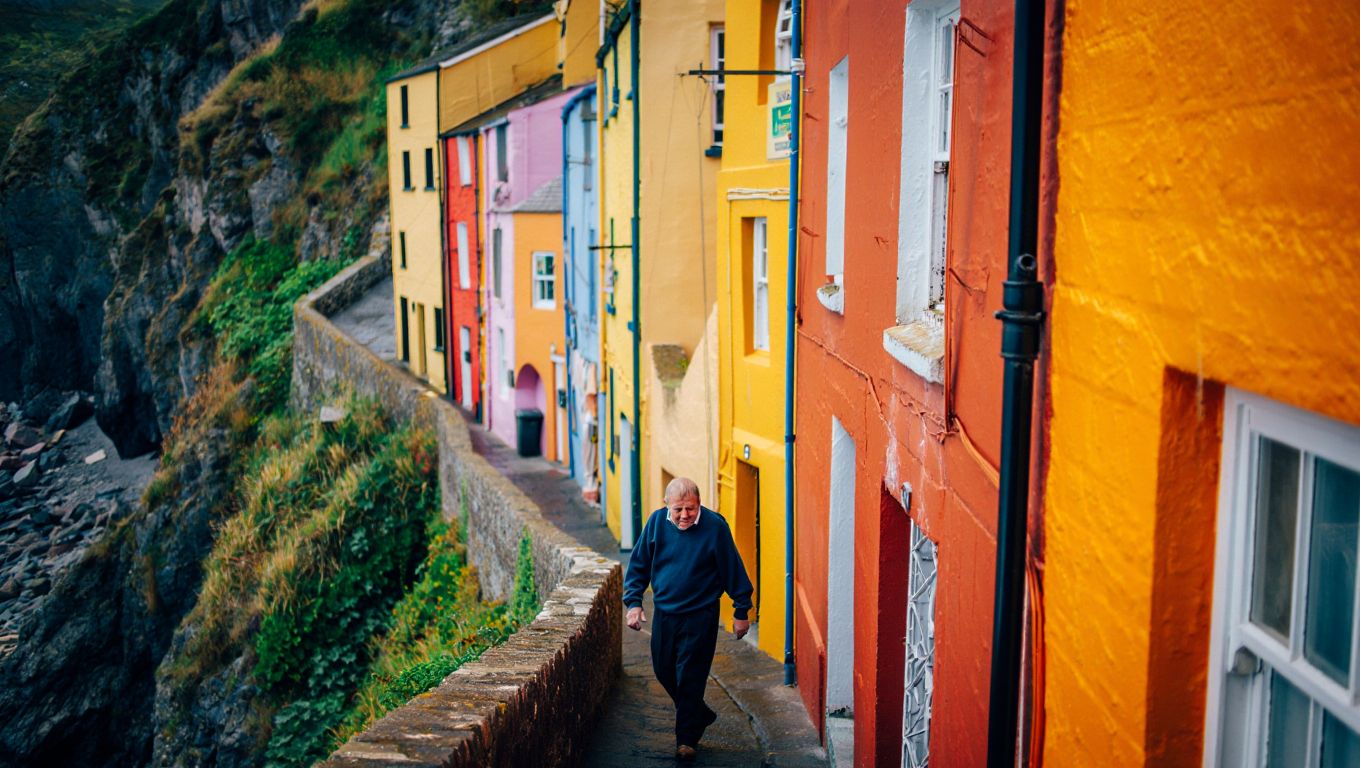
Salt on the air, colour on the walls, and the Atlantic breathing right below the lane. On the far edge of County Clare, a tiny village leans into the cliffs, its cottages painted like a box of crayons. The lanes are quiet, the sea is loud, and time seems to stretch like the horizon.
This is Kilbaha, a crook in the road where fishermen knot lines and windows flash teal, buttercup, and rose. It feels familiar and brand-new, a place both end-of-the-line and centre of your map. “You can hear the ocean thinking,” a woman mending nets said, smiling without looking up.
Finding the edge, slowly
The Loop Head drive runs like a ribbon along stone walls and bog, with sheep like salt scattered in the fields. You pass Carrigaholt, curve past the estuaries, then the land narrows to one lane and the sky grows enormous. The first view of Kilbaha is sudden: colour, boats, and an old bar tilting toward the water.
Park where the tide allows and wander the shoreline road. The village is small, but every door says hello. A gull cackles, a kettle sings, and you exhale without even knowing you’d been holding your breath.
A paintbox by the sea
Kilbaha’s cottages are cheerful without being cute, colours chosen for weather as much as for whim. “We paint for the storms, too,” someone jokes. After a winter gale, bright walls feel like lamplight.
History here is local and lived-in. The Little Ark, a wooden chapel on wheels, once rolled onto the foreshore so a priest could hold Mass beyond a landlord’s reach. You can see it at St Senan’s, a story cradled in timber and stubborn faith. It’s a reminder that community often begins where maps fade.
Keating’s Bar looks over the bay, floorboards rubbed soft by generations of boots. A barman grins: “Nearest bar to New York, if you squint.” The chowder is creamy, the brown bread thick, the view pure west. Wind spools around the corner, pint glasses catch the light, and conversation gathers like a friendly squall.
Walks that recalibrate your scale
The coast beyond the village is a manual in geology and patience. Head for the Bridges of Ross, where ancient arches claw at the sea and kittiwakes write arrows in the air. Paths are wild, cliffs are sheer, and common sense is mandatory.
Further on, the Loop Head Lighthouse stands like a comma in a long sentence of waves. Step into the lantern, feel the stairs spiral, and look toward a meeting of waters that never agree. On calmer days, boats scan the Shannon for dolphins, their backs like brief parentheses in glittering text.
“Out here the wind edits you,” a guide once told me. “It takes the unnecessary and throws it to sea.” You will think of that line when your phone finds no signal and your shoulders drop an inch.
Food, craft, and conversations that linger
By afternoon, the village kitchen smells like buttered crab and lemon-zested mayo. Order what’s fresh, which is code for today. A plate of mussels, a wedge of tart, another slice of bread you didn’t think you needed.
There’s a tiny gallery with storm-blue prints, beach-found jewellery, and wooden spoons smooth as pebbles. “The colours come from the weather,” the owner says. “Grey makes the yellow braver, and sun makes the blue think it’s the Caribbean.”
Evenings hum quietly. One pub, two stories, and a fiddle that warms the rafters. A farmer swaps forecast notes with a visiting walker. Someone laughs about a cow that prefers the view and keeps escaping the field. The night is soft, and the stars leave salt-like pinpricks above the harbour.
When to go and how to be gentle
Shoulder seasons are gold here: April–June and September, when the air feels washed and the lanes stay calm. Summer has buzz, winter has mood, and weather is honest year-round.
Carry layers, respect fences, and keep a sensible distance from the cliffs. The land is working, and you’re a guest. If you love a place, you also leave it as you found it.
- Pack layers and waterproofs; the sky rewrites plans.
- Park with care; tides and tractors have right of way.
- Stay on paths; cliff edges are fragile and often undercut.
- Support local: galleries, cafés, and small boats.
- Take only photos, leave only footprints light as foam.
Why it stays with you
Some destinations are loud about themselves. Kilbaha is confident with a whisper. It offers colour without the clamour, drama without performance, and hospitality with no script.
You remember the yellow door next to the green, the tin roof that pinged in a shower, the way a wave folded like a freshly pressed sheet. You remember a voice at the bar saying, “Take your time, there’s plenty of it here,” and realising that was both blessing and challenge.
Drive away and the road unspools behind you like twine. In the mirror, the village turns smaller, but the feeling grows larger. On this narrow headland, at the edge of an old story, the palette is bolder because the pace is slower—and that’s the kind of luxury that lasts.

Where is the location of that picture as I’m looking at kilbah in Clare on Google maps and… I can’t find it 🤷🏻♂️
That picture is not Kilbaha, maybe Doolin in North Clare
Absolutely not Doolin!
Is that picture ai? FFS why?!…
Very interesting piece. I must visit! Any recommendations on where to stay?
Beautiful story told Liam. I want to go there.
Absolutely beautifully written! Adjectives and imagery used make the village come alive for us, the readers!
Hats off to you Liam 👌🏻
I know Loophead & Kilbaha well, & beautiful though it is, I have never seen that cliffside colourful village shown in your photo. Where is it Liam….truth please!
I know Loophead & Kilbaha well, & beautiful though it is, I have never seen that cliffside colourful village shown in your photo. Where is it Liam….truth please!
I was married in the church of the little ark..long time ago….a phd from u.c.d.and a fellowship from london…
A lot of what you have written.is true.im a native of the ..wild the bleak the fair
Corca baiscin. .BUT not all of us take the road less travelled…the pure poverty is unforgiving…neglect and indifference.for decades….has a much more sinister vibrant colour….because the answer is bliowing inthe wind. . And its too cold for judgement.