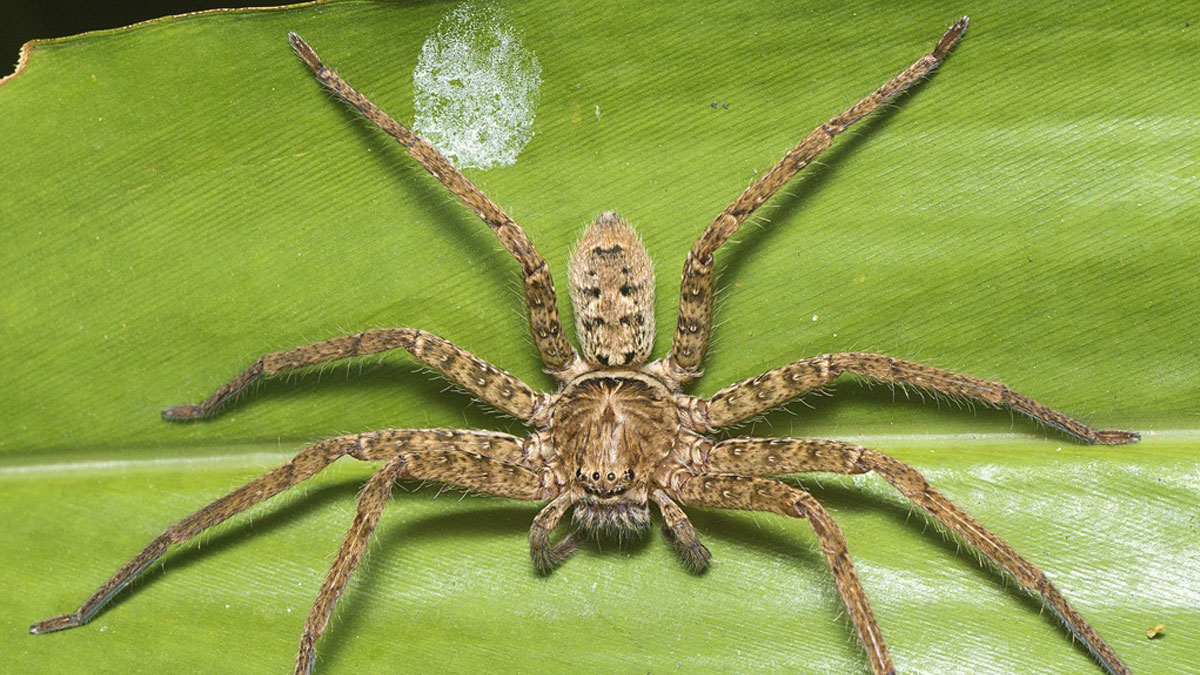
The meticulous study of more than 200 spider species has crowned the fastest in the world. Native to Australia, this exceptional sprinter comes close to 3.6 meters per second.
Heteropoda jugulans Stands Out
To explore the biomechanical forces at play, Shreyas Kuchibhotla of Imperial College London and his colleagues collected 162 spider species from across the globe. Each arachnid was weighed, then filmed during speed tests conducted on lined A4 or A3 sheets. Data from other teams were added, bringing the total number of species examined to 258.
As the authors explain in the new study, pre-published on the bioRxiv server, while light contact with a brush sufficed in most cases, tarantulas proved markedly less cooperative. “Jets of compressed air were necessary for them to finally start running,” they detail.
The world record was set by the Australian hunting spider Heteropoda jugulans. Weighing just 3 grams, the creature reached the spectacular speed of 3.59 meters per second. “They are relatively large but have a small abdomen,” explains Kuchibhotla.
The most comprehensive database ever compiled of how fast arachnids can run has shown how leg anatomy and evolutionary history influence spiders’ running speed https://t.co/2kKClvulOg
— New Scientist (@newscientist) June 30, 2026
The real surprise came from the orange goblin spider (Oonops pulcher), whose performance was likened to teleportation. Weighing no more than 0.1 milligram, it is capable of moving at more than 20 centimeters per second.
Evolutionary Trajectory
As David Labonte, of Imperial College London, reminds us, living strategies (notably hunting tactics) drive extreme anatomical and physiological adaptations. “They explain why a cheetah would easily outrun any dog of similar size,” he explains.
Anatomically speaking, the researchers mainly tie the rapid running of spiders to relatively long and thick legs.
“The main takeaway from these works is that their speed depends above all on the structure of their limbs and their evolutionary history,” concludes Leanda Mason of Edith Cowan University.
Earlier this year, a study had revealed the mechanism enabling an Australian spider to perform prodigious leaps.

Contact details
Address:
Farmers Forum,
36, Dominick Street,
Mullingar,
Co. Westmeath,
Ireland
Phone:
+353 (0)44 9310206
Or email us:
For technical issues please check out our FAQ's page or email - [email protected]
For general Queries email - [email protected]
Request to add event to our Calendar - [email protected]
Send us your mart reports - [email protected]
Suggestions and feedbacks - [email protected]
News Items / Press Release - [email protected]
To Advertise on Farmers Forum - [email protected]