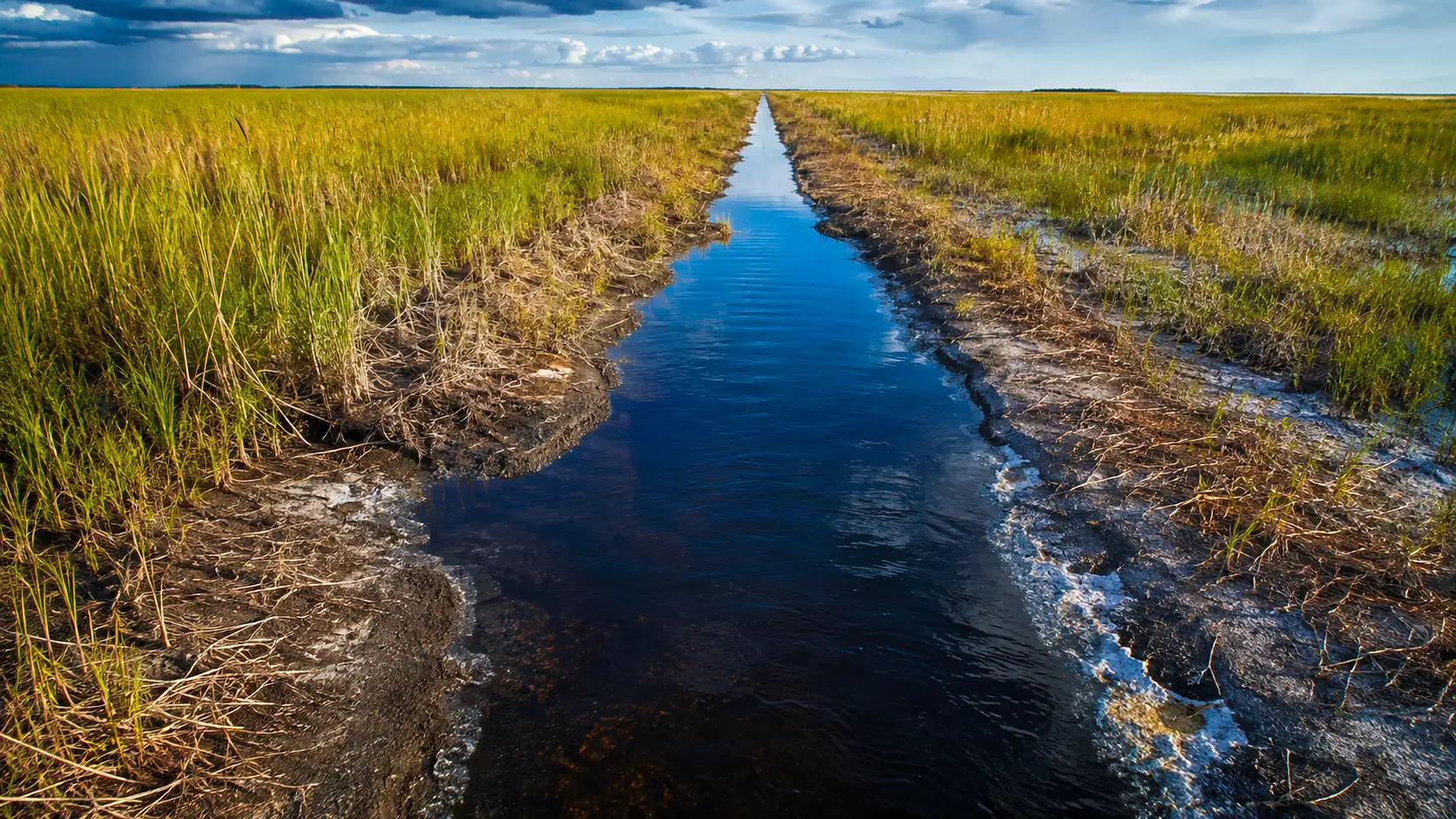
In Florida, a mosquito-control campaign ultimately drained an entire freshwater ecosystem. The Everglades still bear the traces today. And it reveals a common misunderstanding, one that confuses purifying a marsh with drying it out.
In the 1920s, Florida digs 139 kilometers of canals to drive mosquitoes out of the Everglades
The Everglades formed a unique grass river. Spanning tens of kilometers in width, it remained remarkably shallow in places, just a few inches deep. This freshwater flowed slowly toward the sea, feeding a rich fauna on waterlogged and inhospitable soil.
Sticky heat and swarms of mosquitoes made the region unlivable for anyone wishing to settle there. Action was needed. In the 1920s, a solution seemed obvious to local engineers. It was enough to eliminate the standing water, the nursery of the biting insects.
The project began with the digging of 139 kilometers of canals. The objective was simple: push the water toward the ocean and transform the marshes into dry, buildable land. Yet this reasoning overlooked a crucial hydraulic balance.
By draining the Everglades of their freshwater, these canals allowed seawater to invade the soils and the aquifers
No one had anticipated this mechanism. For the freshwater drained toward the ocean had previously exerted a subtle pressure. That pressure kept saltwater at bay from the land. By removing it, the canals allowed the sea to infiltrate the soils.
Result: this phenomenon of saltwater intrusion transformed fertile lands into salty soils. These lands became unusable for the agriculture that was to be developed. The Everglades thus lost more than 70% of their historic water discharge.
From canal to canal, Florida built a giant hydraulic network that disrupted the entire wildlife of the Everglades
One canal led to another. Then an entire water-control system emerged. Today, Florida counts roughly 3,500 kilometers of canals and more than 3,400 kilometers of levees. Hundreds of regulation structures complete this setup.
Dozens of pumping stations fill or drain artificial basins at will. This growing mastery over water ended up upsetting the life that depended on it. The direct consequence: the local fauna paid the price.
Indeed, populations of wading birds have fallen by nearly 90% since the drainage began. This decline has been documented for decades. Pollution and invasive species arrived to worsen this initial fragility.
Because the drinking water of millions of people depends on it, Florida is trying to repair its Everglades
The rains that fall on the Everglades feed the Biscayne aquifer. This underground reservoir, in turn, supplies the drinking water for one of the most densely populated regions in the United States. Every day, hundreds of millions of liters are pumped from it.
Thus, at the turn of the millennium, a restoration program was launched with an estimated budget of about $23 billion. The drying-out took decades to take hold, and its full repair will likely require several more decades.

Contact details
Address:
Farmers Forum,
36, Dominick Street,
Mullingar,
Co. Westmeath,
Ireland
Phone:
+353 (0)44 9310206
Or email us:
For technical issues please check out our FAQ's page or email - [email protected]
For general Queries email - [email protected]
Request to add event to our Calendar - [email protected]
Send us your mart reports - [email protected]
Suggestions and feedbacks - [email protected]
News Items / Press Release - [email protected]
To Advertise on Farmers Forum - [email protected]