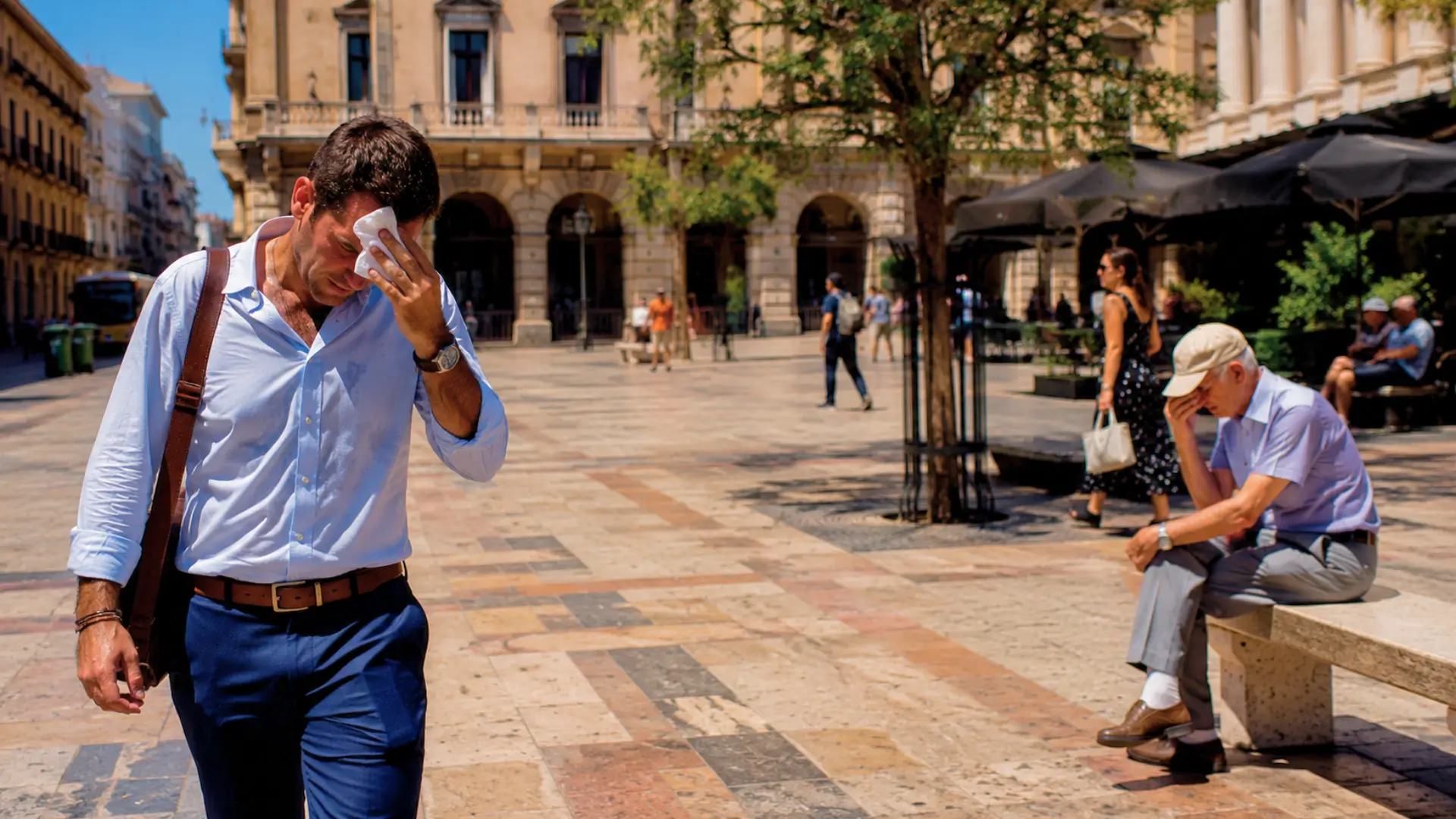
The thermometer is rising everywhere, yet Europe appears to be warming faster. Behind the heatwaves taking hold, a climate mechanism is unfolding: a neighboring Arctic, stubborn anticyclones, cleaner air… And could the Old Continent already be testing the climate of our future?
Europe is warming twice as fast as the global average
The planet has already warmed by about 1.4 °C since the pre-industrial era. Europe, for its part, is warming faster: Copernicus data and the World Meteorological Organization indicate it is warming more than twice the global average since the 1980s. This isn’t the impression of a sunburned tourist squeezed onto a crowded station platform.
The main driver remains well known: the greenhouse gases from coal, oil, and gas. They trap more heat in the atmosphere, like a blanket you won’t take off in the middle of a summer night. But Europe adds to this global trend a series of geographic and atmospheric peculiarities that change the scale of the problem.
What strikes climate scientists is the pace. Copernicus estimates that Europe has warmed by around 0.5 °C per decade since the mid-1990s. At this rate, records stop looking like anomalies: they become milestones of a new thermal landscape, with longer summers, nights that offer less rest, and soils that are more vulnerable.
More tenacious anticyclones that trap heat in place
On a weather map, a high-pressure system can seem almost reassuring: blue skies, stable air, no rain—the postcard-perfect scene. Yet when it sticks around too long, it acts as an invisible lid. Air descends, compresses, heats up, and clouds vanish precisely when they would be most useful.
These high-pressure situations seem to be becoming more frequent or persistent in certain European regions, especially in summer. Researchers remain cautious: the exact share of climate change in this shift of atmospheric circulation is still debated. But the tangible effect is clear: longer heatwaves, less mobile, sometimes stuck for several days over the same regions.
The trap worsens when soils dry out. Moist soil uses part of the sun’s energy to evaporate water, tempering the air. Dry soil heats directly, like an empty pan. Thus a heat wave becomes a local feedback loop, with each scorching day setting up the next.
The proximity to the Arctic accelerates the rise in temperatures
Europe is not merely positioned between the Atlantic and the Mediterranean: it also faces toward the far north. And the Arctic is warming much faster than the global average. When snow and ice retreat, the dark surfaces absorb more solar radiation.
This mechanism, known as albedo, acts like a vicious circle. Ice reflects the Sun’s energy, while the open ocean absorbs it. The warmer it gets, the more ice melts. This dynamic disrupts air masses, the seasons, and leaves the dark ground to accumulate heat earlier.
The drop in pollution reveals heat long masked
Here is the part that often surprises: the reduction in air pollution has also helped make warming more visible. Since the 1980s, Europe has substantially reduced certain aerosols harmful to health. It’s excellent news for lungs, asthma-prone children, and cities long wrapped in a gray veil.
But many of these particles had a temporary cooling effect, reflecting some sunlight or altering clouds. By removing them from the atmosphere, we lifted something like a dirty parasol. The paradox is stark: cleaning the air does not cause climate change, but reveals more of the heat trapped by greenhouse gases.
Europe does not warm uniformly. The East, Southeast, the Alps, or subarctic areas experience very different accelerations. The reports from Copernicus and the WMO already describe a continent of contrasts: droughts, floods, retreating glaciers, warmer seas. The real question becomes how quickly our cities, cultures, and habits adapt.

Contact details
Address:
Farmers Forum,
36, Dominick Street,
Mullingar,
Co. Westmeath,
Ireland
Phone:
+353 (0)44 9310206
Or email us:
For technical issues please check out our FAQ's page or email - [email protected]
For general Queries email - [email protected]
Request to add event to our Calendar - [email protected]
Send us your mart reports - [email protected]
Suggestions and feedbacks - [email protected]
News Items / Press Release - [email protected]
To Advertise on Farmers Forum - [email protected]