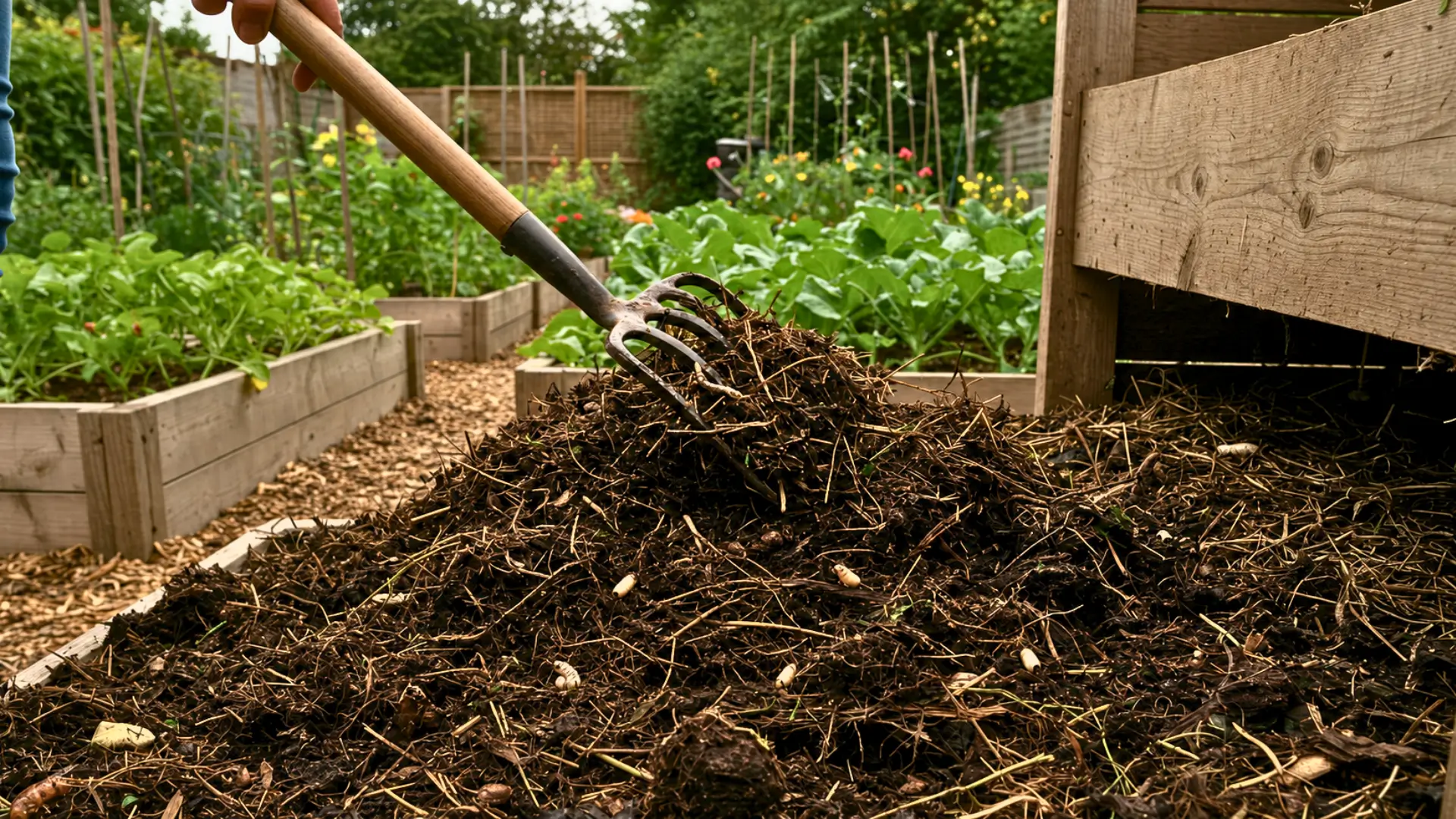
Not all white larvae are pests. In a compost pile, some actively contribute to breaking down plant waste, while others can harm garden roots. Knowing how to tell them apart helps prevent a common mistake with real consequences for soil life.
A White Larva in Compost Isn’t Necessarily Dangerous
The sight of a large white larva in the compost often unsettles gardeners, as it evokes the familiar white grubs reputed to attack plant roots. The cockchafer is among the dreaded species. Yet, in a compost bin, what you’re most likely observing are larvae of flower chafers (cetoniines), which are useful to the decomposition of dead organic matter.
This distinction matters because the two larvae have different dietary habits. The cockchafer larva mainly grows and feeds in the soil, consuming living roots for several years. In contrast, the cetoniine larva prefers piles of leaves, decaying wood, and mature compost, so it does not target young plants.
The compost naturally attracts the decomposer species. In this environment rich with plant waste, the cetoniine finds food, moisture, and protection. Consequently, removing it reflexively deprives the ecosystem of a beneficial organism. It helps fragment the material, aerate it, and prepare a more stable humus for the garden.
Head, Abdomen, and Legs Help Identify the Beneficial Larva
The simplest method begins with observing the silhouette. The cetoniine typically has a small head and a broad, almost swollen abdomen. By contrast, the cockchafer larva shows the opposite: a larger, clearly visible head and a rear end that appears more slender.
The legs also offer a helpful clue. On the cetoniine, they are short, sometimes barely noticeable, and can seem almost out of proportion to the body. In the cockchafer larva, they are longer and better developed. This difference mirrors their lifestyles: one searches through decaying matter, while the other explores the soil around the roots.
A movement test can also assist when in doubt. Placed on a hard surface, a cetoniine larva may glide along on its back, using the tiny hairs that cover its body. The cockchafer larva relies more on its ventral legs. However, this behavior does not replace careful observation; it simply provides another concrete criterion.
Cetoniinae Contribute to the Natural Recycling of Plant Waste
The cetoniine larva thus plays a quiet yet valuable role in the compost. It consumes fragments of dead wood and leaves that are already breaking down. It also ingests other plant residues that have already been transformed. By digesting them, it yields finer particles. These particles facilitate the activity of the compost’s microorganisms.
This action may not be spectacular, but it remains essential. A fertile compost depends on a multitude of actors: bacteria, fungi, earthworms, woodlice, larvae, and beetles. In this way, the cetoniine joins a team of recyclers. Together, they return to the soil a portion of what the garden has produced.
As an adult, the golden cetoniine then changes its role. This metallic green beetle frequents flowers, where it feeds on nectar and pollen. It may occasionally nibble at a few petals. Yet it also participates in occasional pollination by transferring pollen on its body. Its usefulness thus extends beyond the compost bin.
The Right Steps: Identify, Move, or Let Them Live
In a compost, the best course of action is often to leave the cetoniine larvae where they are. Indeed, they do not threaten crops and they help maintain the pile’s biological balance. If the compost must be sieved, the larvae can simply be relocated to a spot rich in fallen leaves or decomposed wood.
If a cockchafer larva is identified in garden soil, the situation differs. It may damage the roots of vegetables, turf, or young plants. In that case, it is best removed manually. Afterwards, promote natural predators such as insectivorous birds, hedgehogs, or certain soil-dwelling mammals.

Contact details
Address:
Farmers Forum,
36, Dominick Street,
Mullingar,
Co. Westmeath,
Ireland
Phone:
+353 (0)44 9310206
Or email us:
For technical issues please check out our FAQ's page or email - [email protected]
For general Queries email - [email protected]
Request to add event to our Calendar - [email protected]
Send us your mart reports - [email protected]
Suggestions and feedbacks - [email protected]
News Items / Press Release - [email protected]
To Advertise on Farmers Forum - [email protected]