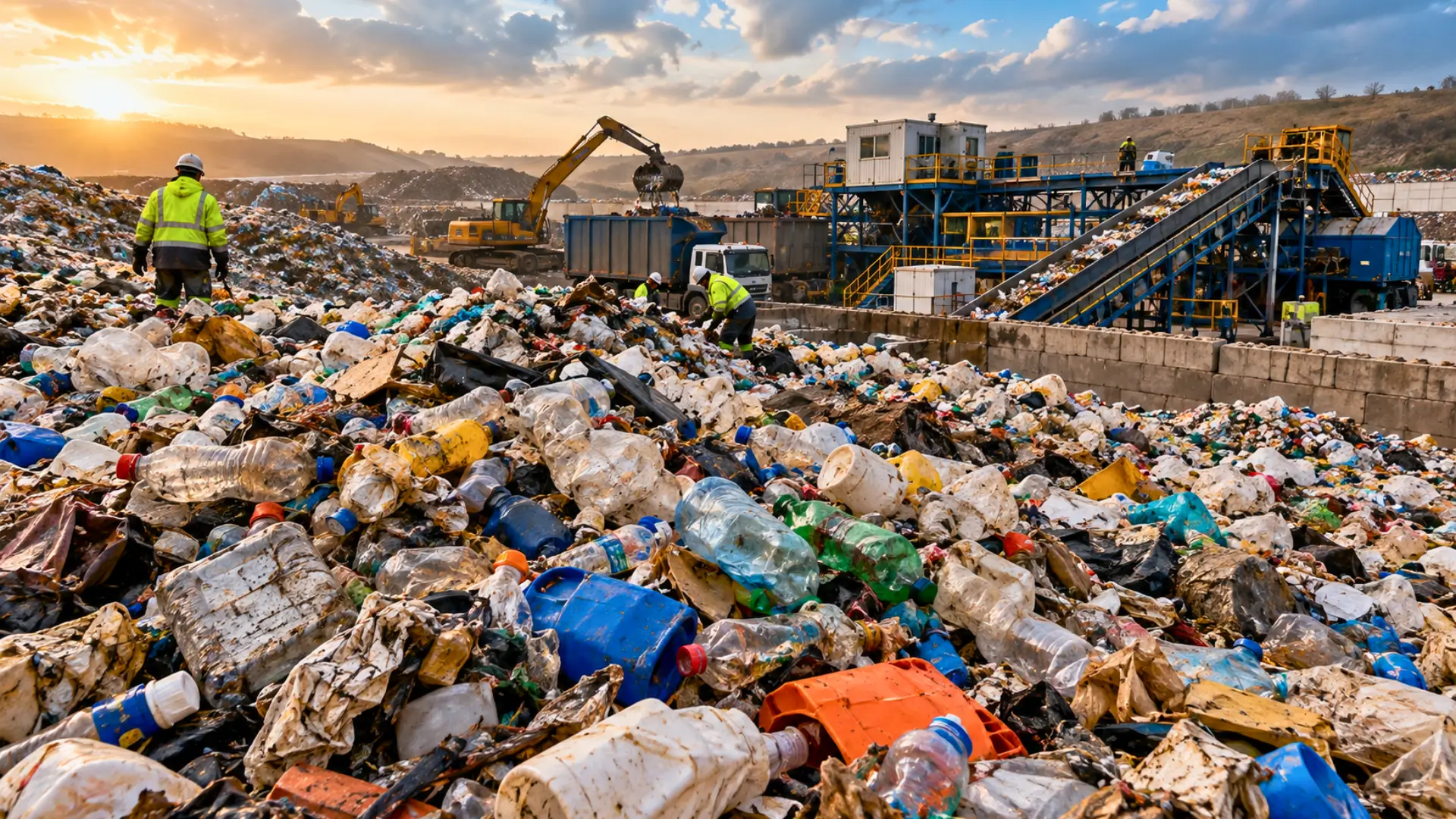
A bottle abandoned fifty years ago, does it still exist somewhere? Probably. Since 1950, the planet has produced billions of tons of plastic. Recycled, burned, buried or dispersed, they tell today a story that is far less circular than we imagine.
In a few generations, plastic has gone from an industrial curiosity to a global flood
In 1950, the world produced about 2 million tons of plastic per year. That figure rose to 460 million tons in 2019, according to the OECD. Over this period, cumulative production approached 9.5 billion tons. This dizzying industrial shift happened within the lifetime of a single human being.
But all those tons did not instantly become waste. Some still lie dormant in buildings, cars or equipment designed to last for decades. Others, especially packaging, have passed through our lives much more quickly. In 2019, nearly two-thirds of plastic waste came from uses with a lifespan of five years or less.
The famous 9% rate hides a far less reassuring fate for our waste
A figure keeps appearing whenever plastic is discussed: recycling actually accounts for only 9% on a global scale. However, be careful with the interpretation. According to the OECD, this rate refers to the global plastic waste produced in 2019. That year, the world generated 353 million tonnes of waste, but effectively recycled only 33 million.
The rest takes paths far from circularity. Incineration consumes about 19%, while controlled landfills absorb almost half. As for the remaining 22%, they escape proper management: illegal dumping, open burning, and other inadequate treatments can then fuel environmental leaks.
That said, not everything ends up in the ocean. Updated estimates presented by Our World in Data place marine inputs at around 1 to 2 million tonnes per year. This slice of the overall problem, though small, is enough to sustain persistent pollution that fragments over time and circulates through ecosystems in the form of microplastics.
Even when placed in the right bin, packaging does not always reborn as packaging
So the sorting bin is not a time machine. In 2019, collection systems recovered 15% of global plastic waste for recycling, according to the OECD. Yet the process ultimately expelled about 40% of that material as residue. Sorting remains essential, but gathering does not automatically equal recycling.
The challenge also lies in the material itself. During mechanical recycling, heat and mechanical stresses alter polymers, while contaminants, additives and blends complicate reuse. Studies published in Nature Communications show how successive treatments can degrade their properties. Plastic thus does not spontaneously offer the almost ideal circularity often associated with metals.
Behind our trash, a race now unfolds between innovation and production
Yet research is trying to change the game. Depolymerization, chemical recycling, selective solvents: several techniques seek to recover usable molecules to manufacture higher-quality materials. A review published in Nature Reviews Materials in 2026 underscores, however, a stubborn obstacle: real waste is complex, with mixtures and contaminants that are absent in laboratory-perfect samples.
Meanwhile, the tap remains wide open. The United Nations Environment Programme estimated that humanity would consume more than 500 million tonnes of plastic in 2024. Without deep change, the OECD projects that the amount of plastic waste could nearly triple by 2060, despite expected advances in recycling.
Perhaps the most disquieting paradox. Techniques are advancing, but they’re racing to catch up with production that is growing as well. More recycling remains essential, as does better collection and smarter design of objects. Yet, when hundreds of millions more tonnes enter the system each year, another question becomes hard to ignore.

Contact details
Address:
Farmers Forum,
36, Dominick Street,
Mullingar,
Co. Westmeath,
Ireland
Phone:
+353 (0)44 9310206
Or email us:
For technical issues please check out our FAQ's page or email - [email protected]
For general Queries email - [email protected]
Request to add event to our Calendar - [email protected]
Send us your mart reports - [email protected]
Suggestions and feedbacks - [email protected]
News Items / Press Release - [email protected]
To Advertise on Farmers Forum - [email protected]