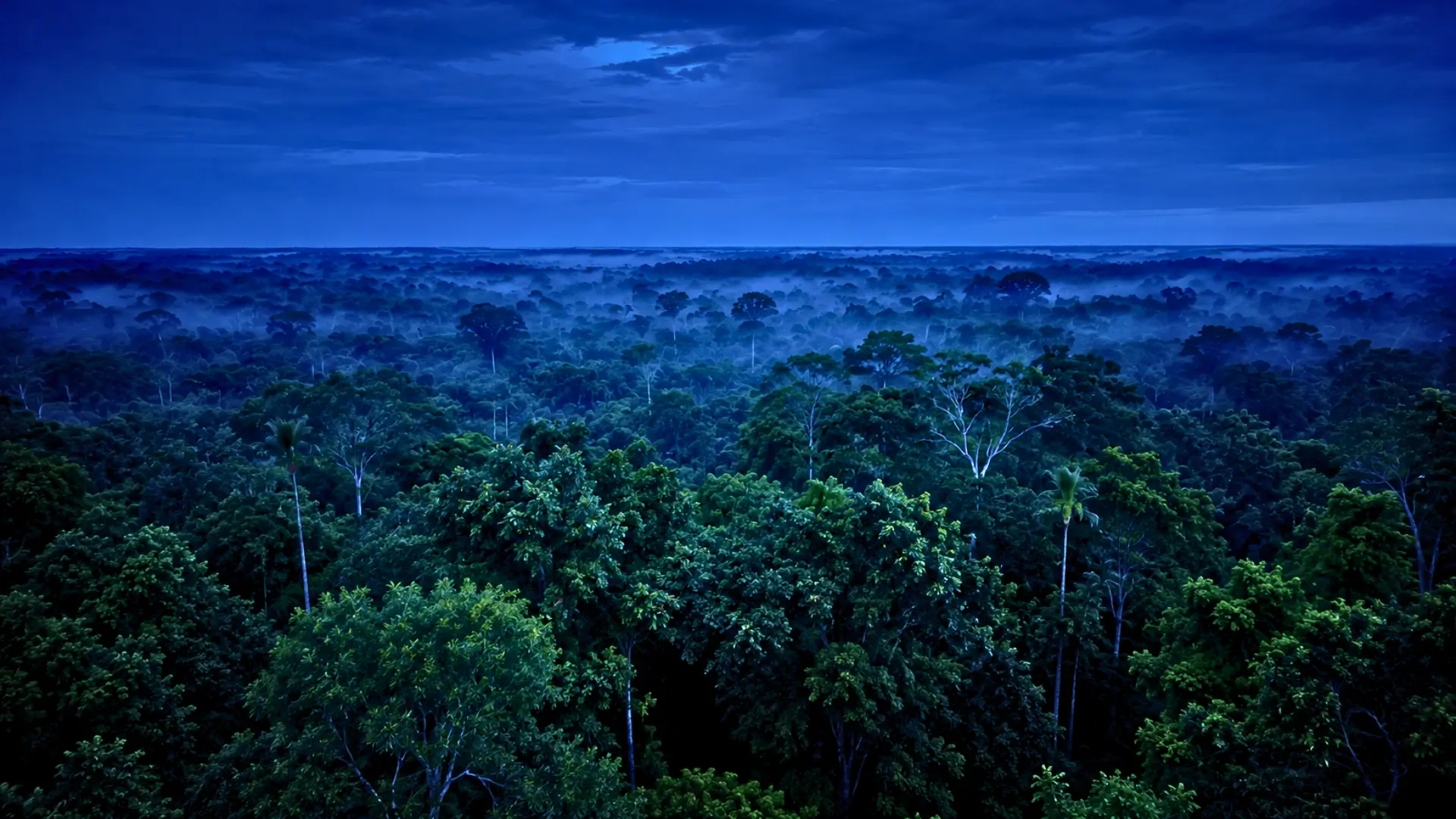
When the sun sets, the world’s largest tropical forest stops absorbing CO₂ and begins releasing it. Yet a portion of this nocturnal respiration has long eluded instruments. A subtle flaw that could alter its true climate balance.
Nocturnal respiration reverses the Amazon rainforest’s climatic role
During the day, the canopy behaves like a vast solar plant. Through photosynthesis, leaves capture carbon dioxide and use it to manufacture sugars, wood, and roots. But when light fades, CO₂ uptake stops, while trees, roots, and soil organisms continue to respire.
The forest becomes, for several hours, a natural source of carbon. This is not unusual: all ecosystems breathe. The challenge lies in the balance between the quantities absorbed during the day and those released at night. A sometimes tiny difference between two enormous fluxes can decide whether a forest genuinely stores carbon.
Biased measurements have long masked a portion of nocturnal emissions
Since the 1990s, towers equipped with sensors measure gas exchanges above the canopy. The technique, known as turbulence covariance, performs remarkably well when the air is well mixed. But during calm and humid nights, CO₂ can accumulate near the ground or slip into valleys without reaching the instruments.
This invisible carbon has long fueled a real scientific puzzle. Studies conducted near Manaus showed that horizontal movements of air could account for more than 70 % of the nocturnal balance on certain calm nights. The forest was not necessarily breathing more: a portion of its breath simply escaped measurement.
Recent observations, taken at multiple heights within and above the vegetation, confirm that CO₂ is distributed very unevenly before dawn. This invisible architecture of the forest’s atmosphere forces researchers to combine towers, ground sensors, vertical profiles, and circulation models to reconstruct the fluxes actually emitted.
Nighttime warming intensifies respiration and weakens the carbon balance
Biological respiration depends strongly on temperature. When the air and soils warm, metabolic reactions generally speed up. Trees burn through more sugars and microorganisms break down organic matter more quickly. Warmer tropical nights can thus increase CO₂ releases, even if daytime photosynthesis remains sustained.
This mechanism does not automatically turn the entire Amazon into a perpetual source. The basin spans several million square kilometers and shows enormous differences in rainfall, vegetation, and land use. It nevertheless makes its balance more sensitive to droughts, heat waves, and forest degradation, particularly in regions already fragmented.
The expression “lungs of the planet” is seductive, but misleading. An ancient forest produces oxygen while consuming it through respiration and decomposition. Its climatic role depends mainly on the carbon stored durably in trunks, roots, and soils, not on a simple alternation between oxygen and CO₂.
A climate role weakened by human pressures and climatic extremes
This reservoir is today under pressure. A study published in Nature showed that some eastern parts of the Amazon were already releasing more carbon than they absorbed, due to deforestation, fires, and warming. Airborne measurements relied on about 600 atmospheric profiles collected between 2010 and 2018.
The El Niño episode of 2023-2024 further underscored this vulnerability. Analyses combining satellites, vegetation models, and atmospheric measurements attribute to the Amazon more than half of the tropical land carbon flux anomaly observed during this period, though methods do not all yield the exact same estimate.
Measuring the night more accurately, therefore, does not lessen the importance of protecting the forest. It makes this protection more urgent and realistic. The Amazon is neither a perfect machine nor an inexhaustible reserve capable of erasing human emissions. Its nocturnal breath mainly reminds us of one thing: climate depends on fragile balances, sometimes hidden beneath a few meters of still air.

Contact details
Address:
Farmers Forum,
36, Dominick Street,
Mullingar,
Co. Westmeath,
Ireland
Phone:
+353 (0)44 9310206
Or email us:
For technical issues please check out our FAQ's page or email - [email protected]
For general Queries email - [email protected]
Request to add event to our Calendar - [email protected]
Send us your mart reports - [email protected]
Suggestions and feedbacks - [email protected]
News Items / Press Release - [email protected]
To Advertise on Farmers Forum - [email protected]