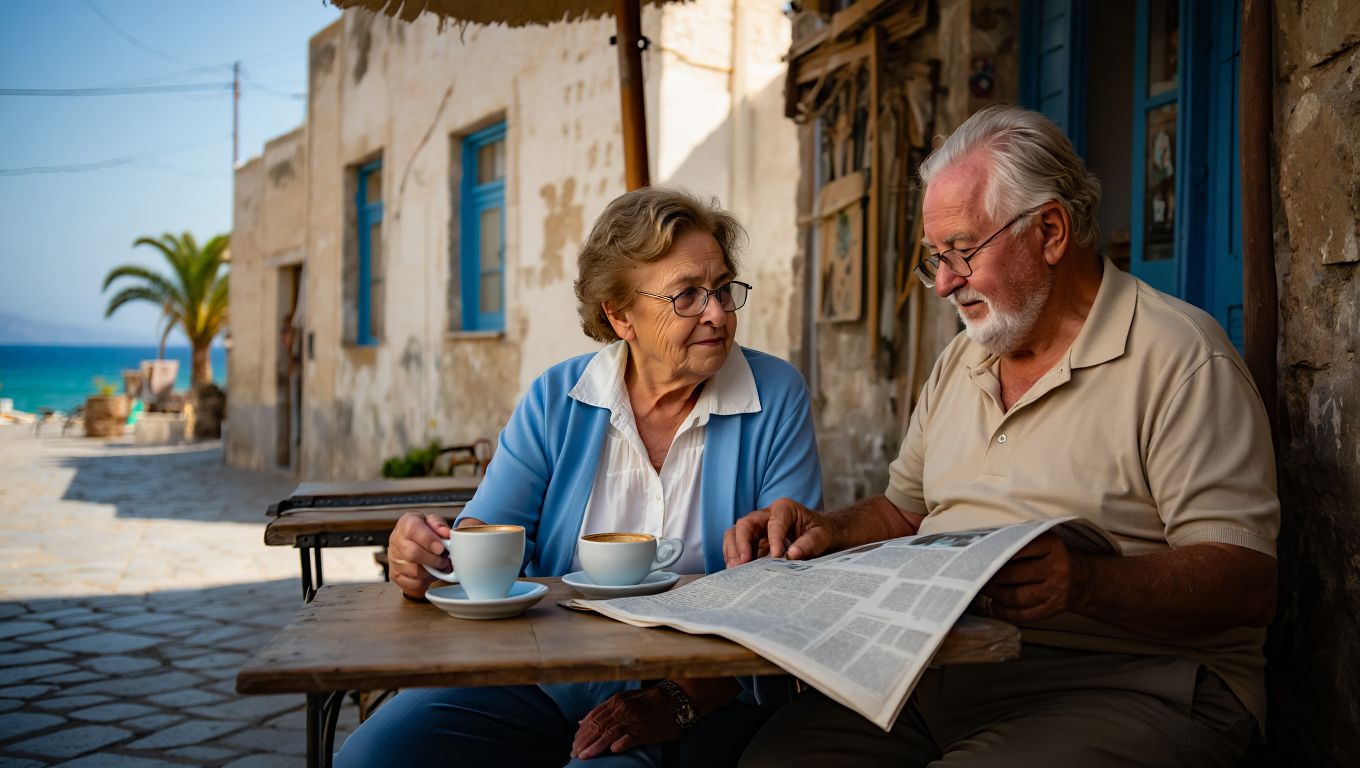
Sun seekers from Ireland are quietly swapping Iberian standbys for a Cypriot address, and a compact seaside town on the island’s northwest coast is where many are landing. Drawn by softer winters, a sea that stays warm deep into autumn, and streets that hum rather than roar, retirees are finding space to breathe without losing the comforts that make daily life easy. “We wanted heat but also hush,” says Mary K., 66, from Galway. “Here, we get both — and a coffee comes with a view you actually hear yourself in.”
Where warmth meets stillness
Set between the Akamas Peninsula and the velvety waters of Chrysochou Bay, Polis (Polis Chrysochous) sits a step away from Cyprus’s headline resorts — close enough for convenience, far enough for quiet. Summer days are reliably toasty, with July–August highs in the low 30s Celsius and sea temperatures that stay swimmable well past October. Compared with Costa del Sol or the Algarve, afternoons feel hotter, yet evenings settle into a gentler breeze under palm silhouettes.
The town’s pace is unhurried. Cafés lean into shade, cats nap on whitewashed thresholds, and the marina at Latchi, five minutes away, clinks softly with sails and fishermen’s talk. “It reminds me of West Ireland on a Sunday, only with figs and bougainvillea,” laughs Tom, 70, from Cork.
Getting there without the fuss
For practicalities, it’s hard to beat the access. Paphos International is roughly an hour’s drive, with seasonal direct flights from Dublin and easy connections via London or other European hubs. Roads are modern, the signage is in Greek and English, and driving on the left soothes anyone who still dreams in roundabouts.
Public buses link Polis, Paphos, and coastal villages, though most retirees keep a small car to reach markets, coves, and medical appointments. Taxis are straightforward and card-friendly, and airport transfers run like clockwork even in late evening.
Everyday life at a human scale
You feel the difference in the mornings, when the square wakes to clinking spoons and the smell of sesame bread rings. A double espresso might cost less than at home, and a shared fish meze at Latchi brings plate after plate — grilled sea bream, tahini, village salad, and glossy aubergines — for the price of a midweek takeaway in Dublin.
Shops keep sensible hours, pharmacies are plentiful, and the Saturday market swings between olives and linen. English is widely spoken, Irish accents are increasingly common, and a handful of community groups host walks, book swaps, and easygoing quiz nights.
Homes with views, not noise
The housing stock runs from tidy apartments and townhouses to hillside villas where the horizon is all blue. Many arrivals start with medium-term rentals to ride out a season and get the measure of a neighborhood before buying. “We didn’t want an impulse purchase,” says Anne M., 64. “A six-month test let us try different streets, see where the breeze comes from, and check how the sun lands on the balcony.”
Expect better value the farther you step from the absolute frontline, and note that winter can reveal where a home holds or loses warmth. Ask about orientation, insulation, and a back-up plan for the occasional stormy night when the rain remembers the mountains.
Healthcare, paperwork, peace of mind
Cyprus runs a modern national health system, GESY, alongside reputable private clinics. For newcomers, registering with a local doctor is straightforward, and English-speaking staff are common in larger facilities. Pharmacies are approachable, and routine checks — eyes, teeth, bloods — are easy to schedule without a month-long wait.
As EU citizens, Irish retirees find the bureaucracy manageable, with familiar forms and timelines rather than a paper maze. Local advisors can help translate acronyms and steer you through residency steps if you plan to stay beyond a sun-splashed trial.
Sea, scrub, and little rituals
This corner of Cyprus is for small rituals and slow adventures. Morning dips off Polis beach, picnic walks to the Baths of Aphrodite, an amble into the Akamas where juniper and myrtle scent the air. Out on the water, a low-key boat trip edges along honeyed cliffs, slipping into coves where the sea turns glass.
Culture comes gently: a Byzantine chapel tucked in the hills, a village festival with stringed melodies, a plate of loukoumades sticky with honey. “We started collecting tiny moments,” says Mary. “A perfect tomato, a neighbor’s figs, a moon that rises with theatrical timing.”
Why Irish retirees are tuning in
- Warmer seas and longer summers without the carnival crowds
- Manageable costs for dining, housing, and everyday treats
- Easy access to healthcare and English-friendly services
- A landscape that mixes seaside ease with wild escapes
How to test-drive a season
Come for late spring or early autumn when the sea is still warm and the light is soft. Book a place with breezy shading and a balcony you’ll actually use, then live as you mean to — shopping at the bakery, timing the walk to the pharmacy, checking the bus rhythm and how long it takes to get to your favorite cove.
Keep notes on the details that matter: noise at night, morning sun, a friendly grocer who remembers your name. “We made a simple list,” says Tom, “and by week three we knew we’d found a new address — the kind where the days expand and the calendar seems to smile.”
In this quiet-edged corner of Cyprus, the promises are modest yet magnetic: heat that lingers, a town that listens, and a coastline that saves its best moments for people who like to find them one unhurried day at a time.

Contact details
Address:
Farmers Forum,
36, Dominick Street,
Mullingar,
Co. Westmeath,
Ireland
Phone:
+353 (0)44 9310206
Or email us:
For technical issues please check out our FAQ's page or email - [email protected]
For general Queries email - [email protected]
Request to add event to our Calendar - [email protected]
Send us your mart reports - [email protected]
Suggestions and feedbacks - [email protected]
News Items / Press Release - [email protected]
To Advertise on Farmers Forum - [email protected]