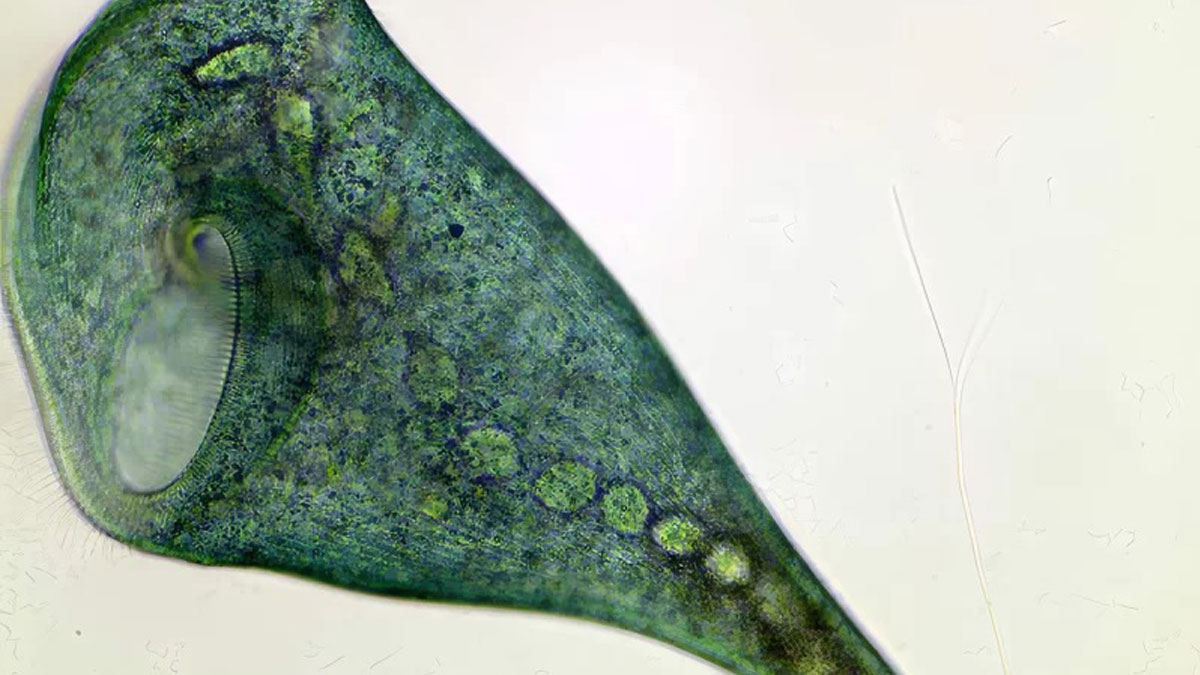
For a long time, it was believed that associative learning, the capacity to understand that two events are linked, required a neural mechanism. A freshwater, single-celled organism found in ponds demonstrates that this is not necessarily the case.
Stimulus and Response
A protozoan measuring roughly one millimeter in length, Stentor coeruleus possesses functionally distinct ends: the first end anchors it to a substrate, while the second, larger end, equipped with cilia, enables feeding by filtration. When normally in the shape of an ancient trumpet, it contracts and becomes spherical upon detecting potential danger.
To evaluate the learning capabilities of S. coeruleus, researchers grew several dozen specimens in the laboratory and then employed an experimental setup to apply mechanical stimulations to the base of the container that housed them.
Initially, the majority of individuals reacted to these “environmental perturbations,” but as the experiment progressed, this number steadily declined, indicating that the protozoa had become accustomed to the stimulus and no longer perceived it as a threat.
A new study reveals that Stentor coeruleus, a single-celled organism, can learn to ignore repeated stimuli. The most surprising is that this “memory” can even pass to its daughter cells, bringing us closer to the evolutionary origin of learning.pic.twitter.com/BNmiDHSOQA
— Biological Community (@Bio_comunidad) April 24, 2026
“ Their response truly surprised us,” explains Samuel Gershman, a Harvard University neuroscientist and the lead author of the new study, which was pre-published on the BioRxiv server. “Up to now, there has been no evidence of associative learning in this species, and findings related to other unicellular organisms were debated.”
Matching Protocol
The second phase of the experiment introduced a “matching protocol,” consisting of a light mechanical stimulus (triggering a moderate contraction of S. coeruleus) followed by a stronger one. The researchers consistently maintained a 45-second interval between pulses, matching the time needed for the protozoa to relax again.
After ten trials, a trend began to emerge, with organisms gradually contracting less during the milder stimulations, suggesting, according to Gershman, the presence of “non-trivial learning mechanisms.”
More broadly, these findings imply that this kind of associative process predates the appearance of nervous systems. “The striking similarities between these protozoa and the neurons in our brain hint at the possibility that they arose in single-celled organisms.” concluded the team.
Another unicellular creature with remarkable learning capacities: the strange (and fascinating) blob.

Contact details
Address:
Farmers Forum,
36, Dominick Street,
Mullingar,
Co. Westmeath,
Ireland
Phone:
+353 (0)44 9310206
Or email us:
For technical issues please check out our FAQ's page or email - [email protected]
For general Queries email - [email protected]
Request to add event to our Calendar - [email protected]
Send us your mart reports - [email protected]
Suggestions and feedbacks - [email protected]
News Items / Press Release - [email protected]
To Advertise on Farmers Forum - [email protected]