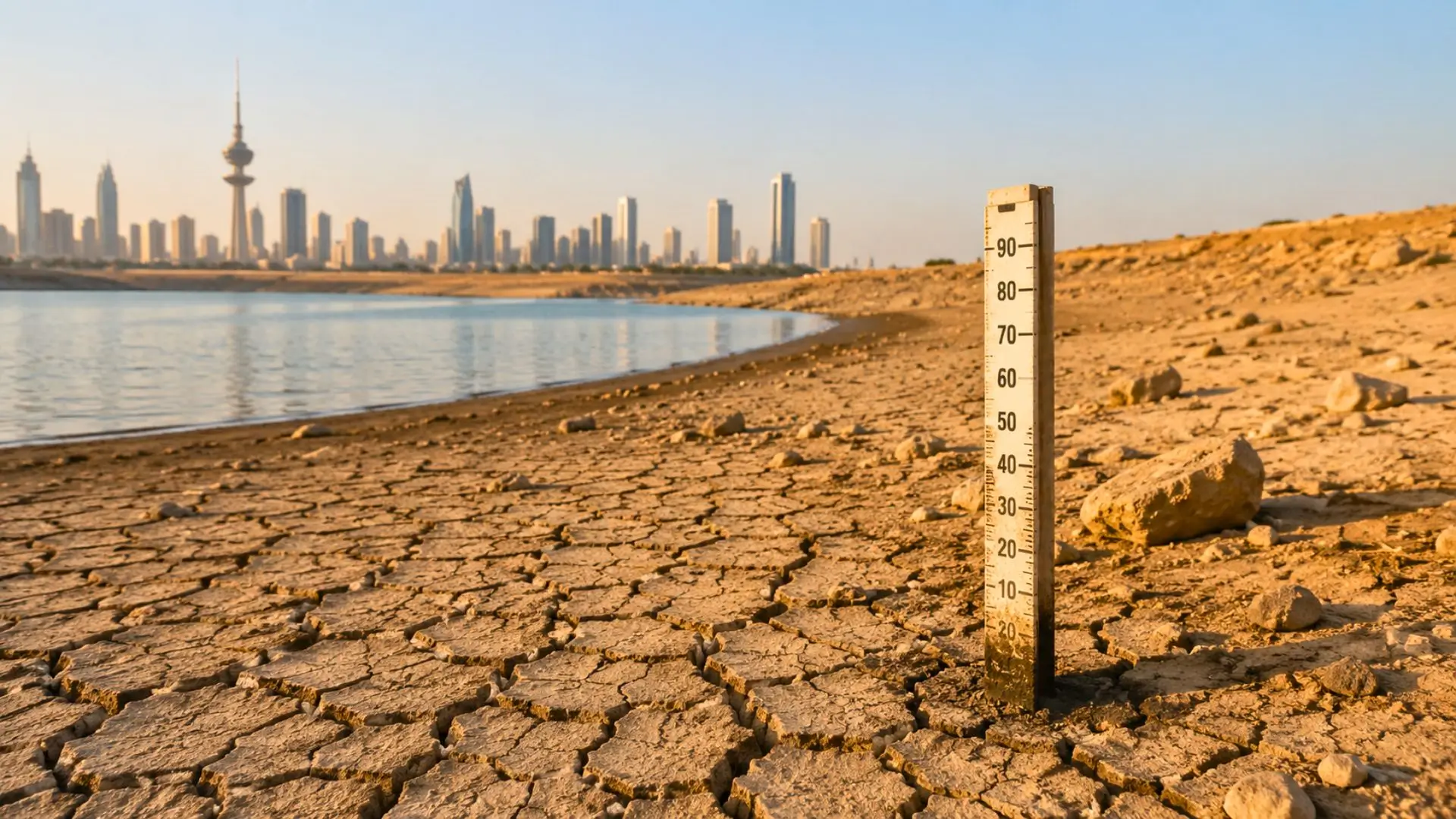
A country can face water scarcity without its taps running dry. Water stress measures the gap between freshwater withdrawals and renewable resources. This indicator explains why some states are already balancing between daily water use, agricultural crops, and supply security.
What Water Stress Measures When a Country Withdraws More Freshwater Than Its Renewable Resources
The most striking figure comes from Kuwait. According to the infographic published by Visual Capitalist based on FAO AQUASTAT data, the country reaches 3,850.5%. Its withdrawals thus far exceed what nature can locally replenish.
The indicator used by the World Bank compares freshwater withdrawals to renewable resources. Withdrawals cover domestic, agricultural, and industrial uses. Renewable resources refer to rivers, usable rainfall, and aquifers that recharge naturally.
A rate above 100% does not mean water disappears immediately. It signals a deficit operation, as a bank account spending more than its salary. Countries make up the gap with fossil aquifers, desalination, or transfers.
Why Kuwait and Gulf Countries Dominate the Global Ranking of Freshwater Shortages
The ranking places Kuwait at 3,850.5%, ahead of the United Arab Emirates, Saudi Arabia, Libya, and Qatar. These states share an arid climate, high urbanization, and a dependence on costly infrastructure to secure drinking water.
This regional concentration aligns with analyses from the World Resources Institute. Its Aqueduct tool ranks the Middle East and North Africa among the most exposed regions. Pressure here arises as much from natural scarcity as from urban and agricultural needs.
How Desalination and Groundwater Limit Shortages Without Ending Dependency
Desalination removes salt from seawater. In the Gulf, it allows densely populated cities to flourish with few perennial rivers. But this solution requires a lot of energy and concentrates part of the risk in a handful of large coastal plants.
News agencies such as the Associated Press highlighted in 2026 the vulnerability of these facilities in the regional context. A power outage, an attack, or marine pollution can quickly weigh on supply, especially when 90% of drinking water depends on desalination.
Why Countries Close to the 100% Threshold Keep a Fragile Safety Margin Over Water
The exceedance is not limited to the Gulf. Yemen, Algeria, Egypt, Bahrain, and Israel also cross the 100% threshold. In Central Asia, Turkmenistan and Uzbekistan appear in the same tension band, notably linked to irrigation needs.
France shows 21.4% in the data cited by Visual Capitalist. This level remains far from the overage countries, but it does not erase local tensions. Some aquifers, rivers, and reservoirs can suffer during droughts, especially in summer.
Water stress is thus less about labeling good and poor performers and more about identifying a safety margin. When the indicator climbs, every decision counts: irrigation, network leaks, wastewater recycling, storage, and the sobriety of water use.

Contact details
Address:
Farmers Forum,
36, Dominick Street,
Mullingar,
Co. Westmeath,
Ireland
Phone:
+353 (0)44 9310206
Or email us:
For technical issues please check out our FAQ's page or email - [email protected]
For general Queries email - [email protected]
Request to add event to our Calendar - [email protected]
Send us your mart reports - [email protected]
Suggestions and feedbacks - [email protected]
News Items / Press Release - [email protected]
To Advertise on Farmers Forum - [email protected]