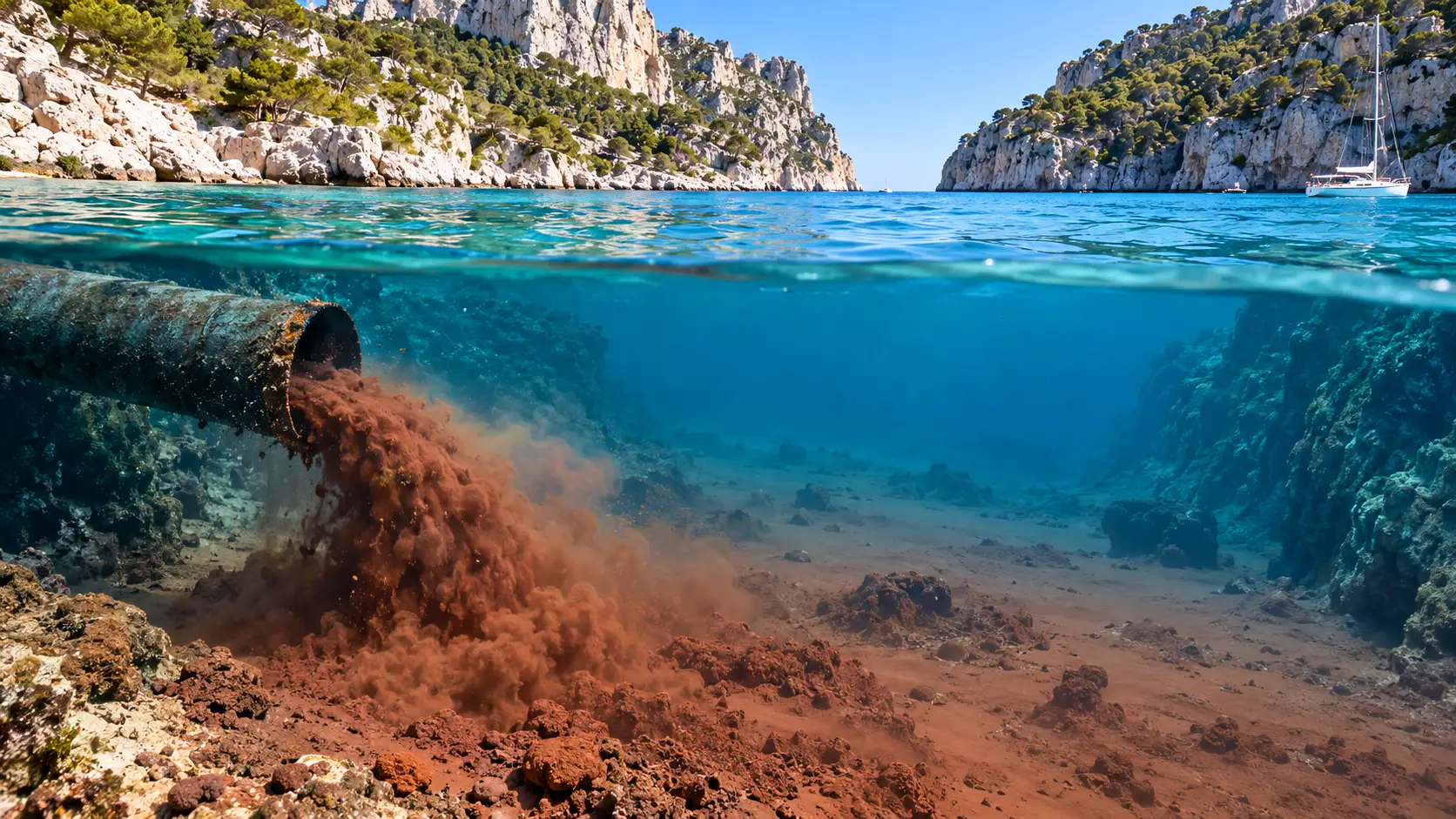
The turquoise waters of the coves hide a vast underwater dump. Since 1966, millions of tons of industrial waste have rested on the floor of the Cassidaigne canyon. This heavy ecological debt still threatens the balance of Mediterranean marine life.
An underwater pipeline discharged Gardanne’s waste for decades off the Provençal coast
The story begins in Gardanne, in the Bouches-du-Rhône. By the end of the nineteenth century, a factory extracted alumina from bauxite. This processing produced large quantities of reddish residues. Lacking space on land, the managers then chose a radical option.
In 1966, the state approved the installation of a submarine pipeline spanning more than seven kilometers. The pipe opens directly into the Cassidaigne Canyon. Thus, industry dumps its polluting materials at a depth of three hundred twenty meters, far from prying eyes.
Official estimates point to at least twenty million tons dumped over time. Other calculations climb as high as thirty-two million tons. For fifty years, these continuous discharges accumulated on the seabed with the state’s consent.
The cocktail of heavy metals accumulated beneath the sea continues to worry environmental specialists
This mineral mud contains many toxic components for wildlife and flora. Analyses reveal high levels of titanium, chromium, and lead. In addition, iron and vanadium join this harmful chemical mix that never disappears.
Scientists also note a pronounced manganese deficit in these underwater deposits. However, the prefecture allowed the Alteo company to extend its liquid discharges in 2015. This administrative exemption scandalized coastal defenders gathered for the climate in Paris.
At depths beyond three hundred meters, a mineral desert has replaced the Mediterranean marine life
Below the surface, sediments smother the rock and natural sand. Marine biologists observe a zone with no aquatic life. Consequently, corals and crustaceans disappear beneath this thick mud layer.
This stark contrast catches the attention of observers in the Provence region. On the surface, the Cassis coves attract thousands of boaters and sunbathers each summer. Yet the abyss bears the scars of a long-standing industrial activity with no possible cleanup.
The judiciary now examines accountability for this historic pollution following citizen mobilization
The ban on solid discharges finally came into effect in 2016. From then on, the operator stored its residues in open-air dumps in the Mange-Garri valley. Later, the company underwent a judicial restructuring in 2019 before halting bauxite processing.
That industrial shutdown does not erase the underwater damage that has accumulated. Fishing groups and environmental associations have therefore taken the case to court. The plaintiffs allege a major harm to the seas and demand the recognition of an ecocide.
These tonnes of mud still lie at 320 meters below the waves. No industrial actor currently possesses a method to suction these underwater masses. The canyon thus preserves the lasting imprint of half a century of unchecked ecological negligence.

Contact details
Address:
Farmers Forum,
36, Dominick Street,
Mullingar,
Co. Westmeath,
Ireland
Phone:
+353 (0)44 9310206
Or email us:
For technical issues please check out our FAQ's page or email - [email protected]
For general Queries email - [email protected]
Request to add event to our Calendar - [email protected]
Send us your mart reports - [email protected]
Suggestions and feedbacks - [email protected]
News Items / Press Release - [email protected]
To Advertise on Farmers Forum - [email protected]