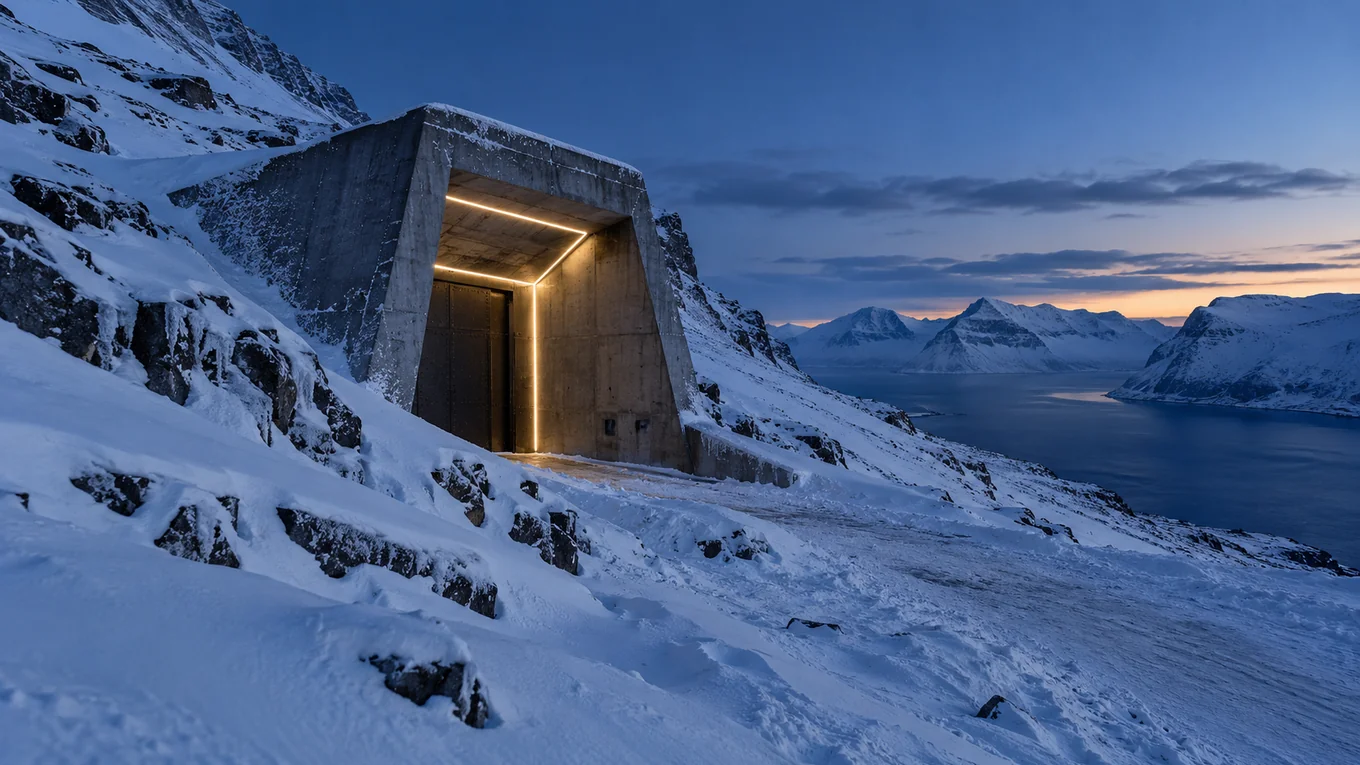
In October 2026, Ukraine entrusted 773 seed samples to the Svalbard Global Seed Vault, the Norwegian archipelago’s worldwide seed reserve. This deposit is its first since the start of the Russian invasion, according to the Norwegian Ministry of Agriculture and Food. It illustrates the concerted effort to safeguard a gene bank struck by war.
The Ukrainian 773 samples are part of a shipment of more than 16,000 seeds from 21 gene banks
The Norwegian press release, published on October 14, 2026, notes that Ukraine was not alone. In total, 21 gene banks from Asia, South America, Europe and Africa contributed more than 16,000 samples during this session. Thus, the Ukrainian contribution represents a modest portion of the batch, but with a strong symbolic significance.
The Ukrainian boxes notably contain
Damaged by bombardments in 2022, Kharkiv’s national gene bank saw its collection move westward
According to the FAO, the Ukrainian genetic collection exceeds 150,000 samples. However, in 2022, Russian strikes damaged the buildings and infrastructure of the national gene bank housed in Kharkiv, in the country’s eastern region. The situation became critical for decades of selective work.
From the spring of 2022, NordGen, the Nordic gene bank, supported an emergency operation with the FAO and The Crop Trust, funded by the Novo Nordisk Foundation. Subsequently, the collection was transferred to western Ukraine, away from the front line. According to Ukrainian authorities, about 10% of the national collection has already been duplicated abroad.
Opened in 2008 beneath the permafrost, the reserve houses more than 1.4 million samples from 130 gene banks
Carved into a mountain near Longyearbyen, roughly 1,300 kilometers from the North Pole, the reserve was inaugurated in 2008. Financed by Norway, it is managed in collaboration with NordGen and The Crop Trust. Today, it houses more than 1.4 million samples belonging to more than 130 gene banks.
The concept is akin to a free safe vault: each depositor remains the owner of their seeds and can reclaim them at any time. In fact, the facility has already been used. In 2015, the ICARDA agricultural research center, deprived of its Aleppo bank by the war in Syria, carried out the first withdrawal in the site’s history.
An infiltration of water in 2016 forced Norway to strengthen access to the bunker amid Arctic warming
The natural cold of the permafrost should keep the seeds frozen even if refrigeration fails. Yet, at the end of 2016, meltwater seeped into the entrance tunnel, though it did not reach the vault chambers. The incident, revealed in 2017, underscored that the Arctic is warming faster than the rest of the globe.
In response, Norway announced in 2018 a budget of around 100 million kroner for a new concrete access tunnel and a technical building. Since then, the reserve has aimed to be better equipped to withstand climatic conditions. For Ukraine, this deposit guarantees that a copy of its seeds will survive, whatever the outcome of the war.

Contact details
Address:
Farmers Forum,
36, Dominick Street,
Mullingar,
Co. Westmeath,
Ireland
Phone:
+353 (0)44 9310206
Or email us:
For technical issues please check out our FAQ's page or email - [email protected]
For general Queries email - [email protected]
Request to add event to our Calendar - [email protected]
Send us your mart reports - [email protected]
Suggestions and feedbacks - [email protected]
News Items / Press Release - [email protected]
To Advertise on Farmers Forum - [email protected]